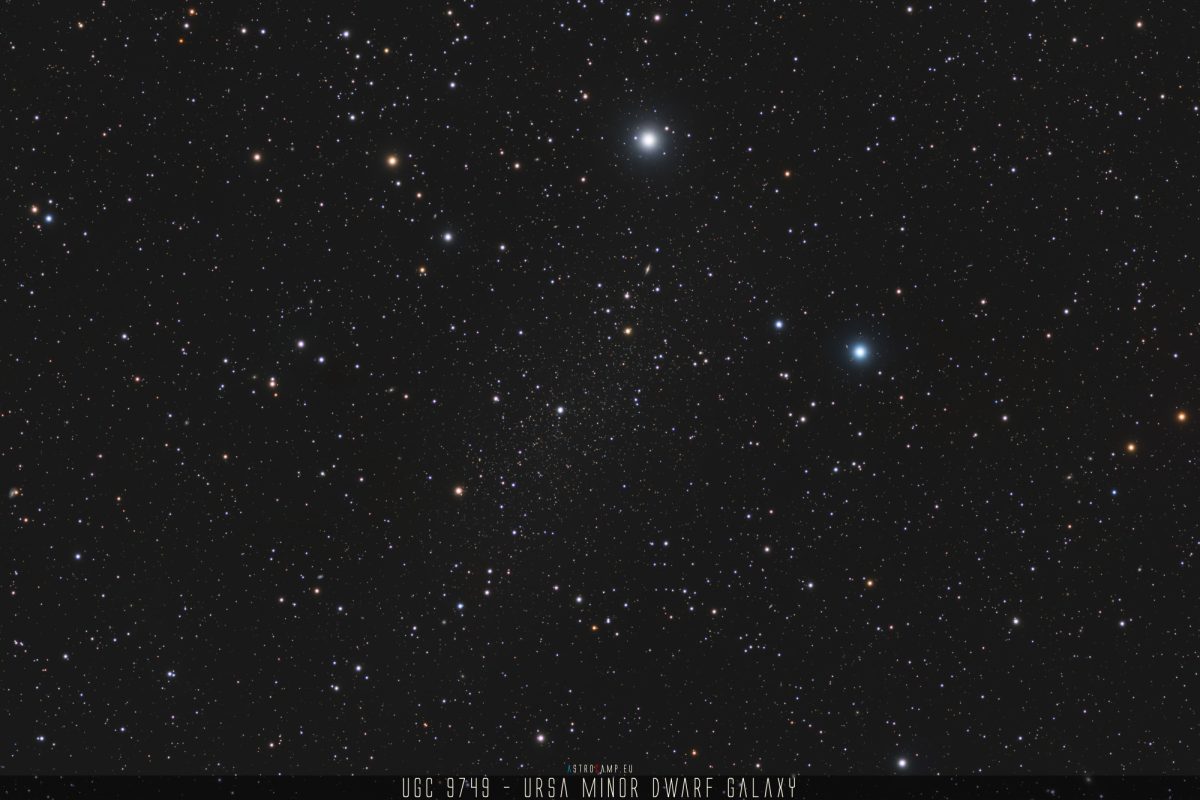
The Ursa Minor Dwarf Galaxy is a faint dwarf galaxy in the constellation Ursa Minor at a distance of around 230,000 light-years, reaches its annual culmination at astronomical midnight and is best observed early May.
The Ursa Minor Dwarf Galaxy is a diffuse, low-surface-brightness companion galaxy whose stellar content is spread thinly across roughly half a degree of sky. With an integrated apparent magnitude of 10.6 but an extremely faint surface brightness of 26.77 mag/arcsec², it is a notoriously difficult target that blends almost invisibly into the background sky. For astrophotographers, capturing this object demands very dark skies, long total integration times, and careful calibration to tease its scattered member stars out of the noise. Rather than appearing as a bright glowing cloud, it resolves in deep exposures as a subtle overdensity of faint stars, making it a rewarding challenge for wide-field setups aimed at the northern circumpolar sky.
Names, key data and data sources
All values come from the astronomical database SIMBAD (CDS Strasbourg). Tap a row to see where the value comes from.
PropertyValueSourceQuality
Designation
NamesUrsa Minor Dwarf GalaxyAstrocamp
●●● reliable
Names from the Astrocamp object database.
Catalogue numbersUGC 9749 · PGC 54074Primary designation: UGC 9749SIMBAD
●●● reliable
All identifiers under which SIMBAD lists the object; order according to the Astrocamp catalogue rule.
TypeGalaxySIMBAD
●●● reliable
Entry in SIMBAD, object type “G”.
Value since Jul 24, 2026 · last confirmed with SIMBAD Oct 20, 2026
ConstellationUrsa Minor (UMi)computed
●●● reliable
Computed from the position (IAU constellation boundaries).
Value since Jul 24, 2026 · last confirmed with SIMBAD Oct 20, 2026
Position (J2000)RA 15h 09m 8s · Dec +67° 13′ 21″SIMBAD
Value since Oct 20, 2026 · last confirmed with SIMBAD Oct 20, 2026
Distance230,000 light-years70 kpcSIMBAD
●●● reliable
Median of all 9 measurements listed in SIMBAD (methods: T-RDB 1, redshift 1, T-RGB 1, RRLyr 1), middle half 210,000 light-years – 230,000 light-years, full range 200,000 light-years – 330,000 light-years, rounded according to the scatter.
Value since Oct 20, 2026 · last confirmed with SIMBAD Oct 20, 2026
Diameter2,100 light-yearscomputed
●○○ uncertain
Computed from the major axis and the distance; takes the weaker rating of the two values.
One catalogue value, error ± 0.1 km/s, quality C (SIMBAD scale A–E). For such nearby galaxies it mainly reflects their own motion, not the expansion of the universe.
Value since Jul 24, 2026 · last confirmed with SIMBAD Oct 20, 2026
reliable – many consistent measurements or catalogue entryadequate – few measurements or catalogue valueuncertain – one measurement with large scatter or rough derivation
Sources and methods (12)
Names: Names from the Astrocamp object database.
Catalogue numbers: All identifiers under which SIMBAD lists the object; order according to the Astrocamp catalogue rule.
Type: Entry in SIMBAD, object type “G”. Value since Jul 24, 2026 · last confirmed with SIMBAD Oct 20, 2026
Constellation: Computed from the position (IAU constellation boundaries). Value since Jul 24, 2026 · last confirmed with SIMBAD Oct 20, 2026
Position (J2000): Entry in SIMBAD, quality D (SIMBAD scale A–E). Publication: 2021ApJ...922..267C (NASA ADS). Value since Jul 24, 2026 · last confirmed with SIMBAD Oct 20, 2026
Galactic coordinates: Converted from the position (IAU 1958 galactic system). Publication: 2021ApJ...922..267C (NASA ADS). Value since Jul 24, 2026 · last confirmed with SIMBAD Oct 20, 2026
Brightness: One catalogue value, band V, error ± 0.5 mag, quality D (SIMBAD scale A–E). Publication: 2012AJ....144....4M (NASA ADS). Value since Jul 24, 2026 · last confirmed with SIMBAD Oct 20, 2026
Apparent size: One catalogue value, measured in N, quality E (SIMBAD scale A–E). Publication: 2008MNRAS.389.1924F (NASA ADS). Value since Jul 24, 2026 · last confirmed with SIMBAD Oct 20, 2026
Orientation: One catalogue value, measured in N, quality E (SIMBAD scale A–E). Publication: 2008MNRAS.389.1924F (NASA ADS). Value since Oct 20, 2026 · last confirmed with SIMBAD Oct 20, 2026
Distance: Median of all 9 measurements listed in SIMBAD (methods: T-RDB 1, redshift 1, T-RGB 1, RRLyr 1), middle half 210,000 light-years – 230,000 light-years, full range 200,000 light-years – 330,000 light-years, rounded according to the scatter. Value since Oct 20, 2026 · last confirmed with SIMBAD Oct 20, 2026
Diameter: Computed from the major axis and the distance; takes the weaker rating of the two values.
Blueshift: One catalogue value, error ± 0.1 km/s, quality C (SIMBAD scale A–E). For such nearby galaxies it mainly reflects their own motion, not the expansion of the universe. Publication: 2012AJ....144....4M (NASA ADS). Value since Jul 24, 2026 · last confirmed with SIMBAD Oct 20, 2026
The Ursa Minor Dwarf Galaxy lies at right ascension 15h 09m 08s and declination +67° 13′ 21″, placing it firmly within the circumpolar constellation Ursa Minor, home to Polaris and the Little Dipper. Because of its high northern declination, the galaxy never sets for most northern-hemisphere observers, giving astrophotographers generous windows across many nights of the year to accumulate the deep integration this faint object requires. Spanning an angular size of 0.5° (32′), it covers an area comparable to the full Moon, so a wide or medium field of view works well to frame its sprawling, low-contrast glow against the surrounding star fields. Cataloged as PGC 54074 and UGC 9749, it sits among the satellite companions of our own Milky Way in the far northern sky.
Click marks an object (its path tonight) · click again for its constellation, once more to zoom to its field · click a frame to see it, again to zoom · its name shows details · click outside zooms out · drag to pan
Month
Nice to Know
At a distance of around 230,000 light-years — the median of 9 published measurements — it ranks among the nearby satellite companions of the Milky Way.
According to current estimates, it measures about 2,000 light-years across, a compact stellar system despite its large apparent footprint on the sky.
Its surface brightness of 26.77 mag/arcsec² makes it one of the more demanding deep-sky targets, requiring dark skies and long exposures to record.
It carries a blueshifted radial velocity of -246.9 km/s (redshift z = -0.000823231), indicating it is approaching us relative to the Sun.