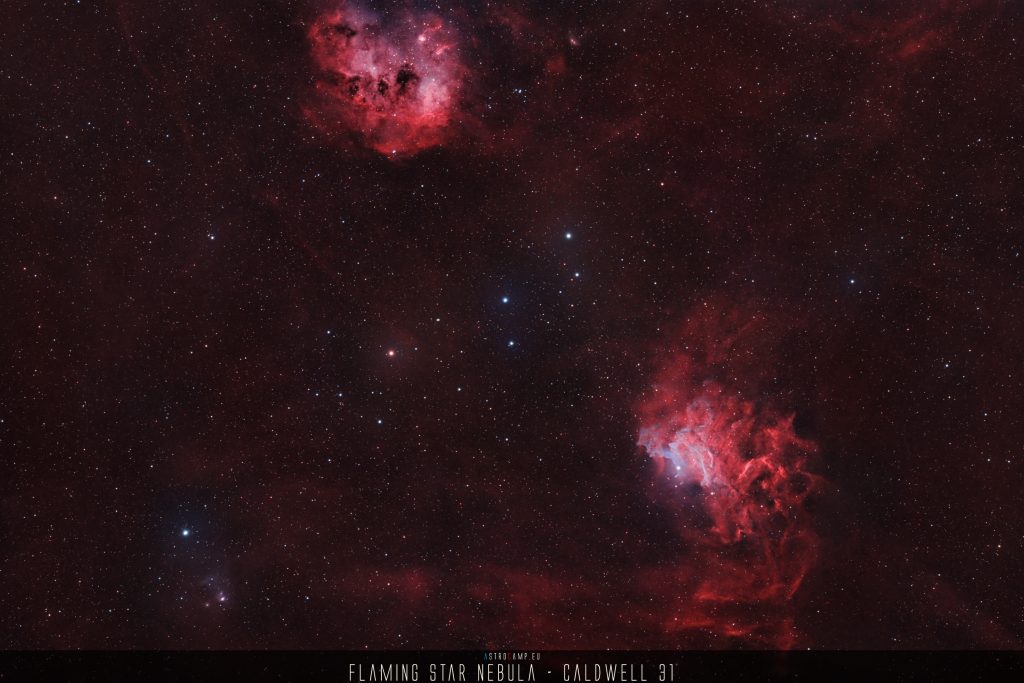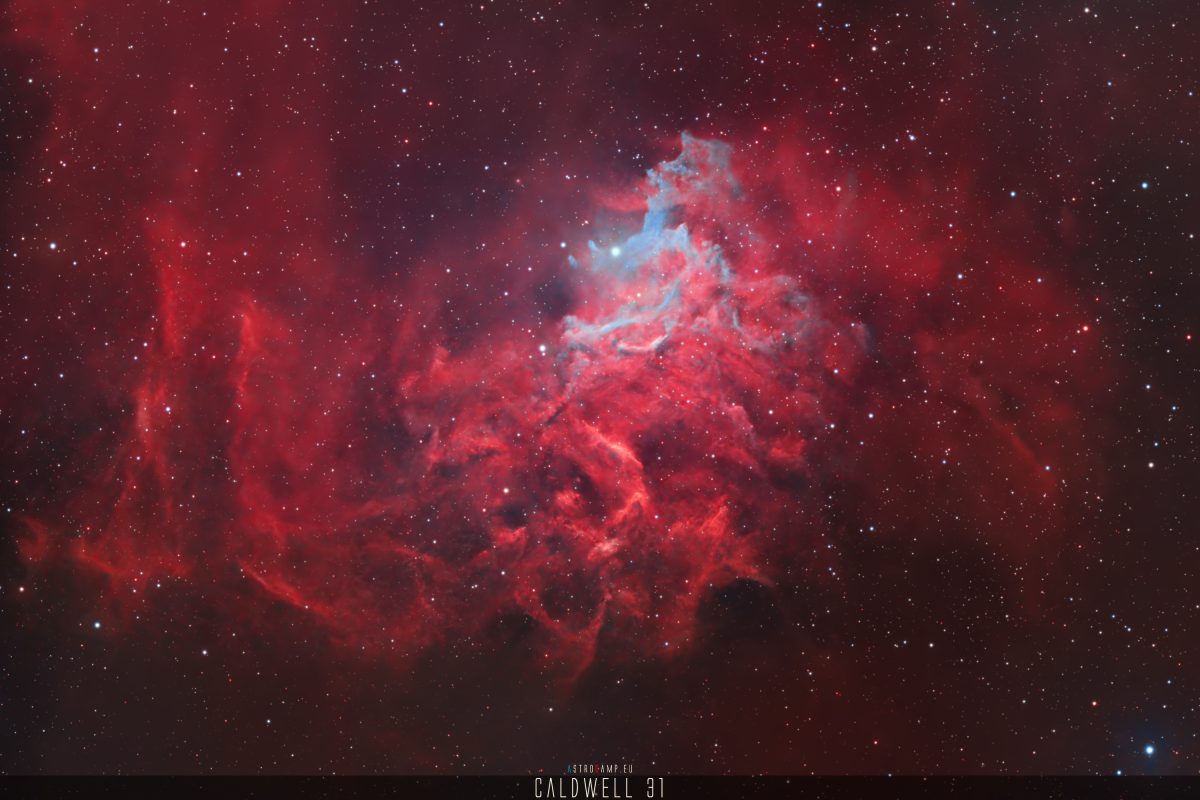
The Flaming Star Nebula, cataloged as Caldwell 31, IC 405 and LBN 795, is a striking emission nebula in Auriga that rewards long-exposure imaging with its blend of glowing hydrogen and dust-scattered starlight. Although it presents itself as a single sprawling target in the frame, the catalogs list it separately from the associated reflection nebula vdB 34, which shares the same region of sky and shines at magnitude 5.96. Imagers typically combine hydrogen-alpha data with broadband RGB to capture both the fiery red emission tendrils and the cooler blue reflection component contributed by vdB 34, which lies roughly 1,790 light-years away. The mix of red and blue structure across a rich Milky Way field makes this one of the more visually rewarding winter targets for narrowband and dual-band photographers alike.
Names and Catalog numbers
- Flaming Star Nebula
- C 31 (Caldwell 31)
- LBN 795
- IC 405
- vdB 34 (van den Bergh 34) (associated object: vdB 34)
Position and the cosmic neighborhood
The Flaming Star Nebula sits high in the northern winter sky within Auriga, near right ascension 05h 17m and declination +34° 23′, placing it in a dense and photogenic stretch of the Milky Way. Just a short distance away on the sky, at right ascension 05h 16m and declination +34° 19′, lies the reflection nebula vdB 34, whose scattered blue light interleaves with the nebula’s red emission in wide-field frames. This corner of Auriga is a favorite hunting ground for astrophotographers, offering a photographically rich backdrop of stars and interstellar dust. Because Auriga rides high overhead for northern observers during the colder months, the region can be tracked for long stretches at favorable altitude, minimizing atmospheric interference.
Nice to Know
- What looks like one glowing target is actually several independently cataloged objects: the emission nebula carries the designations Caldwell 31, IC 405 and LBN 795, while the neighboring reflection nebula is listed separately as vdB 34.
- The associated reflection nebula vdB 34 shines at magnitude 5.96, making it a bright contributor of blue, dust-scattered light in wide-field images.
- vdB 34 lies approximately 1,790 light-years from us, anchoring the distance scale of this photogenic complex.
- The combination of red emission and blue reflection nebulosity makes this region an ideal subject for dual-band and combined narrowband-plus-RGB imaging workflows.