
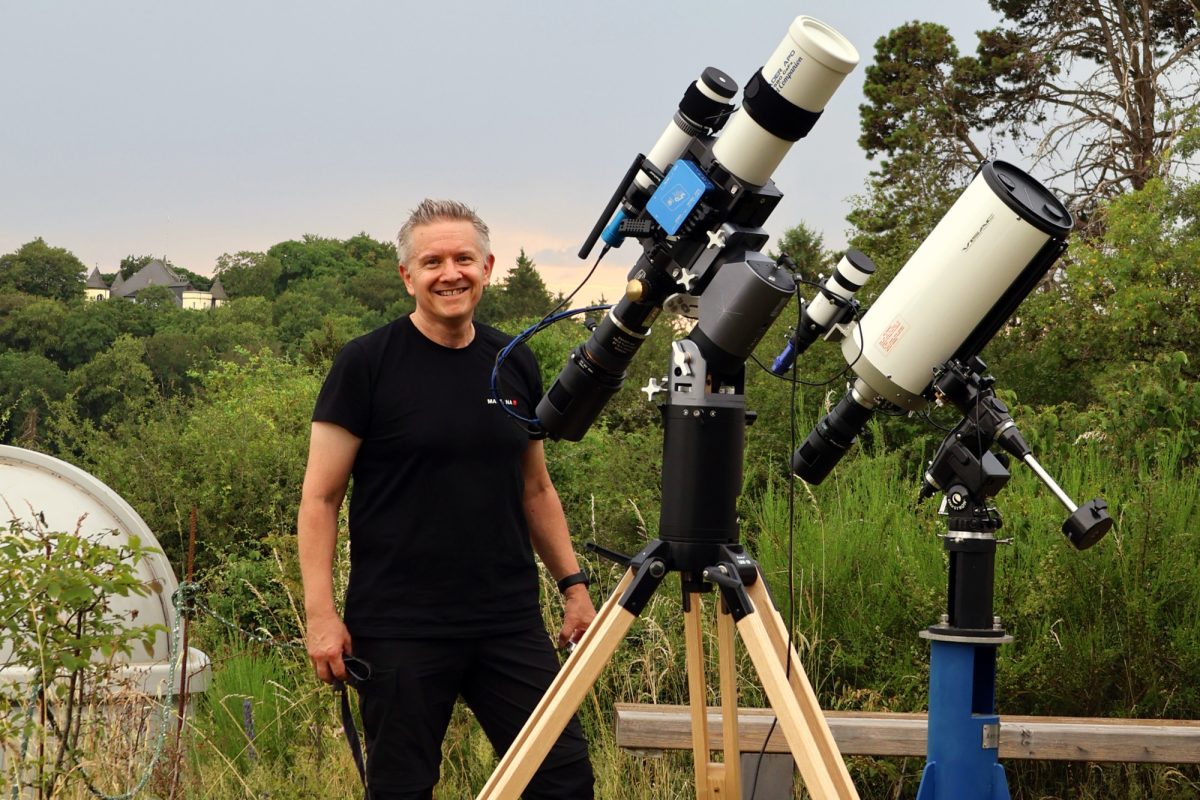
The Person Behind Astrocamp
I’m Thomas Hanrath, 51 years old and a devoted resident of Koblenz for a quarter of a century. I grew up on the Lower Rhine – I spent the first half of my life there, the second here in Koblenz. Professionally I work in IT consulting; but the moment it gets dark and the sky turns clear, my time belongs to the stars.
How My Astrophotography Began
My fascination with the sky isn’t new. Back in the 1980s, as a child, I stood outside with a small telescope, observed the Moon, screwed on a solar filter and marvelled. Photography was out of reach back then – I had neither the equipment nor the persistence, and soon other interests took over. But my interest in astronomy always lingered somewhere in the background.
What reignited the spark was Comet NEOWISE, shortly before the Covid pandemic. I had given my son a small telescope – and suddenly I asked myself: how do I actually attach my camera to this thing? What adapters do I need? How does any of this work? That single question turned into a rabbit hole of research, phone calls with astro shops and late-night experiments. My first target was Mars – and to this day I’m amazed at how well that first image turned out.
What Drives Me in Astrophotography
For me, astrophotography is a craft that demands patience, technical understanding, astronomical knowledge and a healthy tolerance for frustration. There are evenings when nothing works – a forgotten cable, a misconfigured software value, a mount that isn’t properly polar-aligned. And there are nights when everything falls into place and light reaches my camera sensor that has travelled through the universe for millions of years.
That’s the heart of what I do: I collect photons. Not painting on a screen, but mathematical processes that turn hundreds of individual exposures – each five minutes long, captured over weeks – into a single image. My most demanding photo so far, an emission nebula, holds around 45 hours of exposure time.
My Equipment
To turn photons into a finished image, I now work with two setups that I use depending on the target and conditions – and, when it makes sense, both in parallel on the same night.
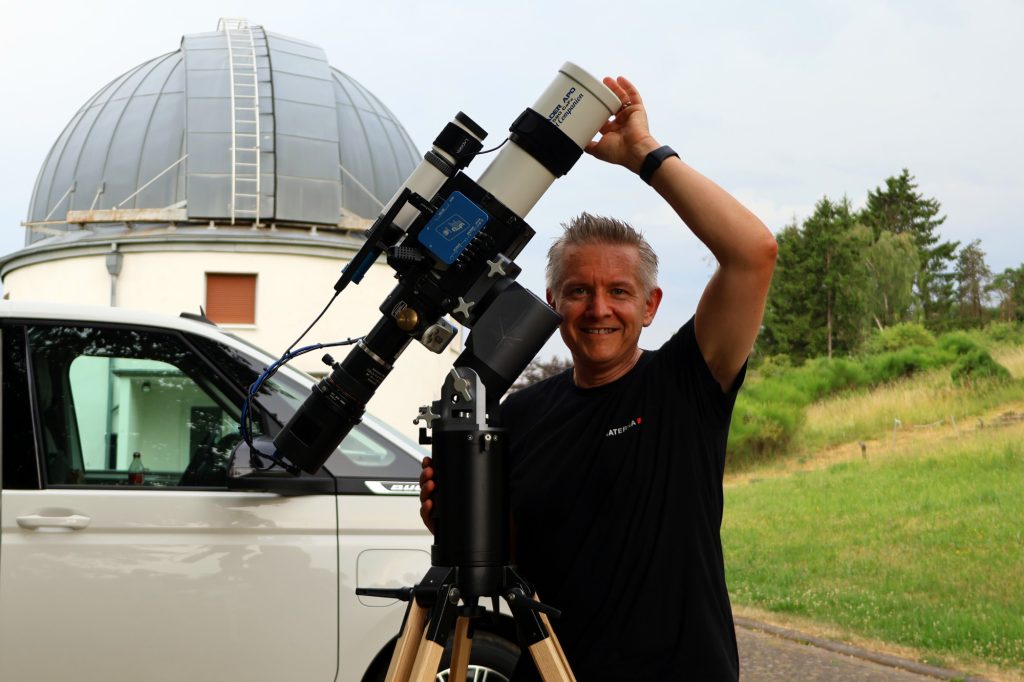
Setup 1 – the travel and narrowband rig: a Baader Apo Travel Companion 95 (CaF₂ apochromat) on my new Warpastron WD-20P mount, carried by a Berlebach Uni 18 wooden tripod. The camera is a ToupTek SkyEye62AM, fronted by a 50.4 mm Baader CMOS filter set: LUM, R, G, B, plus the narrowband filters S, H and O in the ultra-narrowband variant. Guiding runs through a permanently mounted William Optics Uniguide 50, controlled by a Raspberry Pi 5 running Stellarmate OS. This combination is my workhorse for emission nebulae and narrowband projects.
Setup 2 – the galaxy and long-focal-length rig: a Vixen VISAC VC200L (1800 mm focal length) on a Skywatcher HEQ5 Pro (belt-modded and hypertuned). Here I run a ToupTek SkyEye24AC with a 50.4 mm Baader filter – either LUM or UHC-L, depending on the target and light pollution. Guiding is handled by a permanently mounted APM 240 mm guide scope with a QHY 462C guide camera, with a ToupTek Stellavita as the control computer. The long focal length makes this setup ideal for small, faint galaxies.

Both cameras are fitted with a Baader M68 quick-changer and a Baader UFC filter drawer. The back focus is adapted identically for both, so I can swap them freely between the telescopes as needed. I process all my images in PixInsight.
Where I shoot
My default spot is right outside my front door: my own garden. When time and clear nights allow, I set out – into the Hunsrück, the Westerwald, the Eifel. I especially like driving to the Hoher List, where the Vulkaneifel Astronomical Association offers me a place on their grounds under comparatively dark skies. There I shoot all night, stay over on site, and return home in the morning with full hard drives and a contented smile.
By the way: while I’m shooting, hedgehogs regularly sneak through the garden. I find it fitting – loyal companions under the starry sky.
Why This Blog Exists
I’ve been blogging since blogs existed – first about IT projects, until I stopped somewhere around the mid-2010s. Astrophotography brought writing back into my life. On astrocamp.eu I document my journey: techniques, mistakes, insights and of course the images themselves. It’s essentially a learning diary – and anyone who reads from the beginning can see exactly how the quality of my images has evolved over the years.
I simply find it too much of a waste to pour weeks of work into a single image and then let it vanish into a folder. These photos are meant to be seen. Browse the deep-sky catalog or follow what I’m currently working on in the astrophoto timeline.