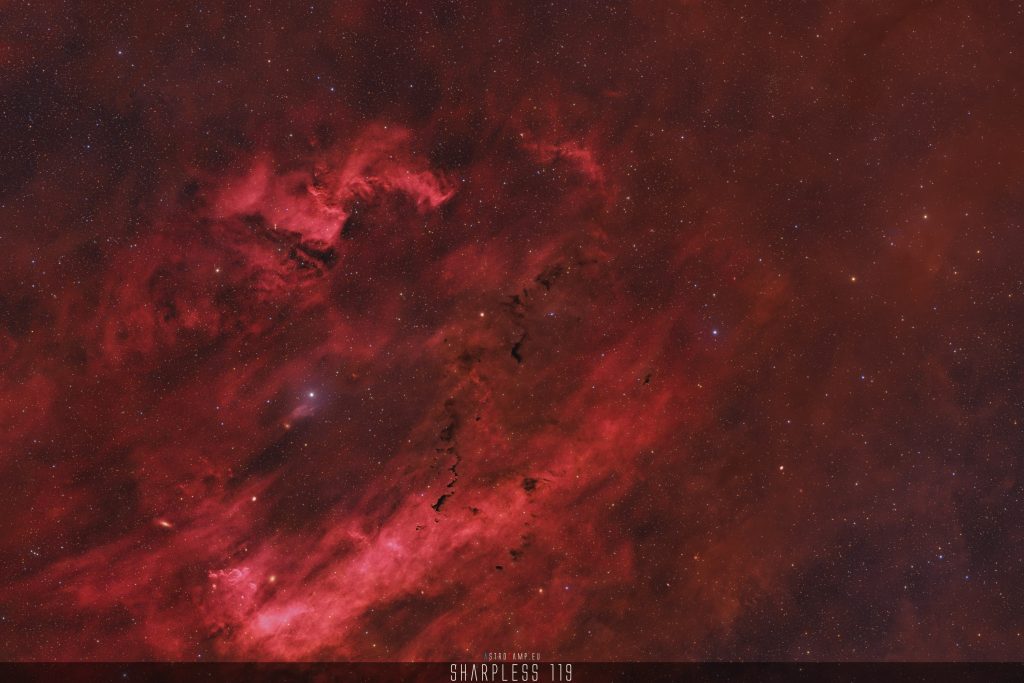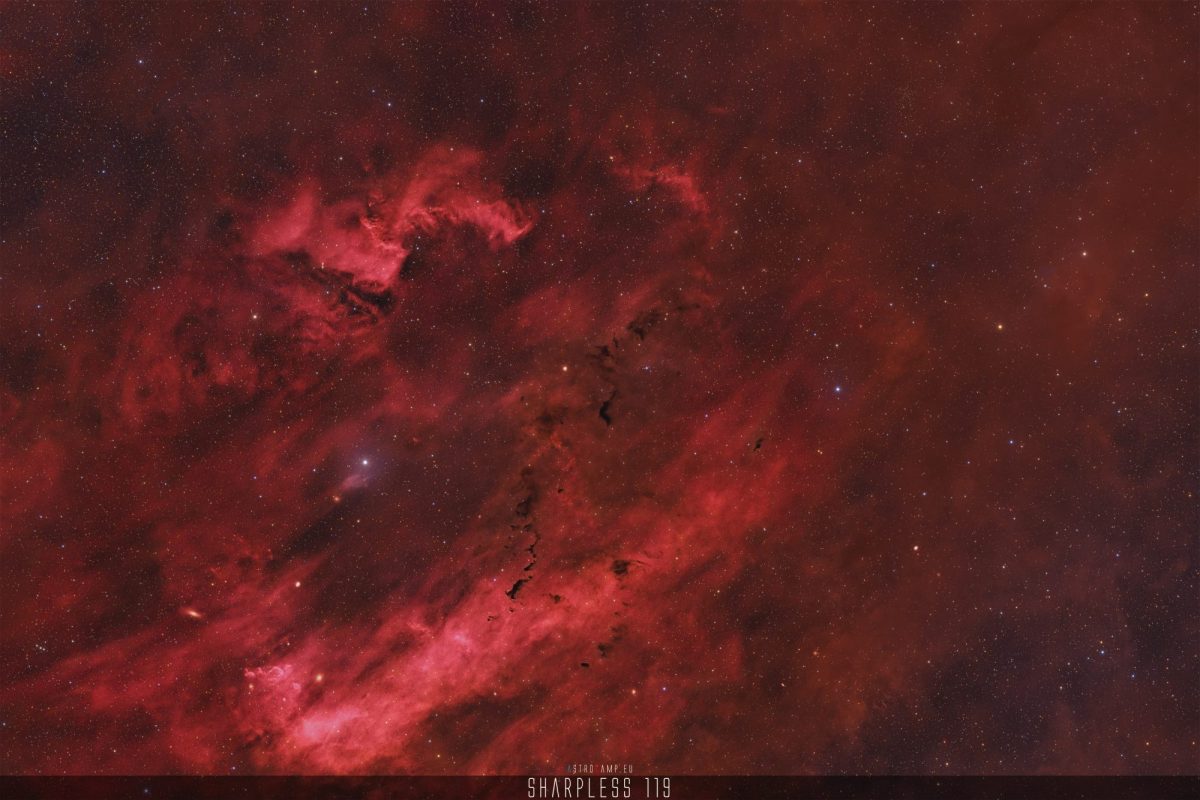
Sharpless 2-119, also cataloged as LBN 391, is an emission nebula nestled within the star-rich fields of the constellation Cygnus. As a hydrogen-emission region, it responds especially well to narrowband imaging, where an H-alpha filter isolates the glowing wisps of ionized gas against a crowded stellar backdrop. The dense Milky Way surroundings make Sh2-119 a rewarding but demanding target, as careful star reduction is often needed to keep the nebula from being overwhelmed by countless field stars. Long integration times under dark skies help bring out the fainter, filamentary structure that gives this region its subtle character.
Names and Catalog numbers
- Sh2-119 (Sharpless 119)
- LBN 391
Position and the cosmic neighborhood
Sh2-119 lies in Cygnus at a right ascension of 21h 18m 30s and a declination of +43° 56′, placing it deep within one of the brightest stretches of the summer Milky Way. This part of the sky is dense with emission nebulae, dark dust lanes, and open star clusters, so wide-field frames of Sharpless 2-119 naturally capture a busy tapestry of surrounding gas and stars. The high northern declination keeps the region well placed for observers across the northern hemisphere, and its embedding in the Cygnus star clouds makes it an appealing anchor for mosaic projects that stitch together neighboring hydrogen regions.
Nice to Know
- Sh2-119 appears in two catalogs, listed as both Sharpless 2-119 and LBN 391, reflecting its inclusion in surveys of emission nebulae and bright nebulae alike.
- As a hydrogen-dominated emission region, it is a prime candidate for narrowband H-alpha imaging that cuts through light pollution.
- Its location in Cygnus places it among some of the richest star fields in the entire night sky, ideal for wide-field astrophotography.
- The nebula’s faint, filamentary structure rewards long total exposure times and thoughtful star-reduction processing.