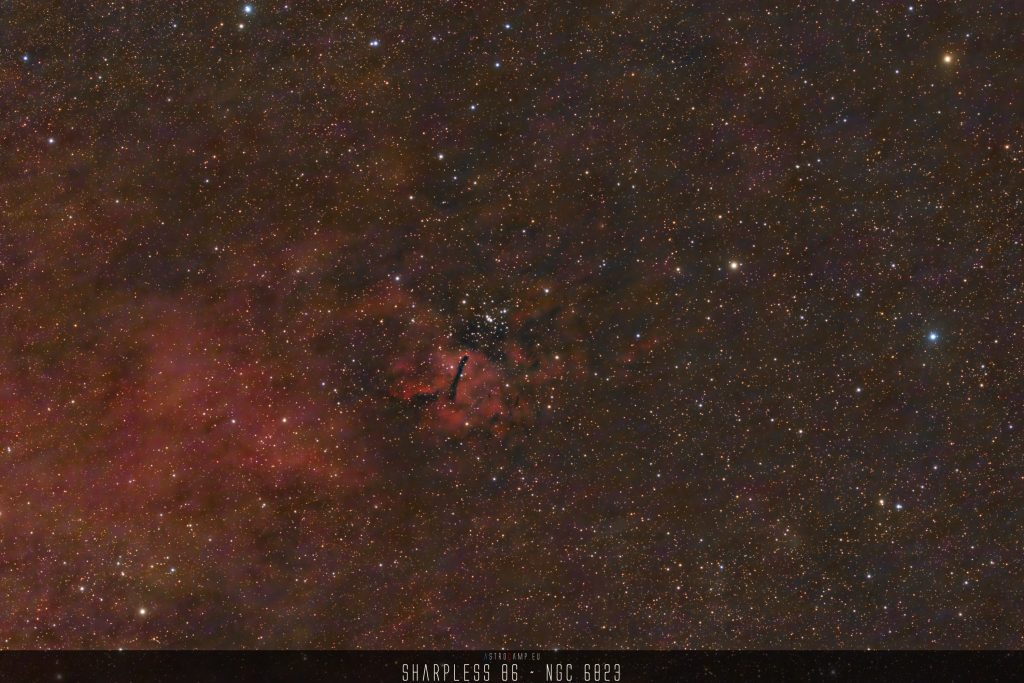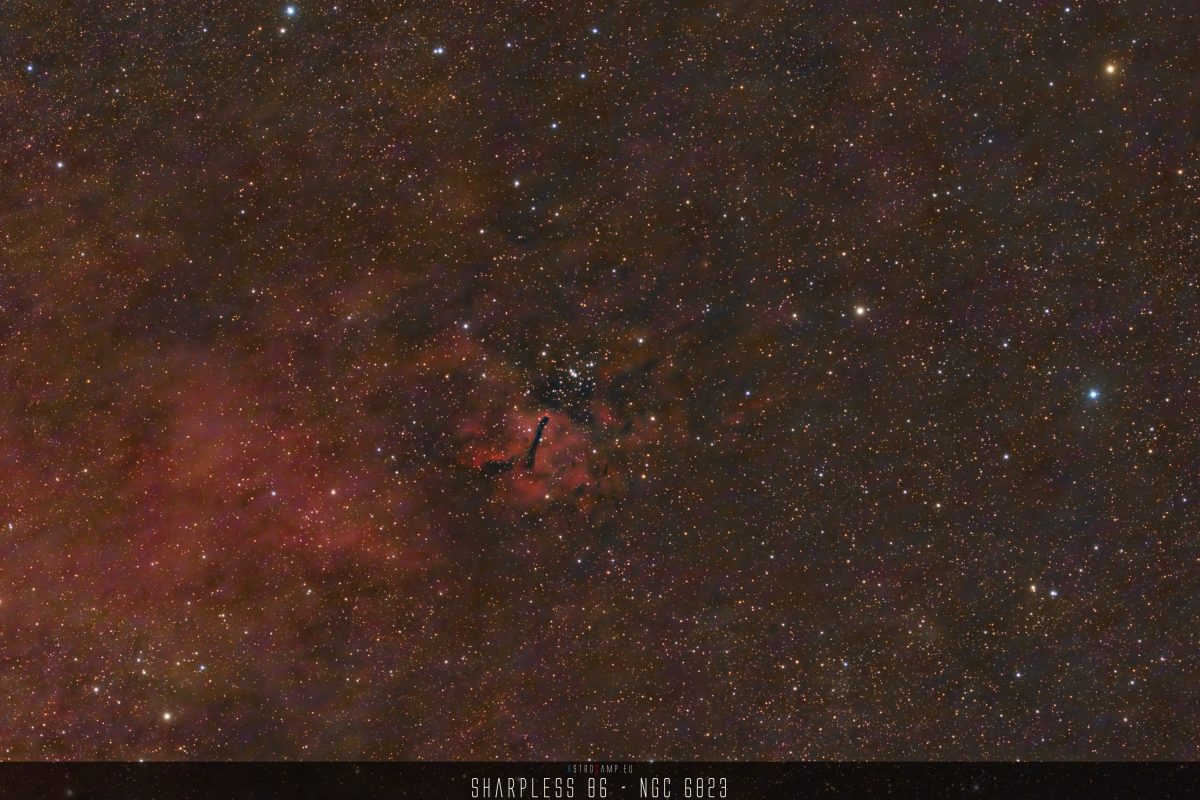
Sh2-86, also cataloged as LBN 135, is a faint emission nebula in Vulpecula that rewards patient deep-sky imagers working under dark skies with long integration times. Embedded within the same region of sky lies NGC 6820, a separate emission nebula, while the young open cluster NGC 6823 shines at magnitude 7.1 mag and acts as the energetic engine illuminating the surrounding gas. Although these objects appear as a single sprawling target in a wide-field photograph, the astronomical catalogs list them as distinct, independent entries, each carrying its own designation. Narrowband filters, particularly H-alpha, are the key to drawing out the delicate ionized hydrogen structures of this subtle complex against the rich Milky Way background of Vulpecula.
Names and Catalog numbers
- Sh2-86 (Sharpless 86)
- LBN 135
- NGC 6820 (associated object: NGC 6820)
- NGC 6823 (associated object: NGC 6823)
Position and the cosmic neighborhood
The complex sits in the small constellation Vulpecula, near right ascension 19h 43m and declination +23° 15′, deep within a star-dense stretch of the summer Milky Way. Sh2-86 itself spreads across this field, while the nearby emission nebula NGC 6820 lies just to the southwest at RA 19h 42m, Dec +23° 05′, and the open cluster NGC 6823 marks the heart of the region at RA 19h 43m, Dec +23° 19′. With NGC 6823 spanning an angular size of 3.6′ and the surrounding nebulosity stretching far wider, the area is a favorite framing for wide-field astrophotographers who want both cluster and glowing gas in one composition. The catalogs keep these as separate objects, so observers should treat the nebula and the cluster as independent targets sharing the same patch of sky.
Nice to Know
- What looks like one object is really three catalog entries together: the emission nebula Sh2-86 (LBN 135), the emission nebula NGC 6820, and the open cluster NGC 6823.
- The open cluster NGC 6823 glows at magnitude 7.1 mag with a surface brightness of about 18.5 mag/arcsec², making the cluster far easier to capture than the surrounding faint nebulosity.
- NGC 6823 lies roughly 6,170 light-years away and measures only about 6 light-years across, a compact young cluster compressed into an angular size of just 3.6′.
- The region is a classic narrowband subject — H-alpha imaging is the most effective way to reveal the ionized hydrogen structure of Sh2-86 against the crowded Vulpecula star fields.