
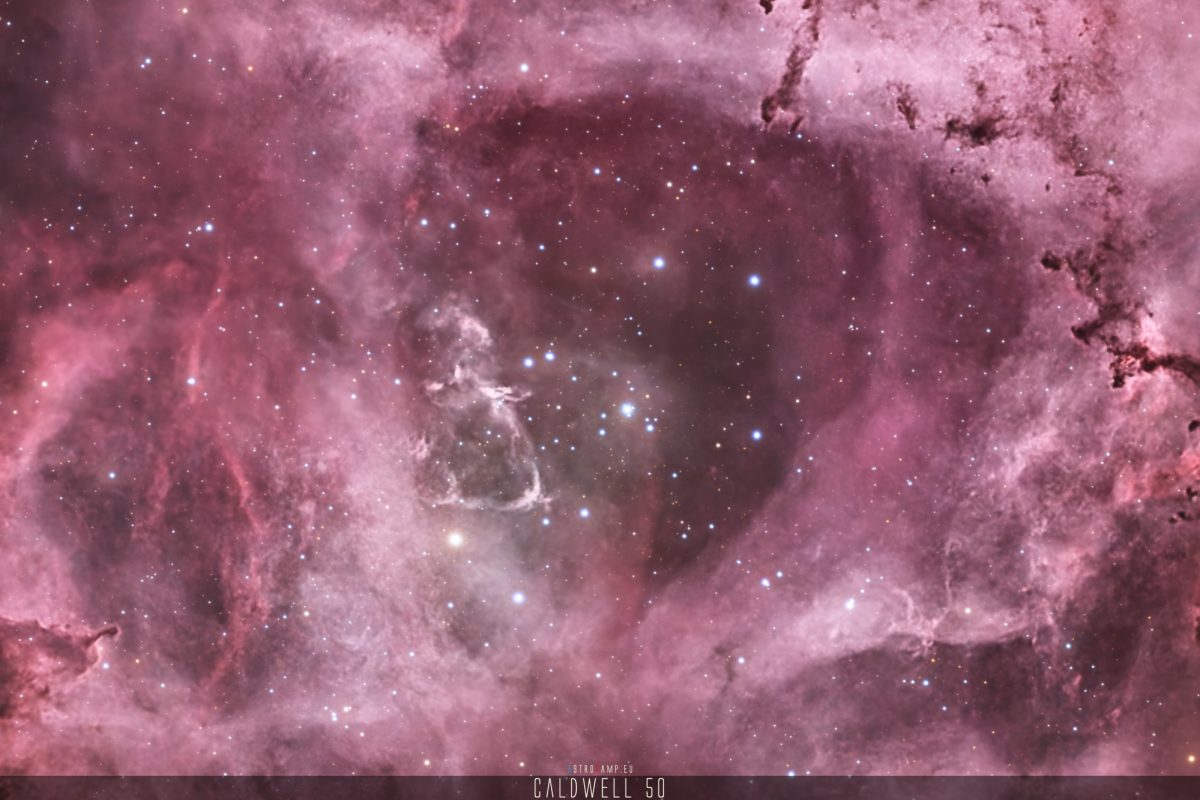
C 50, catalogued as NGC 2244, is a bright open star cluster nestled at the heart of the famous Rosette complex in Monoceros, spanning roughly 1.5° (88′) on the sky and making it a generous, wide-field target for astrophotographers. It is important to note that although the sparkling cluster and its surrounding glowing gas appear as a single showpiece in the eyepiece or on a photograph, the catalogs list them as separate, independent objects: the star cluster carries the designations C 50, Mel 47 and NGC 2244, while the encircling Emission Nebula is catalogued separately as C 49 (NGC 2238). With a physical diameter of about 121 light-years and its member stars energizing the surrounding hydrogen, this region rewards narrowband imaging that isolates the delicate filaments and shell structure of the nebula against the hot central stars. A combination of short exposures to preserve the cluster’s stellar colors and longer narrowband frames for the surrounding gas typically produces the most balanced portrait of this region.
Names and Catalog numbers
- C 50 (Caldwell 50)
- NGC 2244
- Mel 47 (Melotte 47)
- Rosette Nebula (associated object: C 49)
- C 49 (Caldwell 49) (associated object: C 49)
- NGC 2238 (associated object: C 49)
Position and the cosmic neighborhood
C 50 sits in the winter constellation Monoceros at a right ascension of 06h 32m 10.8s and a declination of +04° 54′ 50″, placing it within easy reach of the bright surrounding regions of Orion and the Milky Way’s rich star fields. Just a short distance to the west, at RA 06h 30m 30.0s and Dec +05° 03′ 00″, lies its close companion the Emission Nebula C 49 (NGC 2238), which shares the same field of view and frames the cluster in a vast glowing shell of hydrogen. For imagers, this proximity is a gift, since a single wide-field frame captures both the compact cluster and the sprawling nebula together as one coherent, colorful scene despite their separate catalog identities.
Nice to Know
- The apparent single target is actually two separately catalogued objects: the open cluster C 50 (NGC 2244) and the Emission Nebula C 49 (NGC 2238), each with its own designation and data.
- The cluster carries three catalog identities — C 50, Mel 47 and NGC 2244 — reflecting its long history across different deep-sky surveys.
- With an angular size of 1.5° (88′), it is large enough to require a short focal length or a wide-field setup to fit comfortably within the frame.
- Lying about 4,710 light-years away and measuring roughly 121 light-years across, the cluster’s hot young stars supply the energy that lights up the surrounding nebula, making narrowband imaging especially rewarding.
Brightness, distance and size
It lies about 4,710 light-years from Earth and spans roughly 121 light-years across. On the sky it appears about 1.5° (88′) in size.

