

 2 posts · ♥ 164 · ↻ 12 in total
 2 posts · ♥ 18 · ↻ 0 in total
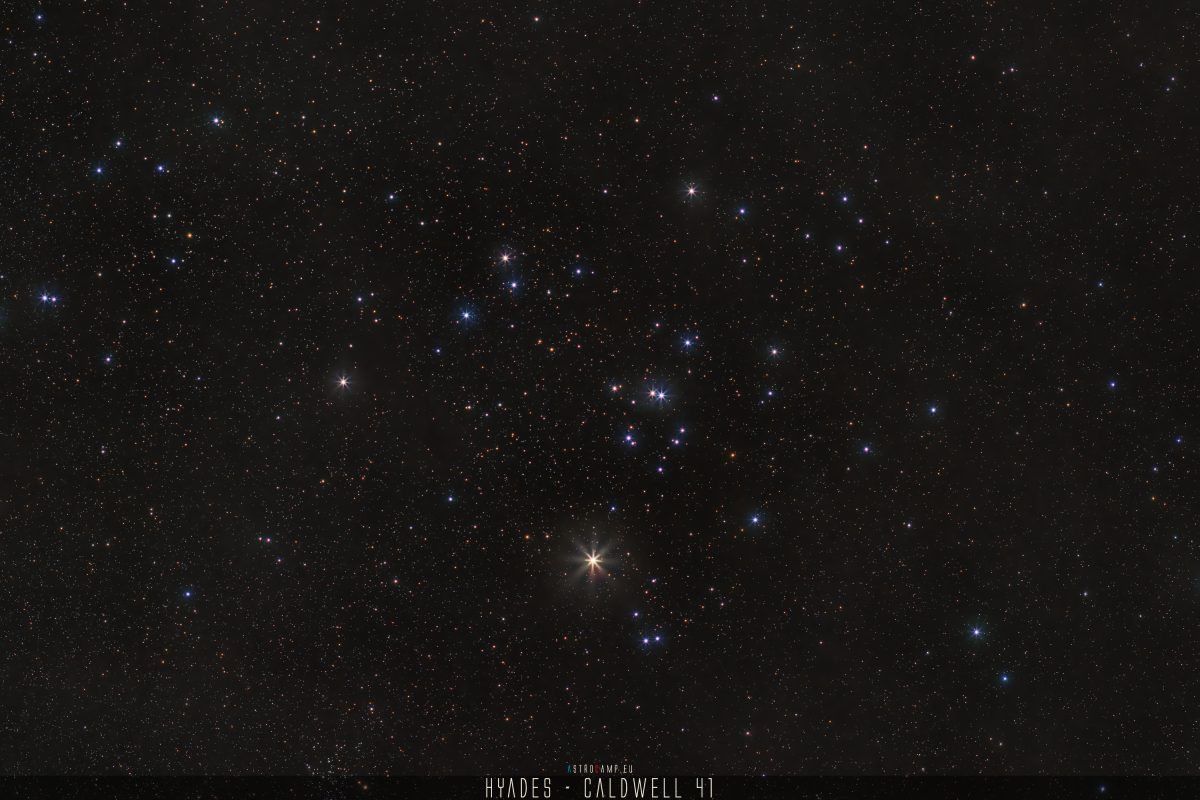
The Hyades are among the brightest and most sprawling open star clusters in the entire night sky, making them a rewarding yet unusual target for astrophotographers. Because the cluster spans several degrees across the sky in Taurus, it is far too large for most telescopes and is best captured with a camera and a short telephoto lens or a wide-field refractor. The scattered, V-shaped arrangement of its stars is easy to frame alongside the brilliant orange foreground star Aldebaran, which produces a striking color contrast in images. Short exposures and careful star-color calibration bring out the varied hues of the member stars while preventing the brightest ones from blooming.
Names, key data and data sources
All values come from the astronomical database SIMBAD (CDS Strasbourg). Tap a row to see where the value comes from.
NamesHyadesAstrocamp
Catalogue numbersC 41 (Caldwell 41) · Mel 25 (Melotte 25) · Cr 50 (Collinder 50)Primary designation: C 41SIMBAD
TypeOpen ClusterSIMBAD
ConstellationTaurus (Tau)computed
Position (J2000)RA 04h 29m 47s · Dec +16° 56′ 53″SIMBAD
Galactic coordinatesl = 179.6° · b = −21.1°Position relative to the Milky Way plane: 21° south of itcomputed
Distance153 light-years46.9 pcSIMBAD
Redshiftz = 0.00013+38 km/s: receding from usSIMBAD
Sources and methods (8)
- Names: Names from the Astrocamp object database.
- Catalogue numbers: All identifiers under which SIMBAD lists the object; order according to the Astrocamp catalogue rule.
- Type: Entry in SIMBAD, object type “OpC”. Value since Jul 2, 2026 · last confirmed with SIMBAD Oct 20, 2026
- Constellation: Computed from the position (IAU constellation boundaries). Value since Jul 2, 2026 · last confirmed with SIMBAD Oct 20, 2026
- Position (J2000): Entry in SIMBAD, quality E (SIMBAD scale A–E). Publication: 2021A&A...647A..19T (NASA ADS). Value since Jul 2, 2026 · last confirmed with SIMBAD Oct 20, 2026
- Galactic coordinates: Converted from the position (IAU 1958 galactic system). Publication: 2021A&A...647A..19T (NASA ADS). Value since Jul 2, 2026 · last confirmed with SIMBAD Oct 20, 2026
- Distance: Median of all 6 measurements listed in SIMBAD (methods: paral 4), middle half 153 light-years – 156 light-years, full range 147 light-years – 163 light-years, rounded according to the scatter. Value since Oct 20, 2026 · last confirmed with SIMBAD Oct 20, 2026
- Redshift: One catalogue value, error ± 0.2 km/s, quality A (SIMBAD scale A–E). Publication: 2021A&A...647A..19T (NASA ADS). Value since Jul 2, 2026 · last confirmed with SIMBAD Oct 20, 2026
Checked against SIMBAD on Oct 20, 2026 · Open C 41 in SIMBAD
Position and the cosmic neighborhood
The Hyades sit in the constellation Taurus at a right ascension of 04h 29m 47s and a declination of +16° 56′ 53″, embedded in one of the richest regions of the winter sky. The cluster forms the distinctive V-shape that marks the face of the celestial bull, with the bright orange star Aldebaran appearing to anchor one tip of the pattern, even though that star lies much closer to us and is not a true member. Nearby in the sky lies the compact Pleiades cluster, offering wide-field imagers the chance to frame two famous star groups within the same stretch of Taurus. This part of the Milky Way’s outskirts provides a sparse but photogenic backdrop, allowing the cluster’s bright members to stand out cleanly against the darker sky.
Click marks an object (its path tonight) · click again for its constellation, once more to zoom · its name shows details · click outside zooms out · drag to pan
Nice to Know
- At a distance of around 153 light-years, the Hyades are one of the nearest open star clusters to Earth, which is why they appear so large and loosely spread across the sky.
- The distance quoted here is the median of six published measurements, reflecting a well-constrained and reliable value.
- The cluster carries several catalog designations, including Caldwell 41, Collinder 50 and Melotte 25, a reminder of how prominent it has been to observers across history.
- Its wide apparent size makes it a classic wide-field target best suited to camera lenses rather than long focal lengths, a rarity among deep-sky objects.

nice picture, what was the exposure time?