
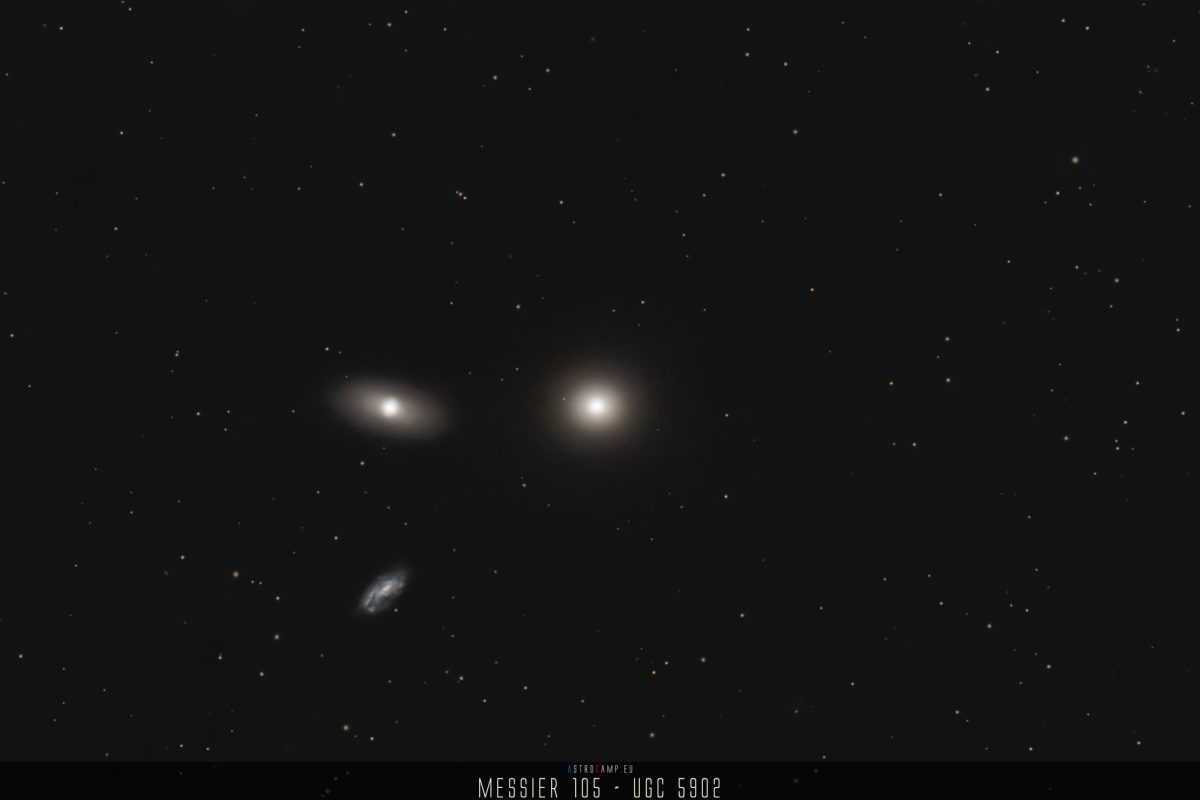
Messier 105, also cataloged as NGC 3379, is a smooth elliptical galaxy that presents astrophotographers with a compact, featureless glow rather than the sweeping spiral arms found in disk galaxies. Shining at magnitude 9.76 with a surface brightness of 21.8 mag/arcsec², it is bright enough for modest apertures yet rewards long integration times that tease out its faint outer halo. Because its light is concentrated in a small angular span of 5.1′, longer focal lengths help resolve the subtle brightness gradient from its dense core to its diffuse edges. Its elliptical nature means color data will be dominated by a warm, aging stellar population, so careful star-color calibration keeps the frame from washing out to a flat monochrome patch.
Names and Catalog numbers
- M 105 (Messier 105)
- NGC 3379
- UGC 5902
- PGC 32256
Position and the cosmic neighborhood
Messier 105 lies in Leo at a right ascension of 10h 47m 49.6s and a declination of +12° 34′ 53.9″, placing it high in the spring sky for northern observers. It is a prime member of the Leo I galaxy group, and wide-field imagers can frame it alongside the nearby lenticular galaxy NGC 3384 and the fainter NGC 3389 in a single satisfying composition. This trio makes an excellent multi-galaxy target that helps convey a sense of cosmic scale, with the elliptical Messier 105 anchoring the scene. Framing the group with a medium focal length telescope captures the interplay of galaxy shapes while leaving room for surrounding field stars to add depth.
Nice to Know
- Messier 105 (NGC 3379) is a classic elliptical galaxy, offering imagers a rare chance to capture a nearly perfectly smooth stellar glow.
- It spans roughly 39,400 light-years across, appearing as a compact 5.1′ target that suits longer focal lengths.
- At about 26.4 million light-years distant, it is close enough that deep exposures can begin to reveal its extended, faint outer halo.
- It shares its field with the neighboring galaxies NGC 3384 and NGC 3389, making it ideal for a group portrait of the Leo I galaxy group.
Brightness, distance and size
The object has an apparent magnitude of 9.8 mag, it lies about 26.4 million light-years from Earth and spans roughly 39,400 light-years across. On the sky it appears about 5.1′ in size.

