
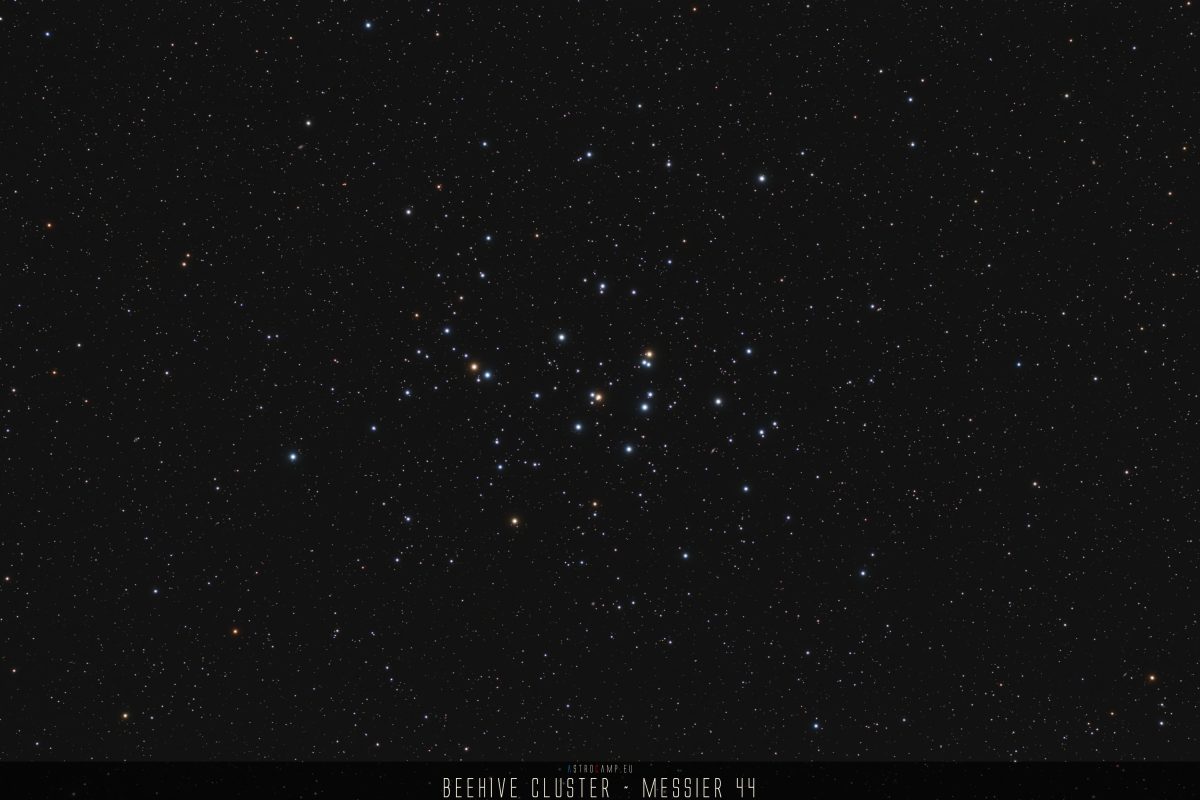
The Beehive Cluster, also catalogued as Messier 44 and NGC 2632, is one of the most rewarding open star clusters for wide-field astrophotography. Spanning a generous 2.0° (118′) on the sky, it overflows the frame of most telescopes and is best captured with a short focal length, a fast refractor, or even a telephoto lens. Its scattered bright stars render cleanly against the background even under modest skies, making it an ideal target for beginners and a satisfying RGB project for experienced imagers. With a physical diameter of 21 light-years, the cluster fills the field with crisp, colorful pinpoint stars that reward careful focus and gentle star-color processing.
Names and Catalog numbers
- Beehive Cluster
- M 44 (Messier 44)
- NGC 2632
- Mel 88 (Melotte 88)
Position and the cosmic neighborhood
The Beehive Cluster sits at right ascension 08 40 13.00 and declination +19 37 16.0 in the constellation Cancer, a faint zodiacal region tucked between the brighter stars of Gemini and Leo. Because Cancer itself offers few prominent guide stars, framing the cluster is easiest by star-hopping from these neighbors, and its large angular extent makes it a natural anchor for wide-field mosaics of the surrounding star fields. The cluster’s open, sparse appearance and its placement along the ecliptic mean planets and the Moon occasionally drift nearby, offering opportunities for memorable conjunction images.
Nice to Know
- At an apparent size of 2.0° (118′), the Beehive Cluster is roughly four times the width of the full Moon, demanding very wide fields of view.
- It is one of the nearest open clusters to the Solar System, lying just 610 light-years away.
- The cluster carries several catalog identities, including Messier 44, NGC 2632, and Melotte 88.
- Its true physical extent of 21 light-years means even its widely spaced stars are genuine members moving together through space.
Brightness, distance and size
It lies about 610 light-years from Earth and spans roughly 21 light-years across. On the sky it appears about 2.0° (118′) in size.


