
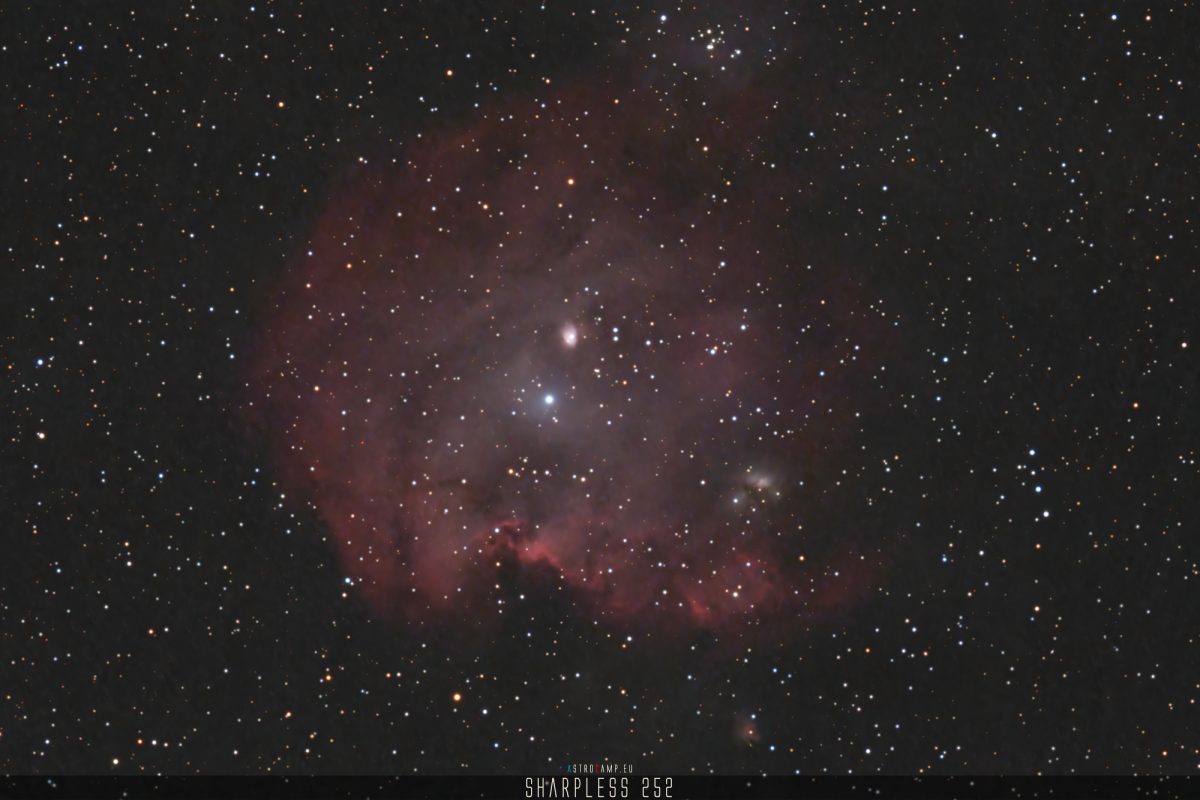
The Monkey Head Nebula, also cataloged as NGC 2175, is an open star cluster wrapped in a glowing region of ionized hydrogen that makes it a rewarding target for wide-field astrophotography. With an apparent magnitude of 6.8, the cluster itself is bright, while the surrounding nebulosity rewards long exposures and narrowband filters that isolate the hydrogen-alpha signal. Its distinctive shape, reminiscent of a primate’s face, emerges most clearly in image stacks that reveal the sculpted pillars and dark lanes carved into the gas. Because the object spans a generous area of sky, short-to-medium focal lengths and camera sensors with a wide field are ideal for framing the full structure.
Names and Catalog numbers
- Monkey Head Nebula
- NGC 2175
- Sh2-252 (Sharpless 252)
- LBN 854
- LBN 190.10+00.58
Position and the cosmic neighborhood
The Monkey Head Nebula lies in the constellation Orion at a right ascension of 06h 09m 39s and a declination of +20° 29′ 12″, placing it in the northern reaches of one of the winter sky’s richest regions. This part of Orion sits near the border with Gemini, in a stretch of the Milky Way dense with star-forming clouds and young stellar associations. For astrophotographers, its high declination keeps it well-placed for northern-hemisphere observers, and the surrounding field offers a colorful backdrop of stars and faint nebulosity that enriches any wide-field composition. The object is also known under designations including NGC 2175, Sh2-252, and LBN 854.
Nice to Know
- Despite being classified as an open cluster, NGC 2175 is best known for the vivid emission nebula surrounding it, which gives the region its famous monkey-face appearance.
- At magnitude 6.8, the cluster is bright enough to hint at in modest optics, yet the surrounding gas demands long exposures to fully reveal its detail.
- The nebula carries multiple catalog identities, appearing as Sh2-252, LBN 854, and LBN 190.10+00.58 in addition to its NGC number.
- Its location deep within the Milky Way band of Orion makes it a favorite subject for narrowband imaging, where hydrogen-alpha data brings out the sculpted pillars and dark structures.
Brightness, distance and size
The object has an apparent magnitude of 6.8 mag, it lies about 7,270 light-years from Earth.
