
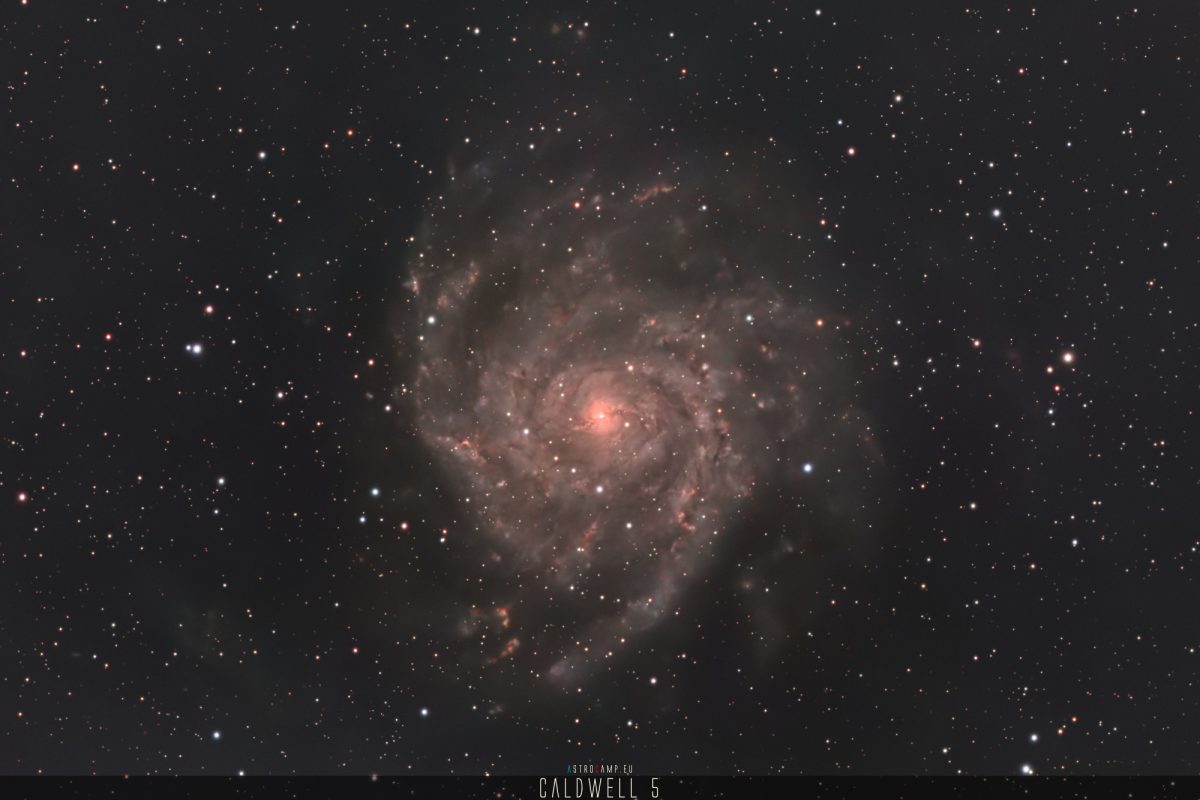
The Hidden Galaxy is a large spiral galaxy that presents a significant challenge for astrophotographers due to its location near the galactic plane, where dense foreground stars and interstellar dust heavily obscure the view. Despite this obstacle, patient imagers can reveal a beautiful face-on spiral structure spanning over 21 arcminutes across the sky, making it appear nearly as large as the full Moon. At 13.4 million light-years away, this relatively nearby galaxy rewards long exposures with intricate spiral arm details and active star-forming regions. Its low surface brightness and heavy extinction demand dark skies, careful integration time, and robust flat-field calibration to overcome the crowded stellar foreground.
Names and Catalog numbers
- Hidden Galaxy
- C 5 (Caldwell 5)
- UGC 2847
- PGC 13826
- IC 342
Position and the cosmic neighborhood
The Hidden Galaxy resides in the northern constellation Camelopardalis at coordinates 03h 46m 48.5s right ascension and +68° 05′ 46″ declination. This placement puts it uncomfortably close to the plane of our own Milky Way, resulting in significant foreground extinction that dims the galaxy and hides it behind a veil of Galactic dust and stars—hence its common name. The galaxy’s face-on orientation would otherwise make it a spectacular imaging target, but astrophotographers must contend with numerous foreground stars scattered across the field of view. Its angular size of nearly 22 by 21 arcminutes means wide-field setups or moderate focal lengths are ideal to frame the entire structure, while its circumpolar position from mid-northern latitudes allows imaging throughout much of the year.
Nice to Know
- The Hidden Galaxy earned its name because it lies behind a dense curtain of Milky Way stars and dust, making it one of the most obscured bright galaxies in the sky despite its relatively close proximity.
- With a physical diameter of 85,300 light-years, the Hidden Galaxy is roughly two-thirds the size of our Milky Way, yet its apparent size on the sky rivals that of the full Moon, offering impressive scale for wide-field astrophotography.
- The galaxy is also cataloged as Caldwell 5, making it one of the brightest members of the Caldwell catalog and a worthy target for advanced imagers seeking a rewarding but challenging deep-sky object.
- Its nearly perfect face-on orientation combined with active star formation makes it an excellent target for capturing detailed spiral structure, HII regions, and dust lanes, provided sufficient integration time is used to overcome the low surface brightness and foreground extinction.
Brightness, distance and size
It lies about 13.4 million light-years from Earth and spans roughly 85,300 light-years across. On the sky it appears about 22′ in size.
