
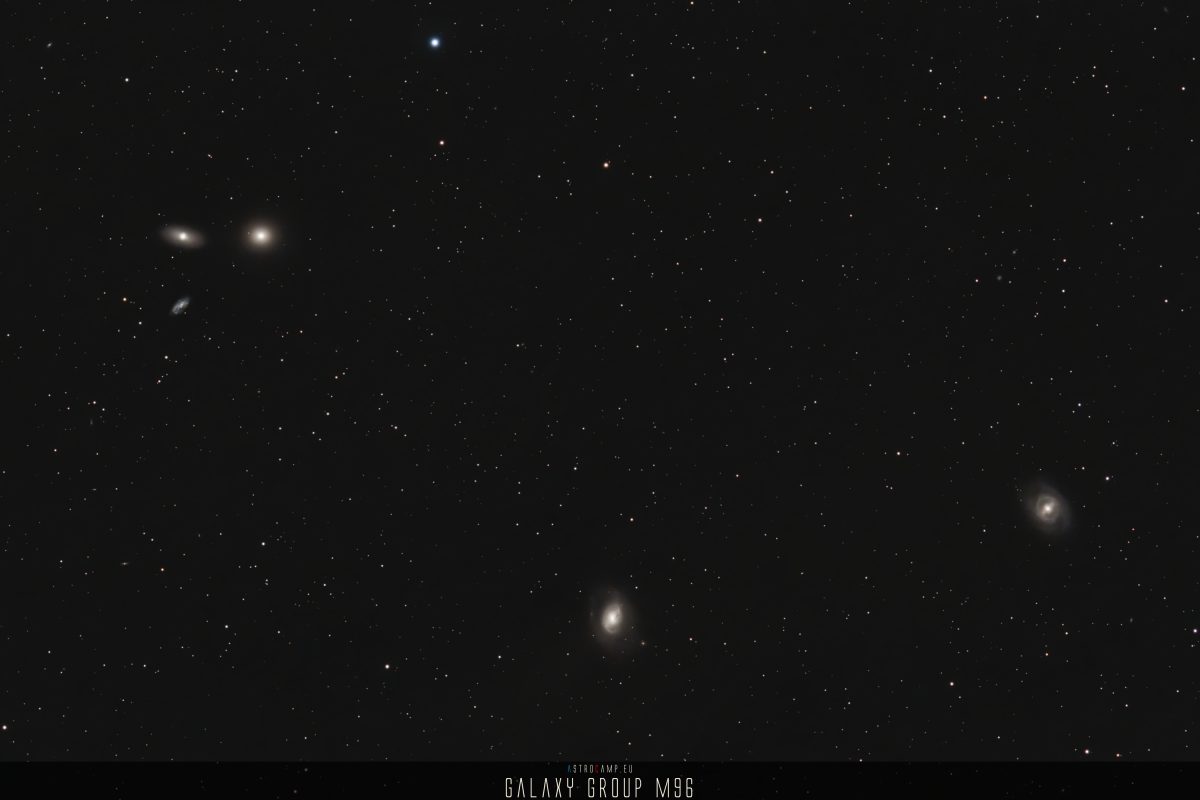
The Leo I Group is a compact gathering of galaxies in Leo that the catalogs list as separate, independent objects, including the bright barred spirals Messier 95 (NGC 3351) and Messier 96 (NGC 3368) along with the elliptical Messier 105 (NGC 3379). These three anchor a photogenic field that also contains the ellipticals NGC 3377, the lenticular-looking barred spirals NGC 3384 and NGC 3412, the spiral NGC 3299, and NGC 3489, giving wide-field imagers a rich mix of galaxy shapes in a single frame. Messier 96 is the brightest member at magnitude 9.25, while the fainter members such as NGC 3412 at magnitude 10.54 and NGC 3377 at magnitude 10.38 reward longer integration times and dark skies. With surface brightnesses around 21.6 to 22.0 mag/arcsec² across the brighter members, this is a target where careful background calibration and patient stacking bring out the subtle spiral arms and halos of these island universes.
Names, key data and data sources
All values come from the astronomical database SIMBAD (CDS Strasbourg). Tap a row to see where the value comes from.
NamesLeo I GroupAstrocamp
Catalogue numbersLeo I GroupPrimary designation: Leo I GroupSIMBAD
TypeGalaxy GroupAstrocamp
ConstellationLeo (Leo)computed
Position (J2000)RA 10h 48m 35s · Dec +12° 40′ 15″Astrocamp
Galactic coordinatesl = 233.5° · b = 57.8°Position relative to the Milky Way plane: 58° north of itcomputed
Cosmic neighbourhoodcontains M 95, M 96, M 105, NGC 3299, NGC 3377, NGC 3384, NGC 3412, NGC 3489Astrocamp
Sources and methods (7)
- Names: Names from the Astrocamp object database.
- Catalogue numbers: All identifiers under which SIMBAD lists the object; order according to the Astrocamp catalogue rule.
- Type: Value since Jul 3, 2026
- Constellation: Computed from the position (IAU constellation boundaries). Value since Jul 3, 2026
- Position (J2000): Value since Jul 6, 2026
- Galactic coordinates: Converted from the position (IAU 1958 galactic system). Value since Jul 6, 2026
- Cosmic neighbourhood: Editorial links in the Astrocamp object database (parent structure, associated objects, members).
Position and the cosmic neighborhood
Centered at roughly right ascension 10h 48m and declination +12° 40′ in Leo, the Leo I Group sprawls across a wide stretch of sky beneath the belly of the celestial lion. The famous Messier trio sits close together, with Messier 95 and Messier 96 separated by less than a degree and the Messier 105–NGC 3384–NGC 3377 complex a short hop to the northeast, making for an ideal multi-galaxy mosaic. Framing slightly wider pulls in the barred spiral NGC 3412 and the galaxy NGC 3489 toward the east, while the small spiral NGC 3299 lies off to the west; distances across the group span from about 32 million light-years for Messier 95 out to around 39 million light-years for NGC 3489, so these companions are genuine neighbors in the same corner of the local universe rather than a chance line-of-sight grouping.
Click marks an object (its path tonight) · click again for its constellation, once more to zoom · its name shows details · click outside zooms out · drag to pan
Nice to Know
- The group’s showpiece is the Messier trio: Messier 95, Messier 96 and Messier 105, three Charles Messier catalog objects that fit comfortably in a single wide-field frame.
- Messier 96 (NGC 3368) is the largest and brightest member, spanning around 65,000 light-years and shining at magnitude 9.25 from a distance of around 34 million light-years.
- The group showcases a full range of galaxy morphologies for imagers, from the barred spirals Messier 95, Messier 96, NGC 3384 and NGC 3412 to the ellipticals Messier 105 and NGC 3377 and the spiral NGC 3299.
- Messier 105 (NGC 3379) is a textbook elliptical lying around 36 million light-years away with a physical diameter of about 54,000 light-years, pairing beautifully with the nearby barred spiral NGC 3384 in the same view.


