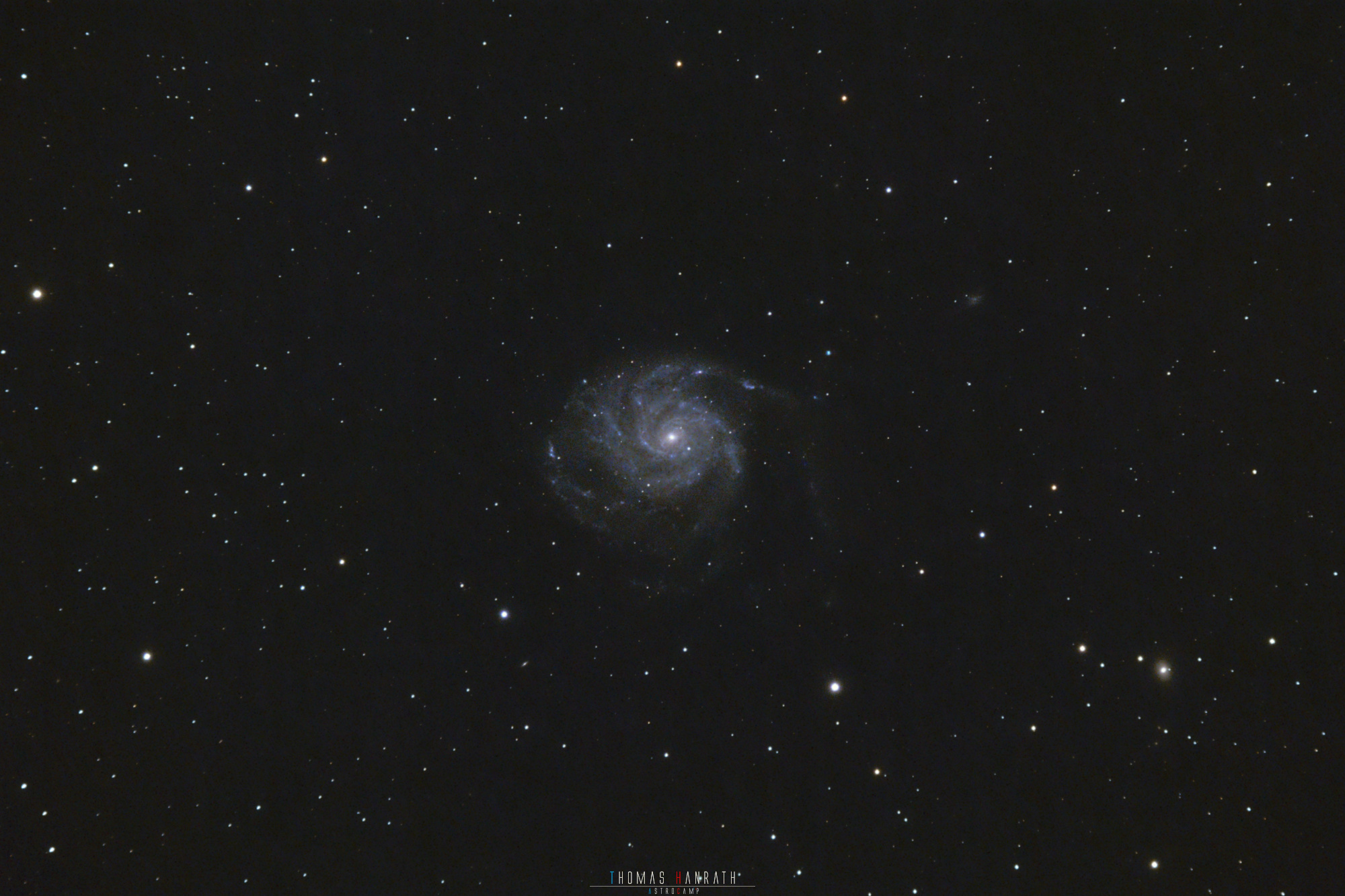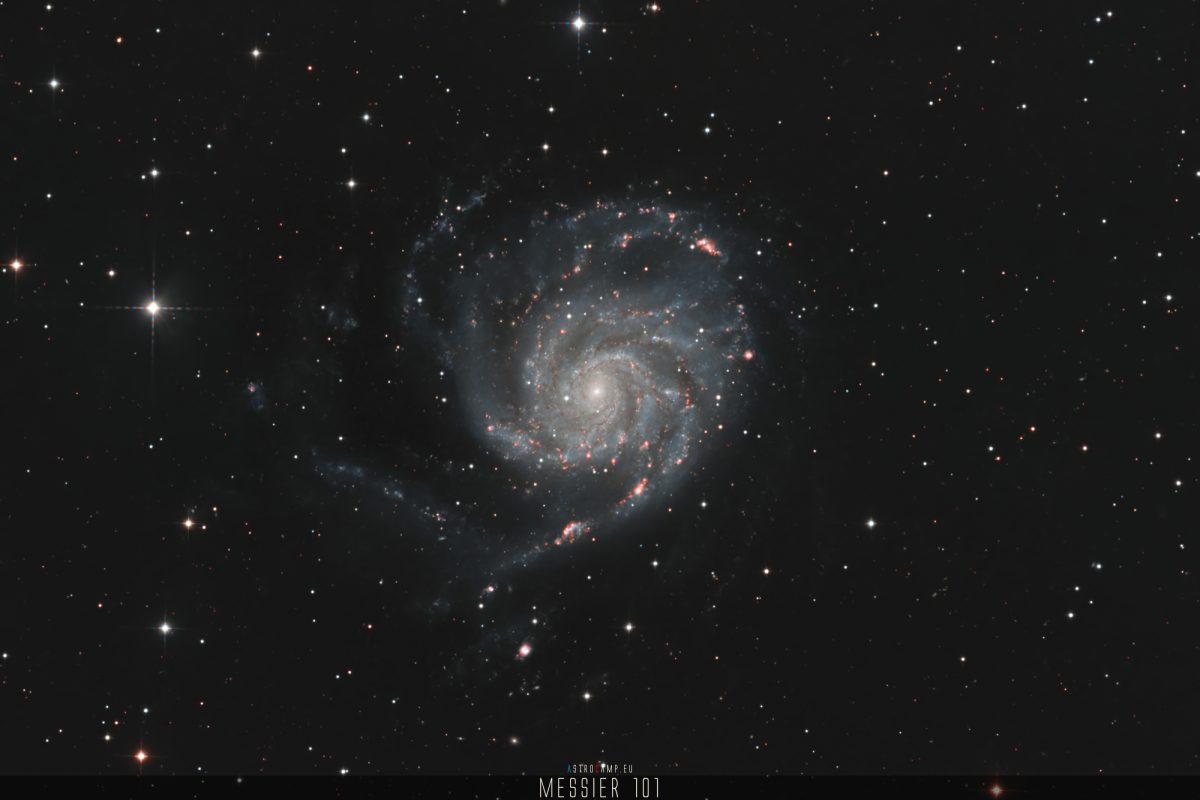
The Pinwheel Galaxy, also cataloged as Messier 101 and NGC 5457, is a sprawling face-on spiral that presents one of the most rewarding wide-field targets in the northern sky. With an apparent magnitude of 7.86 and a generous angular size of 22′, it fills the frame beautifully at moderate focal lengths, though its low surface brightness of roughly 23.1 mag/arcsec² means the delicate outer arms demand dark skies and patient integration. Its broad, sweeping spiral structure rewards long exposures that reveal the numerous star-forming knots and HII regions studded along the arms, which respond especially well to hydrogen-alpha filtration. For color imagers, capturing the subtle contrast between the bright core and the faint, extended disk is the central challenge and the ultimate payoff of this classic galaxy.
Names and Catalog numbers
- Pinwheel Galaxy
- M 101 (Messier 101)
- NGC 5457
- UGC 8981
- PGC 50063
- Arp 26
Position and the cosmic neighborhood
The Pinwheel Galaxy sits high in the northern constellation Ursa Major at a right ascension of 14h 03m 12.6s and a declination of +54° 20′ 56″, placing it near the handle of the Big Dipper where it enjoys long, favorable visibility for northern observers. This region of the sky offers a convenient stepping-off point from the familiar Dipper stars, making the galaxy relatively easy to locate for framing and guiding. As an interacting system, Messier 101 is accompanied by several fainter companion galaxies scattered around its disk, and wide-field astrophotographers can often capture these companions in the same frame, adding depth and context to a portrait of this grand spiral.
Nice to Know
- The Pinwheel Galaxy earns its name from its striking, symmetric spiral arms seen nearly face-on, a geometry that makes it a showcase target for revealing full spiral structure.
- It is classified as an interacting galaxy (Arp 26), and gravitational encounters with its companions have subtly distorted its disk — a feature that deep imaging can help bring out.
- Spanning roughly 139,000 light-years across, it is one of the larger spiral galaxies within reach of amateur telescopes, offering plenty of detail to resolve.
- Its numerous bright star-forming regions along the arms respond strongly to hydrogen-alpha imaging, allowing photographers to emphasize the glowing nebulae that trace ongoing stellar birth.
Brightness, distance and size
The object has an apparent magnitude of 7.9 mag, it lies about 21.9 million light-years from Earth and spans roughly 139,000 light-years across. On the sky it appears about 22′ in size.