

5 sessions. Actually there were 6, but the second-to-last of these sessions, in which I wanted to test Narrowband-O, didn’t work due to a technical misunderstanding, or rather was manually aborted by me.
Messier 101, the Pinwheel Galaxy, had been a long-sought target with my new cooled system. There were 3 imaging sessions with the UHC filter on the RGB sensor and 2 additional sessions with my new ultra-narrowband H-alpha filter. The first light, so to speak, of this accessory.
The imaging experiences with narrowband and ultra-narrowband filters deserve a separate account in a future article.
Overall, I was incredibly delighted by this unusually long stretch of good weather and was able to make excellent use of it.
I think this fifth photo of the Pinwheel Galaxy by me definitely has the greatest depth and quality.
High resolution on Astrobin:
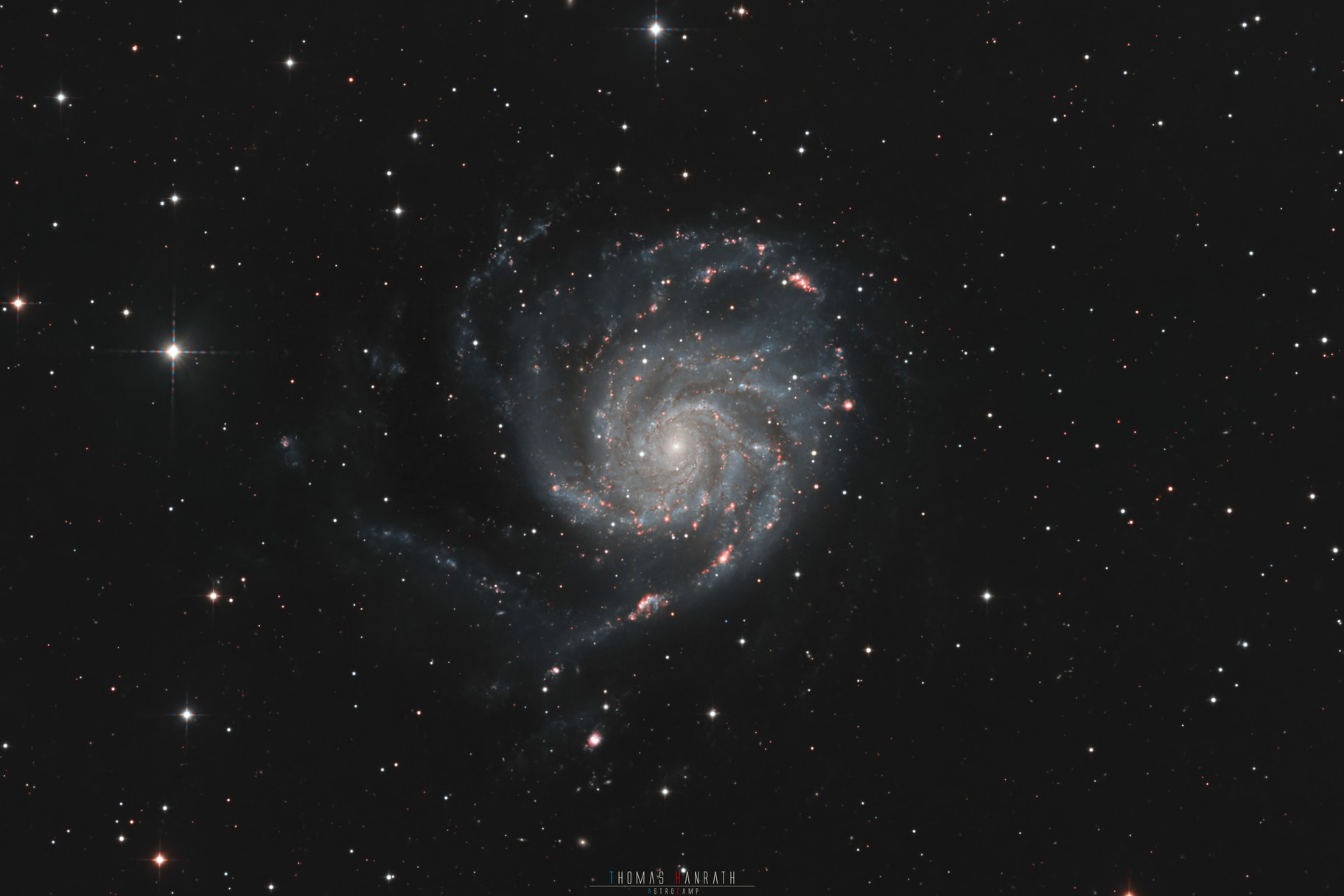
The annotated image:

Session details
| Telescope | Vixen VC200L |
|---|---|
| Corrector | intern |
| Effective focal length | 1800 mm |
| Camera | SkyEye24AC SkyEye62AM |
| Filters | Baader UHC-L CMOS Optimized 50,4mm Baader H CMOS Optimized 50.4mm Baader O CMOS Optimized 50.4mm |
| Mount | Skywatcher HEQ5 Pro Hypertuned |
| Guiding equipment | APM 240mm |
| Guiding camera | QHY 5-III-462C |
| Date of capture | 2026-04-21 2026-04-22 2026-04-23 2026-04-24 2026-04-25 2026-04-26 |
| Nights | 6 |
| Exposure (lights) | UHC: 165 × 300 s Ha: 95 × 300 s OIII: 5 × 300 s |
| Total integration | 22 h 5 min |
| Calibration frames | FLATS, DARKS |
| Sensitivity | GAIN 100, Offset 125 |
| Capture setup | StellaVita |
| Processing date | 2026-05-07 |
| Software stack | PixInsight, Affinity Photo |
| Location | Koblenz |
| Focal ratio | f/9,0 |
| Image scale | 0,68 ″/px |
| Field of view | 68,7 × 45,8 ′ |


