
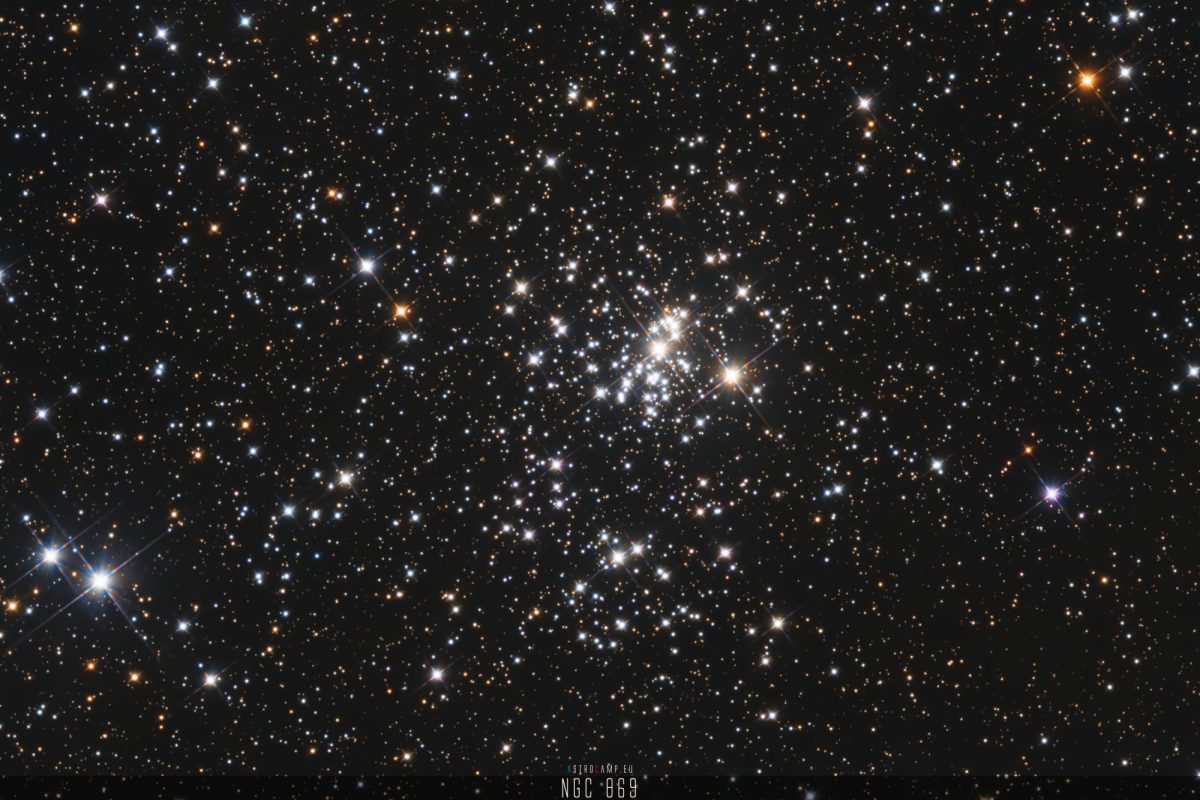
The h Persei Cluster, catalogued as NGC 869, is a brilliant open star cluster in Perseus that rewards both wide-field and moderate-focal-length astrophotography. Spanning about 16′ on the sky and roughly 33 light-years across, it presents a dense swarm of hot, luminous stars that render as crisp, color-rich points in well-focused exposures. Because its stars are intrinsically bright, relatively short sub-exposures are enough to capture them, while longer integration brings out the fainter background members and subtle star colors ranging from icy blue to warm gold. Careful attention to star-sizing and gentle stretching is key, as over-processing can quickly bloat the brightest members and wash out the cluster’s natural sparkle.
Names, key data and data sources
All values come from the astronomical database SIMBAD (CDS Strasbourg). Tap a row to see where the value comes from.
Namesh Persei ClusterAstrocamp
Catalogue numbersNGC 869 · Mel 13 (Melotte 13) · Cr 24 (Collinder 24)Primary designation: NGC 869SIMBAD
TypeOpen ClusterSIMBAD
ConstellationPerseus (Per)computed
Position (J2000)RA 02h 18m 58s · Dec +57° 08′ 2″SIMBAD
Galactic coordinatesl = 134.6° · b = −3.7°Position relative to the Milky Way plane: 4° south of itcomputed
Cosmic neighbourhoodPart of: Persei Double Cluster (C 14)Astrocamp
Apparent size16′SIMBAD
Orientation0°Position angle of the major axis, measured from north through eastSIMBAD
Distance7,000 light-years2.1 kpcSIMBAD
Diameter33 light-yearscomputed
Blueshiftz = −0.00021−62 km/s: approaching usSIMBAD
Sources and methods (12)
- Names: Names from the Astrocamp object database.
- Catalogue numbers: All identifiers under which SIMBAD lists the object; order according to the Astrocamp catalogue rule.
- Type: Entry in SIMBAD, object type “OpC”. Value since Aug 30, 2026 · last confirmed with SIMBAD Oct 20, 2026
- Constellation: Computed from the position (IAU constellation boundaries). Value since Aug 30, 2026 · last confirmed with SIMBAD Oct 20, 2026
- Position (J2000): Entry in SIMBAD, quality E (SIMBAD scale A–E). Publication: 2021A&A...647A..19T (NASA ADS). Value since Aug 30, 2026 · last confirmed with SIMBAD Oct 20, 2026
- Galactic coordinates: Converted from the position (IAU 1958 galactic system). Publication: 2021A&A...647A..19T (NASA ADS). Value since Aug 30, 2026 · last confirmed with SIMBAD Oct 20, 2026
- Cosmic neighbourhood: Editorial links in the Astrocamp object database (parent structure, associated objects, members).
- Apparent size: One catalogue value, measured in visible light, quality D (SIMBAD scale A–E). Publication: 2020A&A...633A..99C (NASA ADS). Value since Aug 30, 2026 · last confirmed with SIMBAD Oct 20, 2026
- Orientation: One catalogue value, measured in visible light, quality D (SIMBAD scale A–E). Publication: 2020A&A...633A..99C (NASA ADS). Value since Oct 20, 2026 · last confirmed with SIMBAD Oct 20, 2026
- Distance: Median of all 4 measurements listed in SIMBAD (methods: paral 2, ST-L 1), middle half 6,800 light-years – 7,200 light-years, full range 6,800 light-years – 7,300 light-years, rounded according to the scatter. Value since Oct 20, 2026 · last confirmed with SIMBAD Oct 20, 2026
- Diameter: Computed from the major axis and the distance; takes the weaker rating of the two values.
- Blueshift: One catalogue value, error ± 1.2 km/s, quality B (SIMBAD scale A–E). Publication: 2023A&A...674A..37G (NASA ADS). Value since Aug 30, 2026 · last confirmed with SIMBAD Oct 20, 2026
Checked against SIMBAD on Oct 20, 2026 · Open NGC 869 in SIMBAD
Position and the cosmic neighborhood
Located in the northern constellation Perseus at right ascension 02h 18m 57.8s and declination +57° 08′ 02″, the h Persei Cluster sits high in the autumn sky for northern observers and is a classic circumpolar-season target. It forms one half of the celebrated Persei Double Cluster (catalogued as C 14), of which it is a member, sharing the field with its companion cluster in a pairing that is among the finest wide-field sights in the entire sky. The two clusters together make an ideal single-frame composition for cameras with a generous field of view, set against the rich stellar backdrop of the Perseus spiral arm. This bright, easily located region is a favorite for both visual sweeps with binoculars and photographic work under moderately dark skies.
Click marks an object (its path tonight) · click again for its constellation, once more to zoom to its field · click a frame to see it, again to zoom · its name shows details · click outside zooms out · drag to pan
Nice to Know
- The h Persei Cluster is one of the two components of the famous Persei Double Cluster, making it a natural partner for stunning two-cluster astrophotos.
- At a distance of about 7,000 light-years, its light left the cluster thousands of years ago, yet it remains bright enough to frame beautifully in short, achievable exposures.
- With a physical diameter of about 33 light-years packed into an apparent span of 16′, it is a compact, densely populated field ideal for showcasing star color.
- It carries several catalog designations, including NGC 869, Collinder 24, and Melotte 13, reflecting its long-standing popularity among observers and astrophotographers.
