



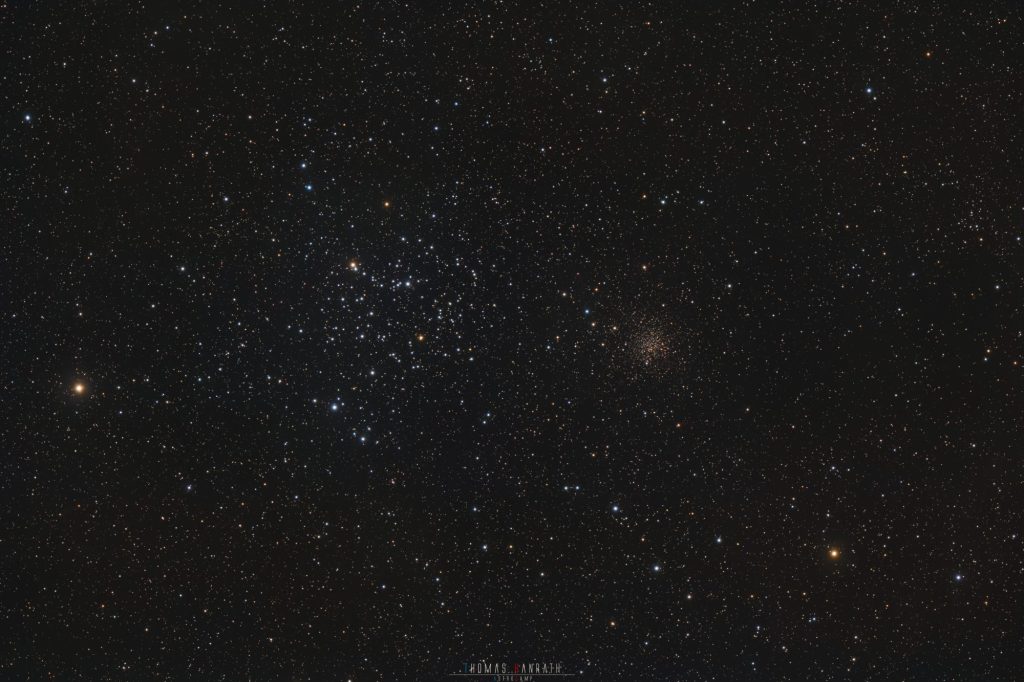
NGC 2158 is a compact, richly populated open cluster in Gemini that rewards imagers with a dense, globular-like concentration of faint stars packed into a small angular footprint. With an angular size of just 5.3′, it demands a long focal length and good seeing to resolve its myriad members cleanly rather than blending them into a soft glow. Its distant location around 14,000 light-years means the cluster is intrinsically faint and relatively uniform in color, so careful exposure stacking and gentle contrast work bring out its texture without overwhelming the surrounding star field. Framed alongside the far brighter and looser Messier 35, NGC 2158 makes for a striking wide-to-medium-field astrophotography target that contrasts two very different open clusters in a single view.
Names, key data and data sources
All values come from the astronomical database SIMBAD (CDS Strasbourg). Tap a row to see where the value comes from.
Catalogue numbersNGC 2158 · Mel 40 (Melotte 40)Primary designation: NGC 2158SIMBAD
TypeOpen ClusterSIMBAD
ConstellationGemini (Gem)computed
Position (J2000)RA 06h 07m 27s · Dec +24° 05′ 56″SIMBAD
Galactic coordinatesl = 186.6° · b = 1.8°Position relative to the Milky Way plane: 2° north of itcomputed
Apparent size5.3′SIMBAD
Orientation0°Position angle of the major axis, measured from north through eastSIMBAD
Distance14,000 light-years4.3 kpcSIMBAD
Diameter22 light-yearscomputed
Redshiftz = 0.000091+27 km/s: receding from usSIMBAD
Sources and methods (10)
- Catalogue numbers: All identifiers under which SIMBAD lists the object; order according to the Astrocamp catalogue rule.
- Type: Entry in SIMBAD, object type “OpC”. Value since Jul 4, 2026 · last confirmed with SIMBAD Oct 20, 2026
- Constellation: Computed from the position (IAU constellation boundaries). Value since Jul 4, 2026 · last confirmed with SIMBAD Oct 20, 2026
- Position (J2000): Entry in SIMBAD, quality E (SIMBAD scale A–E). Publication: 2021A&A...647A..19T (NASA ADS). Value since Jul 4, 2026 · last confirmed with SIMBAD Oct 20, 2026
- Galactic coordinates: Converted from the position (IAU 1958 galactic system). Publication: 2021A&A...647A..19T (NASA ADS). Value since Jul 4, 2026 · last confirmed with SIMBAD Oct 20, 2026
- Apparent size: One catalogue value, measured in visible light, quality D (SIMBAD scale A–E). Publication: 2020A&A...633A..99C (NASA ADS). Value since Jul 4, 2026 · last confirmed with SIMBAD Oct 20, 2026
- Orientation: One catalogue value, measured in visible light, quality D (SIMBAD scale A–E). Publication: 2020A&A...633A..99C (NASA ADS). Value since Oct 20, 2026 · last confirmed with SIMBAD Oct 20, 2026
- Distance: Median of all 7 measurements listed in SIMBAD (methods: paral 2, ST-L 1), middle half 14,000 light-years – 15,000 light-years, full range 13,000 light-years – 28,000 light-years, 1 measurement(s) deviate by more than a factor of 1.5, rounded according to the scatter. Value since Oct 19, 2026 · last confirmed with SIMBAD Oct 20, 2026
- Diameter: Computed from the major axis and the distance; takes the weaker rating of the two values.
- Redshift: One catalogue value, error ± 0.2 km/s, quality A (SIMBAD scale A–E). Publication: 2021A&A...647A..19T (NASA ADS). Value since Jul 4, 2026 · last confirmed with SIMBAD Oct 20, 2026
Checked against SIMBAD on Oct 20, 2026 · Open NGC 2158 in SIMBAD
Position and the cosmic neighborhood
NGC 2158 sits in the constellation Gemini at a right ascension of 06h 07m 26.9s and a declination of +24° 05′ 56″, placing it in a star-rich stretch of the winter Milky Way. Its most famous neighbor is the large, bright open cluster Messier 35, which lies nearby in the sky and offers imagers an irresistible opportunity to capture both clusters together in a single frame. Because NGC 2158 is far more distant than Messier 35, the two appear dramatically different in scale and density, creating a natural comparison of cosmic depth within one field. This region of Gemini rides high overhead for northern observers during the winter months, making it a comfortable and well-placed subject for long imaging sessions.
Click marks an object (its path tonight) · click again for its constellation, once more to zoom · its name shows details · click outside zooms out · drag to pan
Nice to Know
- At a distance of around 14,000 light-years — the median of 7 published measurements — NGC 2158 is one of the more remote open clusters commonly targeted by astrophotographers.
- Despite spanning about 22 light-years across, its great distance compresses the cluster into an angular size of only 5.3′, giving it a dense, almost globular-cluster appearance.
- Its proximity on the sky to the far larger Messier 35 makes it a favorite for side-by-side framing that showcases two contrasting open clusters at once.
- The cluster carries the catalog designations Mel 40 and NGC 2158, both of which identify this same tight stellar grouping in Gemini.
 Mastodon-Feed
Possibly best know to visual astronomers as being right next to M35. They fit in the same wide-field eyepiece. M35 is at the top of this image, 2156 is at bottom. 3 minutes on a #Seestar S50 🔭
In
That open cluster should have been where my spark of consciousness came into being. Stuck here a spur off a spiral arm – not even on a spiral arm – 😮💨