


 2 posts · ♥ 87 · ↻ 10 in total
 2 posts · ♥ 22 · ↻ 1 in total
Messier 3, also cataloged as NGC 5272, is one of the showpiece globular clusters of the northern sky and a rewarding target for astrophotographers of all experience levels. Shining at magnitude 6.39 and spanning an angular size of 16′, it presents a dense, bright core surrounded by a rich halo of stars that resolves beautifully with moderate to long focal lengths. Its high surface brightness of 21.0661 mag/arcsec² means relatively short sub-exposures can capture the cluster, though longer integration brings out the fainter outer members and subtle color differences among the stars. For best results, pair the cluster with a telescope offering good resolution and keep exposures balanced to avoid blowing out the brilliant central region.
Names, key data and data sources
All values come from the astronomical database SIMBAD (CDS Strasbourg). Tap a row to see where the value comes from.
Catalogue numbersM 3 (Messier 3) · NGC 5272 · Mel 119 (Melotte 119)Primary designation: M 3SIMBAD
TypeGlobular ClusterSIMBAD
ConstellationCanes Venatici (CVn)computed
Position (J2000)RA 13h 42m 12s · Dec +28° 22′ 38″SIMBAD
Galactic coordinatesl = 42.2° · b = 78.7°Position relative to the Milky Way plane: 79° north of itcomputed
Brightness6.4 magBand V (visual)SIMBAD
Apparent size16′SIMBAD
Orientation90°Position angle of the major axis, measured from north through eastSIMBAD
Distance≈ 33,000 light-years10 kpcSIMBAD
Diameter≈ 150 light-yearscomputed
Blueshiftz = −0.00049−147 km/s: approaching usSIMBAD
Sources and methods (11)
- Catalogue numbers: All identifiers under which SIMBAD lists the object; order according to the Astrocamp catalogue rule.
- Type: Entry in SIMBAD, object type “GlC”. Value since Jul 4, 2026 · last confirmed with SIMBAD Oct 20, 2026
- Constellation: Computed from the position (IAU constellation boundaries). Value since Jul 4, 2026 · last confirmed with SIMBAD Oct 20, 2026
- Position (J2000): Entry in SIMBAD, quality D (SIMBAD scale A–E). Publication: 2010AJ....140.1830G (NASA ADS). Value since Jul 4, 2026 · last confirmed with SIMBAD Oct 20, 2026
- Galactic coordinates: Converted from the position (IAU 1958 galactic system). Publication: 2010AJ....140.1830G (NASA ADS). Value since Jul 4, 2026 · last confirmed with SIMBAD Oct 20, 2026
- Brightness: One catalogue value, band V, quality D (SIMBAD scale A–E). Publication: 2012AJ....144..126D (NASA ADS). Value since Jul 4, 2026 · last confirmed with SIMBAD Oct 20, 2026
- Apparent size: One catalogue value, measured in visible light, quality D (SIMBAD scale A–E). Publication: 1989Sci...246.1066D (NASA ADS). Value since Jul 4, 2026 · last confirmed with SIMBAD Oct 20, 2026
- Orientation: One catalogue value, measured in visible light, quality D (SIMBAD scale A–E). Publication: 1989Sci...246.1066D (NASA ADS). Value since Oct 20, 2026 · last confirmed with SIMBAD Oct 20, 2026
- Distance: One published measurement, rounded according to the scatter. Publication: 2008MNRAS.389.1924F (NASA ADS). Value since Jul 4, 2026 · last confirmed with SIMBAD Oct 20, 2026
- Diameter: Computed from the major axis and the distance; takes the weaker rating of the two values.
- Blueshift: One catalogue value, error ± 0.2 km/s, quality A (SIMBAD scale A–E). Publication: 2018MNRAS.478.1520B (NASA ADS). Value since Jul 4, 2026 · last confirmed with SIMBAD Oct 20, 2026
Checked against SIMBAD on Oct 20, 2026 · Open M 3 in SIMBAD
Position and the cosmic neighborhood
Messier 3 lies in the constellation Canes Venatici, near the border with Boötes, at a position of RA 13h 42m and Dec +28° 23′. This places it high in the spring night sky for northern observers, well away from the dense star fields of the Milky Way, which gives it a clean, dark background that works to the advantage of astrophotographers. Its elevated declination means it rides high overhead during spring evenings, minimizing atmospheric distortion and making it an easy, satisfying subject for extended imaging sessions.
Click marks an object (its path tonight) · click again for its constellation, once more to zoom · its name shows details · click outside zooms out · drag to pan
Nice to Know
- Messier 3 is estimated to span about 150 light-years across, making it one of the larger and more populous globular clusters within reach of amateur telescopes.
- At a distance of about 33,000 light-years, its light has traveled for tens of thousands of years before reaching your camera sensor.
- The cluster carries several catalog designations, including Messier 3, NGC 5272, and Mel 119.
- With an apparent magnitude of 6.39, Messier 3 sits right at the edge of naked-eye visibility under exceptionally dark skies and is a bright, easy target for binoculars and imaging gear alike.

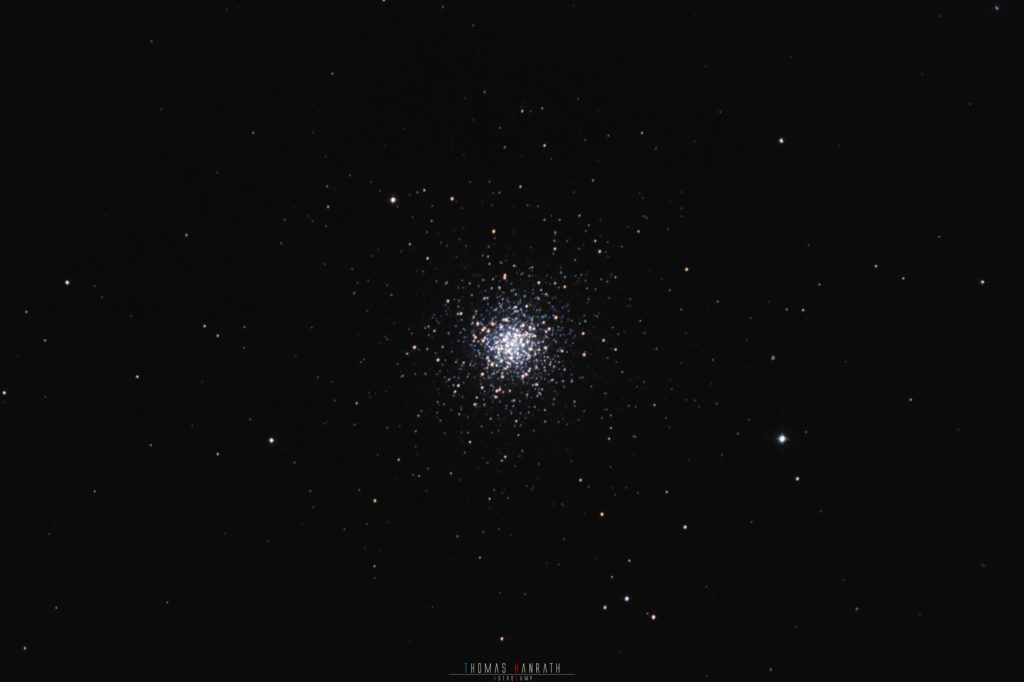
M3 is known for containing many more varisble stars than any other known cluster!
Thanks so much for sharing. How far is it from Orion constellation?