
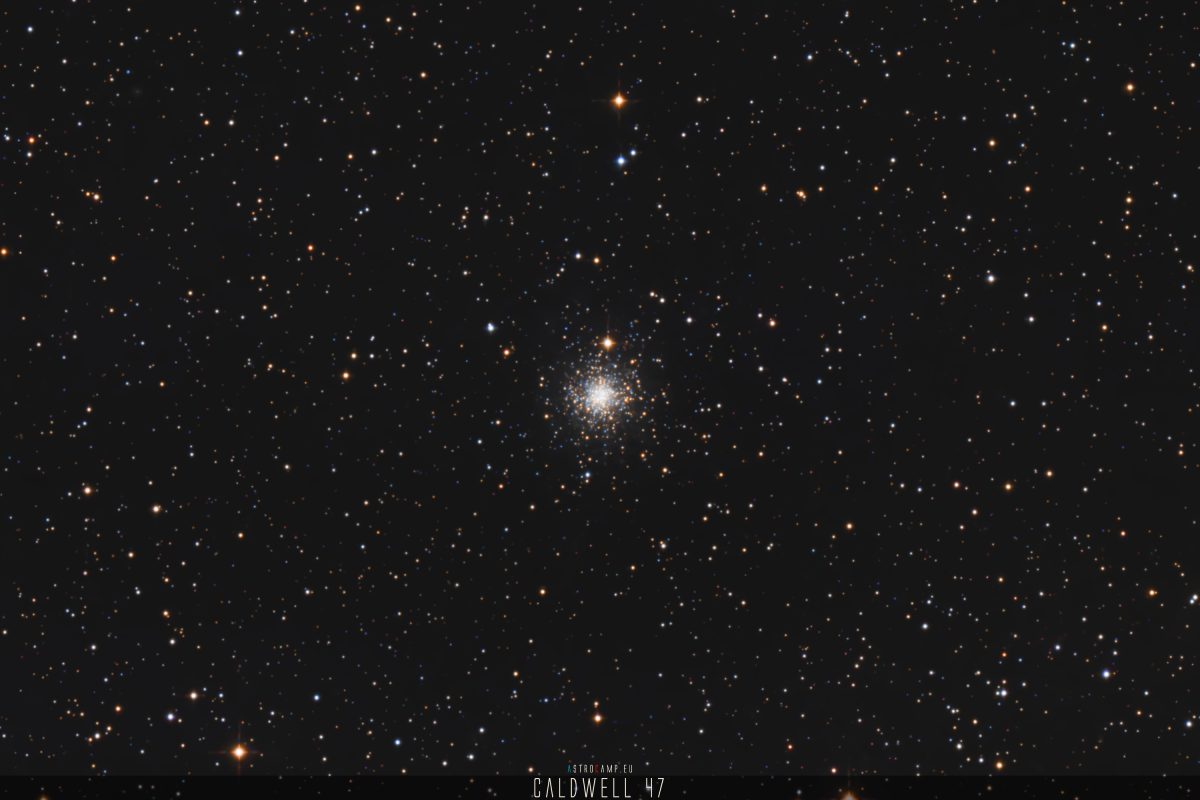
NGC 6934, also cataloged as Caldwell 47, is a compact globular cluster in the small constellation Delphinus that presents a rewarding target for intermediate-focal-length astrophotography. With an angular size of 5.9′, it fits comfortably into most telescope fields and rewards long focal lengths that can resolve its densely packed outer stars into pinpoints. Its bright, condensed core demands careful exposure management to avoid clipping the center while still capturing the fainter halo members. A patient approach with many short-to-moderate subframes and accurate guiding helps deliver clean, well-resolved stellar cores across the entire cluster.
Names and Catalog numbers
- C 47 (Caldwell 47)
- NGC 6934
- Mel 230 (Melotte 230)
Position and the cosmic neighborhood
NGC 6934 sits in the modest constellation Delphinus at right ascension 20h 34m 11s and declination +07° 24′ 16″, a region of the summer Milky Way that is well placed for northern-hemisphere imagers. This part of the sky is not crowded with bright deep-sky showpieces, so the cluster stands out as a concentrated globe of stars set against a relatively sparse stellar backdrop. Delphinus is a compact, easily recognizable star pattern, which makes framing and star-hopping to NGC 6934 straightforward when planning a wide-to-medium field of view. The surrounding starfields provide a pleasing natural border for images centered on this globular cluster.
Nice to Know
- NGC 6934 lies roughly 52,200 light-years away, making it a distant but still resolvable target for well-tracked long-focal-length setups.
- The cluster spans about 90 light-years across, packed into an angular size of only 5.9′ in the sky.
- It carries several designations, including Caldwell 47, Melotte 230 and NGC 6934, reflecting its inclusion in multiple historical catalogs.
- Its measured radial velocity of -406.1 km/s corresponds to a blueshift (z = -0.00135369), indicating the cluster is approaching us.
Brightness, distance and size
It lies about 52,200 light-years from Earth and spans roughly 90 light-years across. On the sky it appears about 5.9′ in size.
