Globular clusters are among the oldest structures in our galaxy. In these densely packed, spherical swarms, hundreds of thousands to millions of stars crowd together in a small space, so dense at the core that even large telescopes struggle to resolve them. They orbit the Milky Way in a vast halo and date back to the early universe. Magnificent examples like the Hercules Cluster, M13, are among the most striking targets of the summer sky. Photographically, the appeal lies in the transition from the bright, compact core to the scattered outer stars – resolving it cleanly without overexposing the centre is the real art. Globular clusters are bright enough for shorter exposures but benefit greatly from good seeing and precise tracking, so the individual stars stay crisp. This page gathers every globular cluster I have photographed so far. Click into any object to learn more about it and see all the astrophoto posts it appears in.
The Intergalactic Wanderer is a globular cluster in the constellation Lynx, lying about 271,000 light-years away, and reaches its annual culmination at astronomical midnight and is best observed mid January ...
C 47 is a globular cluster in the constellation Delphinus, lying about 52,200 light-years away, and reaches its annual culmination at astronomical midnight and is best observed late July ...
M 3 is a bright globular cluster in the constellation Canes Venatici, lying about 32,600 light-years away, and reaches its annual culmination at astronomical midnight and is best observed mid April ...
M 5 is a bright globular cluster in the constellation Serpens, located about 25,400 light-years away, and reaches its annual culmination at astronomical midnight and is best observed early May ...
The Hercules Globular Cluster is a bright globular cluster in the constellation Hercules, lying about 26,100 light-years away, and reaches its annual culmination at astronomical midnight and is best observed early June ...
Messier 15 is a striking globular cluster located in the constellation Pegasus at a distance of approximately 33,600 light years from Earth; it reaches its annual culmination at astronomical midnight and is best observed mid August ...
M 53 is a globular cluster in the constellation Coma Berenices that reaches its annual culmination at astronomical midnight and is best observed early April ...
M 56 is a globular cluster in the constellation Lyra, located about 32,600 light-years away, and reaches its annual culmination at astronomical midnight and is best observed mid July ...
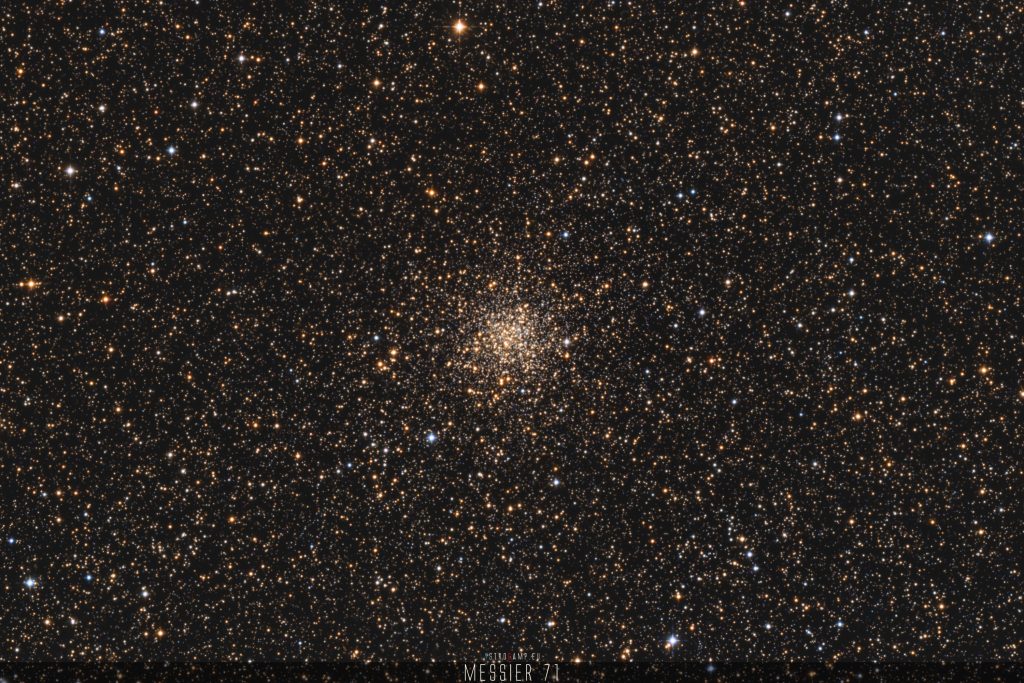
M 71 is a globular cluster in the constellation Sagitta, located roughly 13,000 light-years away, and reaches its annual culmination at astronomical midnight and is best observed late July ...
M 92 is a bright globular cluster in the constellation Hercules, lying about 29,100 light-years away, and reaches its annual culmination at astronomical midnight and is best observed early June ...