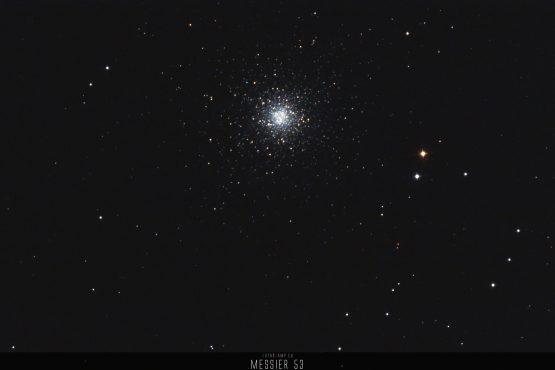
Messier 53 is a dense, spherical collection of hundreds of thousands of ancient stars, making it one of the more massive and distant globular clusters in the Milky Way. Its stars are tightly packed and mostly faint, requiring a telescope to resolve individual members, though the cluster itself can be glimpsed as a hazy patch with binoculars. M53 is a popular target for astrophotographers, especially in spring, due to its compact size and the relative ease of imaging compared to more complex deep-sky objects. The cluster is notable for its unusual population of blue straggler stars and its proximity to another globular cluster, NGC 5053, which can be captured in the same field of view.
Names and Catalog numbers
- Messier 53 (M53)
- NGC 5024
- Melotte 117
Position and the cosmic neighborhood
Messier 53 lies in the constellation Coma Berenices, at Right Ascension 13h 12m 55.3s and Declination +18° 10′ 09″ (J2000), about 2.5 degrees southeast of Diadem, the constellation’s brightest star. To locate it, observers often use the bright star Arcturus in neighboring Bootes as a guide, drawing an imaginary line toward Coma Berenices. The cluster appears as a small, hazy patch in binoculars and is easily resolved with a telescope. Nearby deep-sky objects include the globular cluster NGC 5053 and galaxies such as M64, M85, and M100, making this region rich for astrophotography.
Nice to Know
- Messier 53 is one of the most distant globular clusters in the Milky Way, lying nearly 58,000 light-years from Earth.
- It contains an unusually high number of blue straggler stars, which are thought to form from stellar mergers or close encounters.
- The cluster’s apparent size of 13 arcminutes makes it an excellent target for both small and large telescopes, with the nearby NGC 5053 offering a unique double-cluster imaging opportunity.
- M53 is home to a millisecond pulsar, a rapidly spinning neutron star, adding to its scientific interest.
Brightnes, distance and size
Messier 53 shines at an apparent magnitude of about 7.7 to 8.3, making it visible in binoculars under dark skies but best resolved in telescopes. It is located approximately 58,000 light-years from Earth and spans about 220 light-years in diameter. In the night sky, M53 covers an area of roughly 13 arcminutes, about one third the apparent diameter of the full moon, making it a compact and rewarding subject for astrophotographers, especially with longer focal length instruments.