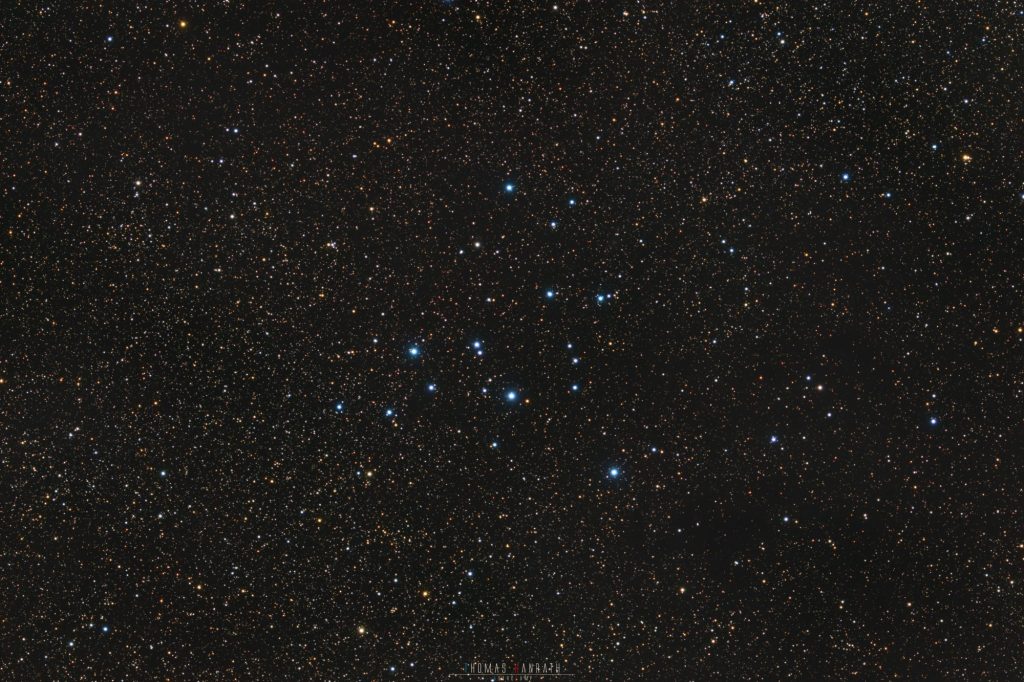
Messier 39, also cataloged as NGC 7092, is a large, loosely scattered open cluster in Cygnus that presents a rewarding target for wide-field astrophotography. Spanning roughly 2.0° (120′) on the sky, it is far too extensive for long focal lengths and instead calls for short refractors, camera lenses, or fast astrographs that can frame the whole grouping comfortably. Because its bright member stars are sparsely spread against the rich Milky Way background of Cygnus, relatively short exposures preserve their colors while still capturing faint field stars. The cluster’s generous angular size and modest star count make it an ideal subject for beginners learning to balance star saturation, framing, and background nebulosity in a busy region of the summer sky.
Names and Catalog numbers
- M 39 (Messier 39)
- NGC 7092
- Mel 236 (Melotte 236)
Position and the cosmic neighborhood
Messier 39 (NGC 7092) lies in the northern reaches of Cygnus at right ascension 21h 31m 33s and declination +48° 14′ 49″, embedded in one of the richest stretches of the summer Milky Way. This part of the sky is dense with star fields, dark dust lanes, and faint nebulosity, so wide-field images of the cluster naturally sweep up a wealth of background detail. Its position high in the northern sky during late summer makes it well placed for observers and imagers across the northern hemisphere, and its brightness lets it stand out even under moderately light-polluted conditions. Sitting some 1,050 light-years from us, it is a relatively nearby cluster, which contributes to its large apparent footprint on the sky.
Nice to Know
- With an angular size of 2.0° (120′), Messier 39 covers roughly four times the diameter of the full Moon, demanding very wide-field optics to frame it fully.
- At a distance of about 1,050 light-years, it is one of the nearer bright open clusters, which explains its large apparent spread across the sky.
- Its true physical diameter measures around 37 light-years, a compact grouping made to appear expansive by its proximity.
- The cluster carries several designations, including Melotte 236, Messier 39, and NGC 7092, reflecting its long history in deep-sky catalogs.
Brightness, distance and size
It lies about 1,050 light-years from Earth and spans roughly 37 light-years across. On the sky it appears about 2.0° (120′) in size.