
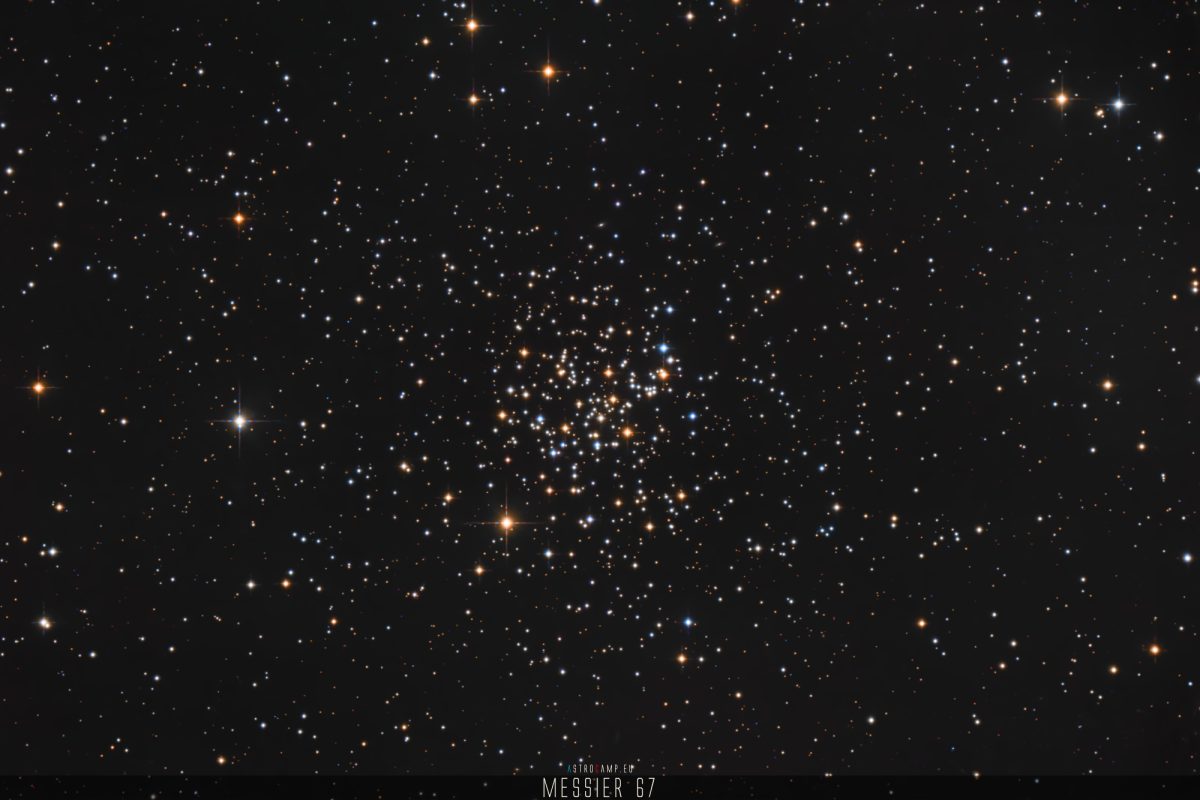
Messier 67, also cataloged as NGC 2682, is a rich open cluster in Cancer that presents a compact, star-dense field spanning roughly 25′ across, an inviting target for medium focal-length astrophotography setups. Its densely packed member stars deliver a pleasing spread of colors, making it rewarding to capture true star hues with careful white balance and moderate exposures that avoid overexposing the brightest members. Because the cluster fits comfortably within the frame of many APO refractors and small reflectors, it suits both wide-field and closer portrait compositions. Spanning about 22 light-years in physical diameter at a distance of some 2,960 light-years, it offers a stable, well-resolved subject that resolves cleanly even under modest seeing conditions.
Names and Catalog numbers
- M 67 (Messier 67)
- NGC 2682
- Mel 94 (Melotte 94)
Position and the cosmic neighborhood
Messier 67 (NGC 2682) sits in the constellation Cancer at a right ascension of 08h 51m 23s and a declination of +11° 48′ 50″, placing it well within reach of northern-hemisphere imagers for much of the winter and early spring. This region of the sky is relatively subdued compared to the brighter surrounding constellations, which helps the cluster stand out against a darker background and simplifies framing without competing bright field stars. Its modest 25′ angular size makes it an easy fit for a range of imaging scales, whether you prefer to isolate the cluster tightly or set it within a broader star field. From a dark site, its position allows long unobstructed imaging runs as it climbs high toward the meridian.
Nice to Know
- Messier 67 carries several designations, including Melotte 94, M 67, and NGC 2682, reflecting its long history of cataloging.
- The cluster measures about 22 light-years across, making it a compact yet well-resolved subject for detailed astrophotography.
- At a distance of roughly 2,960 light-years, it remains bright and clearly defined for imagers using modest apertures.
- With an angular size of 25′, Messier 67 frames neatly for both close portrait and wider-field compositions.
Brightness, distance and size
It lies about 2,960 light-years from Earth and spans roughly 22 light-years across. On the sky it appears about 25′ in size.
