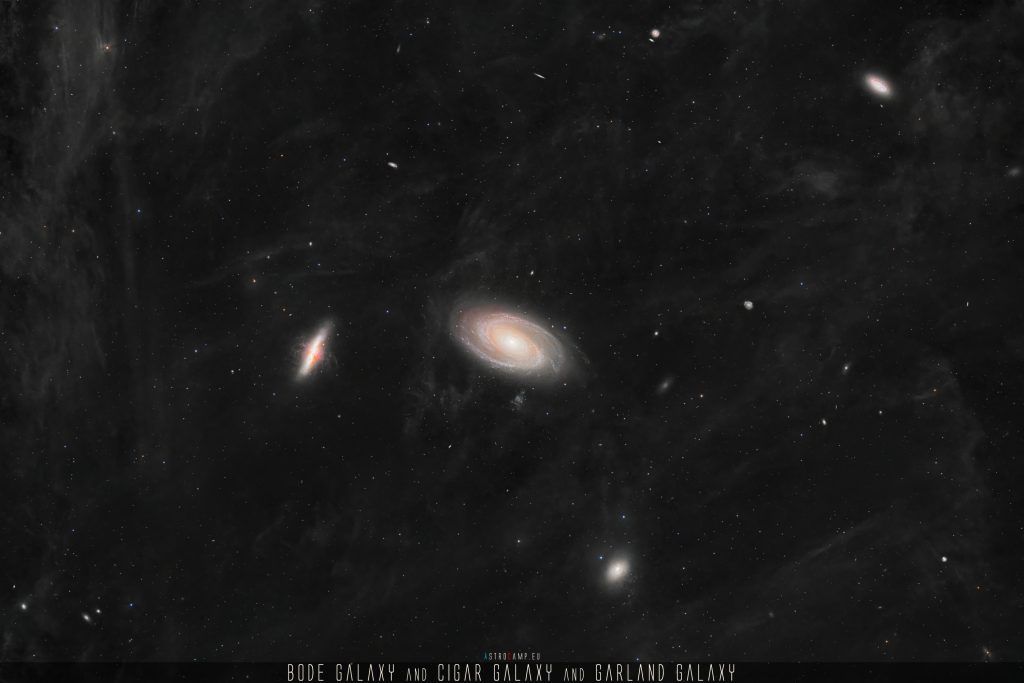
Bode’s Galaxy, also cataloged as Messier 81 and NGC 3031, is a bright spiral galaxy that ranks among the most rewarding deep-sky targets for astrophotographers in the northern sky. Shining at an apparent magnitude of 6.94 and spanning an angular size of 21′ × 10′, it presents a large, well-defined disk that captures beautifully even with modest focal lengths. Its high surface brightness of 21.4 mag/arcsec² makes the sweeping spiral arms and bright core stand out cleanly against the background sky, rewarding careful stretching in post-processing. Long integration times bring out the faint outer arm structure and the delicate dust lanes threading through the galaxy’s disk.
Names and Catalog numbers
- Bode's Galaxy
- M 81 (Messier 81)
- NGC 3031
- UGC 5318
- PGC 28630
Position and the cosmic neighborhood
Bode’s Galaxy sits high in the northern circumpolar region of Ursa Major, at right ascension 09h 55m 33s and declination +69° 03′ 55″, making it accessible for much of the year from mid-northern latitudes. Its far northern declination means it never sets for many observers, offering generous windows for extended imaging sessions. The galaxy shares its field with the nearby edge-on Cigar Galaxy (Messier 82), and the two are close enough to be framed together in a single wide-field composition, a favorite arrangement for astrophotographers looking to combine two contrasting galaxy morphologies in one image.
Nice to Know
- At roughly 13.4 million light-years distant, it is one of the nearer bright spiral galaxies, allowing its structure to be resolved in remarkable detail.
- With a physical diameter of about 83,400 light-years, its grand-design spiral disk fills the frame elegantly at moderate focal lengths.
- Its bright magnitude of 6.94 and high surface brightness make it a forgiving target that shows results even under less-than-ideal skies.
- It pairs naturally with the Cigar Galaxy (Messier 82) in the same field, enabling a striking two-galaxy portrait in a single exposure.
Brightness, distance and size
The object has an apparent magnitude of 6.9 mag, it lies about 13.4 million light-years from Earth and spans roughly 83,400 light-years across. On the sky it appears about 21′ × 10′ in size.