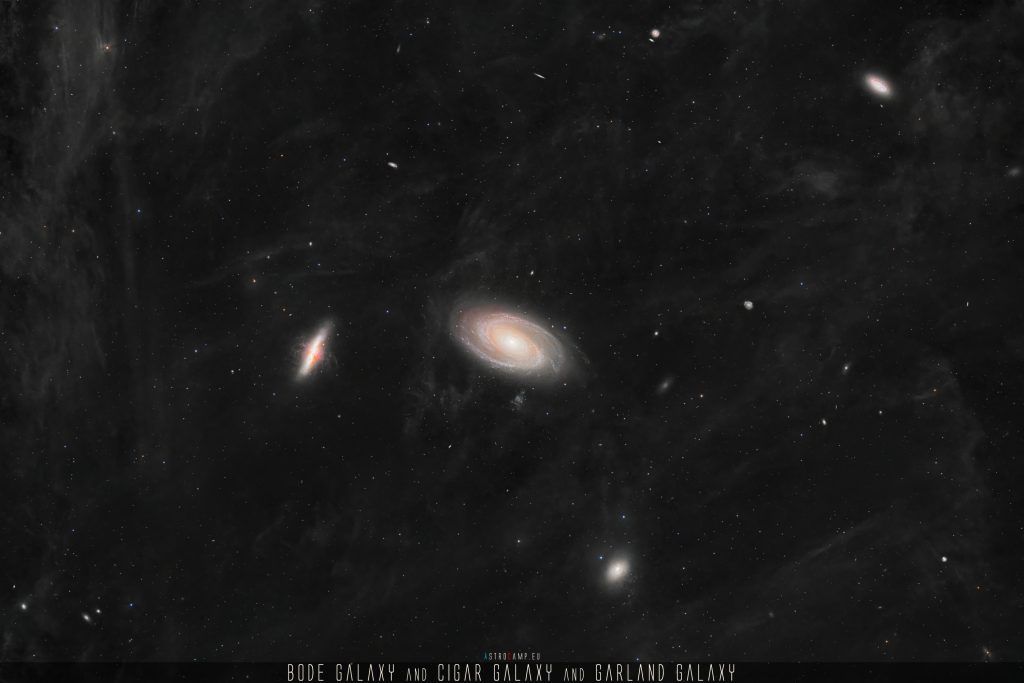
The Cigar Galaxy, also cataloged as Messier 82 and NGC 3034, is a bright edge-on spiral galaxy that presents a striking, elongated silhouette perfectly suited to long-exposure imaging. At an apparent magnitude of 8.41, it is bright enough to be captured with modest apertures, yet it rewards larger instruments with intricate detail along its dusty disk. Its compact, cigar-shaped profile makes it a favorite target for astrophotographers, especially when framed alongside its nearby galactic companion for a compelling wide-field composition. Narrowband and H-alpha imaging can help reveal the dramatic reddish filaments erupting from the galaxy’s central regions, adding vivid color and structure to a finished portrait.
Names and Catalog numbers
- Cigar Galaxy
- M 82 (Messier 82)
- NGC 3034
- UGC 5322
- PGC 28655
- Arp 337
Position and the cosmic neighborhood
The Cigar Galaxy lies in the northern constellation Ursa Major at a right ascension of 09h 55m 52.43s and a declination of +69° 40′ 46.9″, placing it high in the circumpolar sky for many northern observers. This favorable, near-polar position keeps it accessible across much of the year and makes it an easy object to locate near the familiar stars of the Big Dipper. It forms one half of a celebrated galactic pair, sharing its patch of sky with the larger spiral Messier 81, so a single wide-field frame can capture both galaxies together for a dramatic two-in-one image.
Nice to Know
- The galaxy carries an unusually rich set of designations, including Messier 82, NGC 3034, and the peculiar-galaxy label Arp 337.
- Its edge-on, elongated shape gives rise to the popular “Cigar Galaxy” nickname, an ideal profile for framing in astrophotography.
- At magnitude 8.41 it is bright enough for small telescopes yet detailed enough to reward long, high-resolution exposures.
- Lying just 15.9 million light-years away, it pairs beautifully with nearby Messier 81 in a single wide-field composition.
Brightness, distance and size
The object has an apparent magnitude of 8.4 mag, it lies about 15.9 million light-years from Earth.