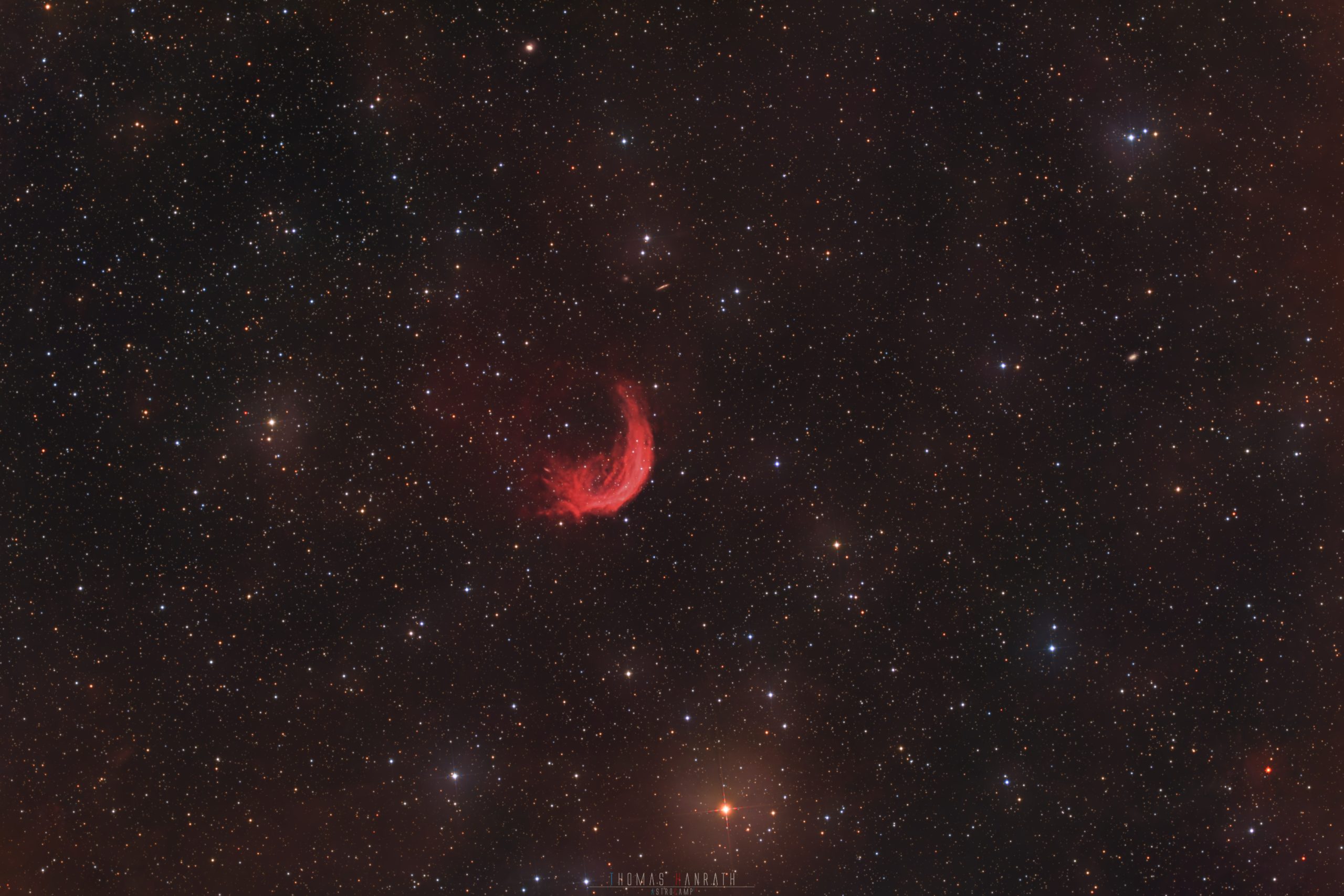
Sharpless 188 (also Simeis 22) is a faint planetary nebula recognized for its asymmetric crescent shape and bright southeastern arc. The nebula formed from a dying star shedding its outer layers, and the gas shell is illuminated by the remaining hot stellar core. The nebula’s appearance is striking in deep astrophotographic images, which reveal a blueish central star and faint, wispy extensions in the opposite direction from the bright arc. Its unique morphology results from the central star’s rapid movement through the interstellar medium and interaction with ambient gas.
Names and Catalog numbers
- Shrimp Nebula
- Sharpless 188 (Sh2-188)
Position and the cosmic neighborhood
Sharpless 188 is situated near the bright star Ruchbah (Delta Cassiopeiae) in Cassiopeia, which makes it accessible for telescope pointing and framing in astrophotography. The area is rich in deep sky nebulae, notably near the Pacman Nebula (NGC 281), creating a vibrant field for imaging wide-field mosaics or combining data with neighboring objects. The nebula stands out in narrowband imaging, where its crescent arc and faint outer ring are made prominent against the dense star field of Cassiopeia.
Nice to Know
- Sharpless 188 displays a striking crescent shape, brighter to the southeast due to the central star’s high velocity through space.
- It is a challenging but rewarding target for astrophotographers, requiring long exposure times and narrowband filters to reveal its faint structure.
- The central star is a hot, blue remnant whose motion shapes the nebula’s asymmetric appearance.
- Sh2-188 is estimated to be an ancient planetary nebula, with much of its material already dissipated into the surrounding interstellar medium.
Brightnes, distance and size
Sharpless 188 has a very faint surface brightness, making it suitable mostly for advanced astrophotographers equipped with sensitive cameras and narrowband filters. The nebula lies about 850 light-years from Earth, spans roughly 2.5 light-years in diameter, and appears about 10 arcminutes across in the sky. High-contrast imaging techniques are essential to capture its delicate and extended emission features.