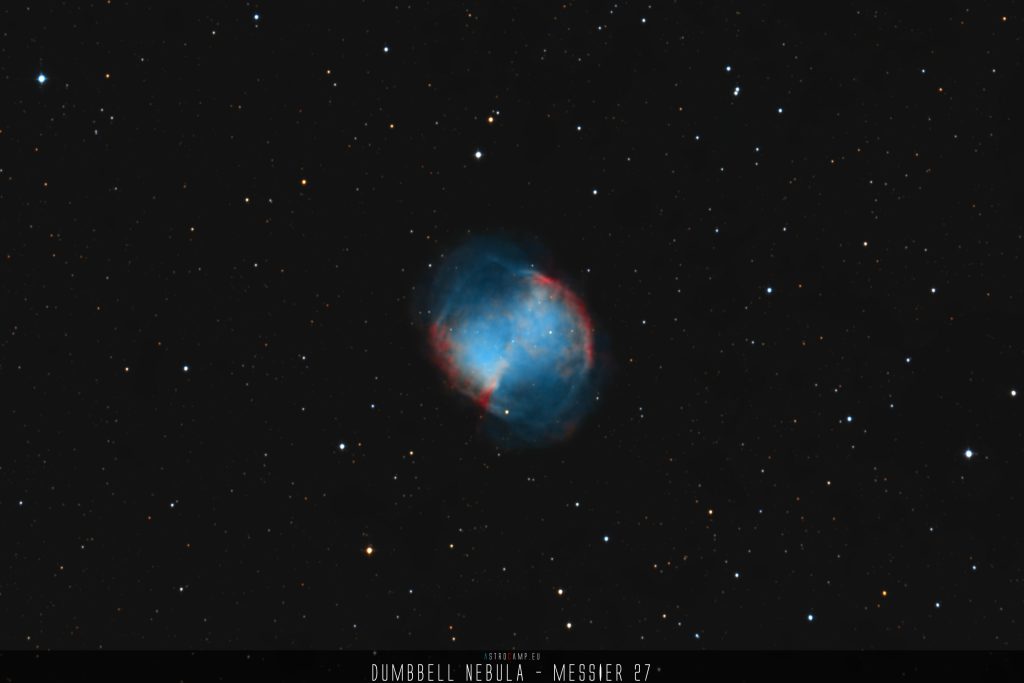
The Dumbbell Nebula, also cataloged as Messier 27 and NGC 6853, is one of the most rewarding planetary nebulae for astrophotographers, offering a generous angular size of 6.7′ that fills the frame nicely even with modest focal lengths. Its bright, symmetric bipolar structure responds beautifully to narrowband imaging, where Hydrogen-alpha and Oxygen-III filters reveal the characteristic hourglass core wrapped in fainter outer halo shells. Broadband RGB capture brings out the striking teal and salmon tones of the ionized gas, making it an ideal target for both beginners and seasoned imagers. Because the nebula is relatively bright while spread across a large area, exposures balance easily to preserve the delicate outer envelope without blowing out the intense central lobes.
Names and Catalog numbers
- Dumbbell Nebula
- M 27 (Messier 27)
- NGC 6853
- PK 060-03.1
- PN G060.8-03.6
Position and the cosmic neighborhood
The Dumbbell Nebula sits within the small constellation Vulpecula at a right ascension of 19h 59m 36.4s and a declination of +22° 43′ 16″, placing it in a rich stretch of the summer Milky Way. This region of sky is dense with star fields, offering imagers a colorful, mottled backdrop that frames the nebula against countless faint suns. Its northerly declination makes it comfortably accessible from mid-northern latitudes, where it climbs high overhead during the warmer months. The surrounding stellar neighborhood provides ample bright guide stars, simplifying framing, focusing, and autoguiding for long imaging sessions.
Nice to Know
- The Dumbbell Nebula, Messier 27 or NGC 6853, spans a physical diameter of roughly 2 light-years, an expanding shell of gas cast off by its dying central star.
- At an apparent magnitude of 14.089 mag it is remarkably photogenic, and its large 6.7′ angular size makes it one of the easiest planetary nebulae to resolve in detail.
- Lying only about 861 light-years away, it is among the closest and brightest planetary nebulae, allowing rich structure to be recorded even with short focal lengths.
- It carries a negative radial velocity of -42 km/s, corresponding to a redshift of z = -0.000140087, indicating it is approaching us.
Brightness, distance and size
The object has an apparent magnitude of 14.1 mag, it lies about 861 light-years from Earth and spans roughly 2 light-years across. On the sky it appears about 6.7′ in size.