
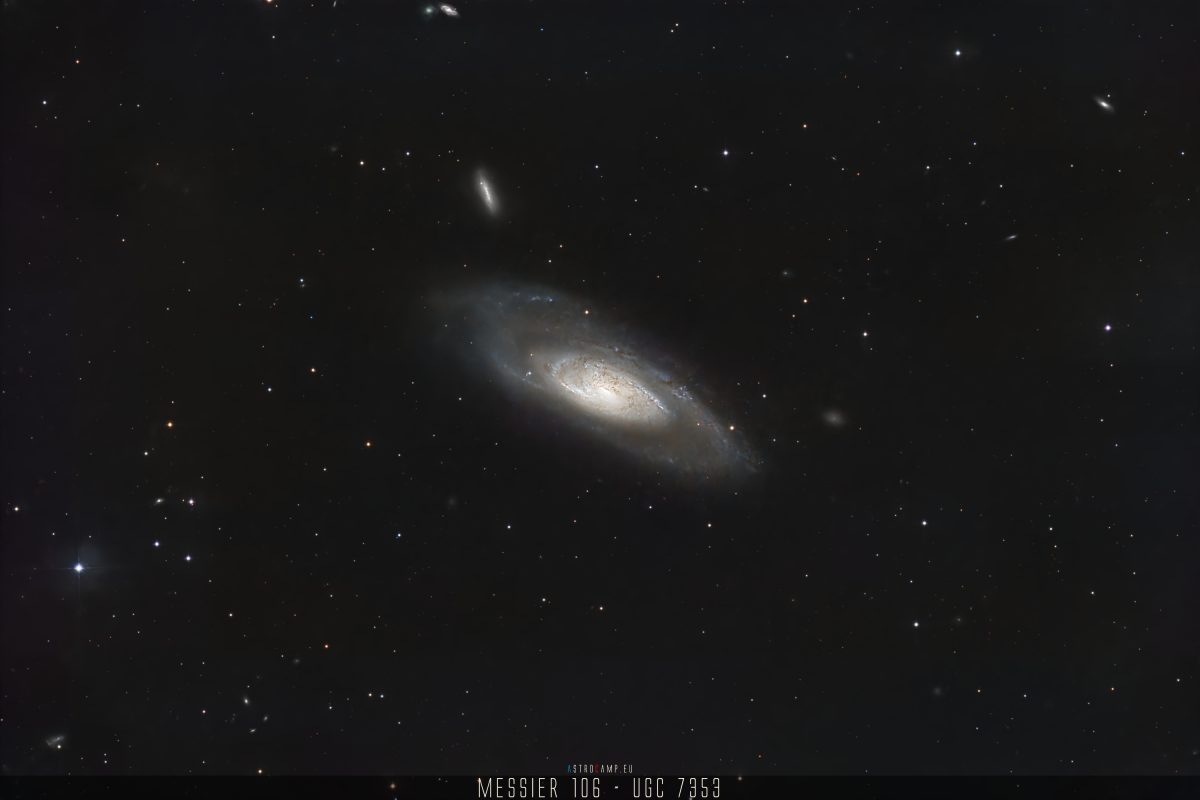
Messier 106, also cataloged as NGC 4258, is a barred spiral galaxy that presents a rewarding target for astrophotographers thanks to its bright core and sprawling spiral structure. Shining at magnitude 8.41 with a surface brightness of about 22.3 mag/arcsec², it is bright enough for modest apertures yet detailed enough to reward long integration times. Spanning 18′ × 6.9′ on the sky, its elongated form fits comfortably within the field of most telescopes and astrographs, allowing you to frame both the luminous central region and the fainter outer arms. Broadband RGB imaging brings out the dusty spiral lanes and the galaxy’s warm nucleus, while patient acquisition under dark skies reveals the subtle halo surrounding this stately island universe.
Names and Catalog numbers
- M 106 (Messier 106)
- NGC 4258
- UGC 7353
- PGC 39600
Position and the cosmic neighborhood
Messier 106 lies in the northern constellation Canes Venatici at right ascension 12h 18m 57.6s and declination +47° 18′ 13″, placing it high in the spring sky for observers in the northern hemisphere. This location near the boundary with Ursa Major keeps it well clear of the dense Milky Way star fields, offering a relatively clean backdrop that favors deep exposures of faint galactic detail. From this vantage the galaxy climbs to a favorable altitude, making it an ideal subject for wide-field and long-focal-length setups alike as it drifts through a region rich in other distant galaxies.
Nice to Know
- Despite its Messier designation as M 106, the galaxy is also widely known by its NGC 4258 catalog number, along with the identifiers PGC 39600 and UGC 7353.
- At a distance of roughly 24.5 million light-years, its light has traveled a great cosmic span before reaching your camera sensor.
- The galaxy stretches about 127,000 light-years across, making it comparable in physical scale to our own Milky Way.
- With an apparent magnitude of 8.41, Messier 106 is a bright and accessible target that rewards even modest astrophotography gear under dark skies.
Brightness, distance and size
The object has an apparent magnitude of 8.4 mag, it lies about 24.5 million light-years from Earth and spans roughly 127,000 light-years across. On the sky it appears about 18′ × 6.9′ in size.
