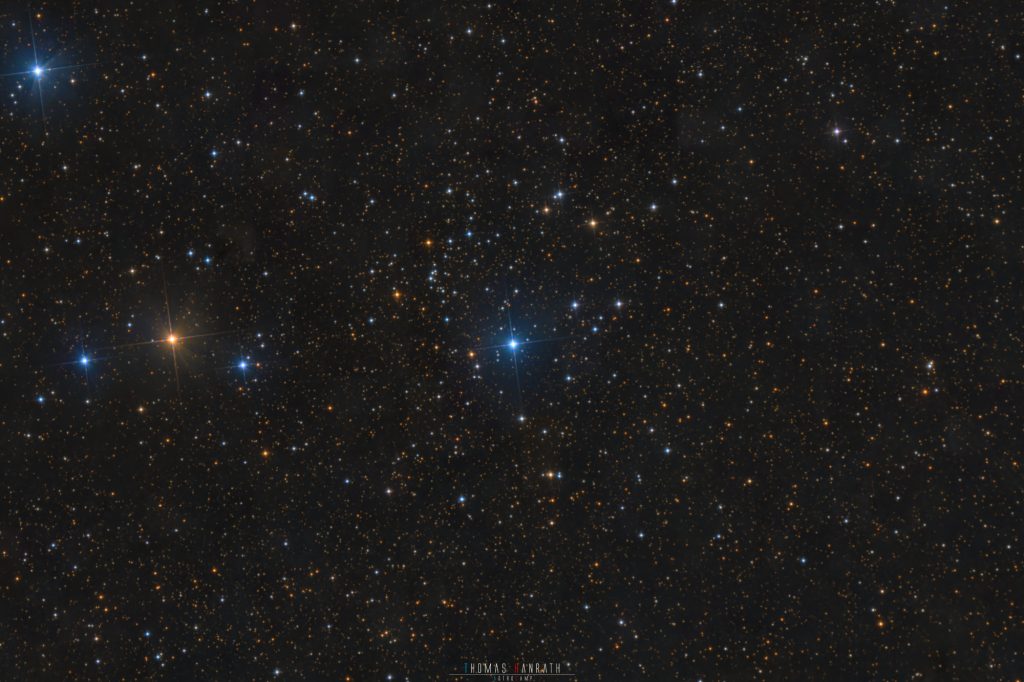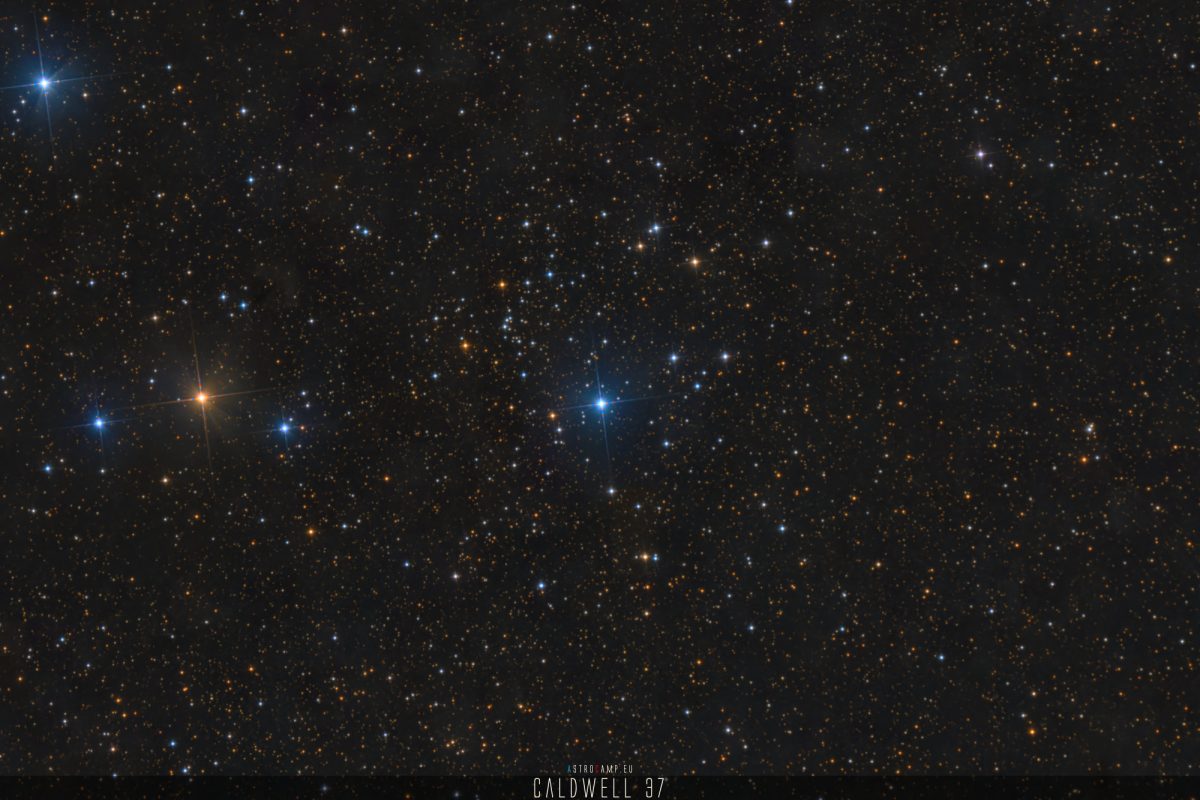
C 37, also cataloged as NGC 6885, is an open star cluster in the constellation Vulpecula that shines at magnitude 8.1, making it a rewarding target for wide-field astrophotography. Spanning roughly 15′ across the sky and around 21 light-years in physical extent, it frames comfortably within short to moderate focal lengths without crowding the sensor. Its relatively bright members reward shorter sub-exposures, so imagers can build depth with many frames while preserving the tighter cores of individual stars. Because it sits within the rich star fields of the summer Milky Way, careful stretching and star-size control help the cluster stand out against the dense stellar backdrop.
Names and Catalog numbers
- C 37 (Caldwell 37)
- NGC 6885
Position and the cosmic neighborhood
C 37 is located in the small but Milky-Way-rich constellation Vulpecula, at a right ascension of 20h 12m and a declination of about +26° 29′. This places the cluster amid the dense, star-strewn fields of the summer Milky Way, offering a busy and colorful backdrop that photographers can use to good effect. The surrounding region is a favorite hunting ground for wide-field imagers, and framing C 37 alongside nearby star fields lets the loose cluster blend into a tapestry of foreground and background suns. At around 4,740 light-years distant, it is comfortably within reach of modest amateur setups from northern-hemisphere skies.
Nice to Know
- C 37 carries the alternative designation NGC 6885, so both catalog names refer to the same open cluster.
- At magnitude 8.1, it is bright enough to be a straightforward target for small telescopes and camera lenses under dark skies.
- Its angular size of 15′ makes it an ideal fit for wide-field and short-focal-length astrophotography.
- With a physical diameter of about 21 light-years at a distance of roughly 4,740 light-years, the cluster is a genuine stellar grouping embedded in the summer Milky Way.
Brightness, distance and size
The object has an apparent magnitude of 8.1 mag, it lies about 4,740 light-years from Earth and spans roughly 21 light-years across. On the sky it appears about 15′ in size.