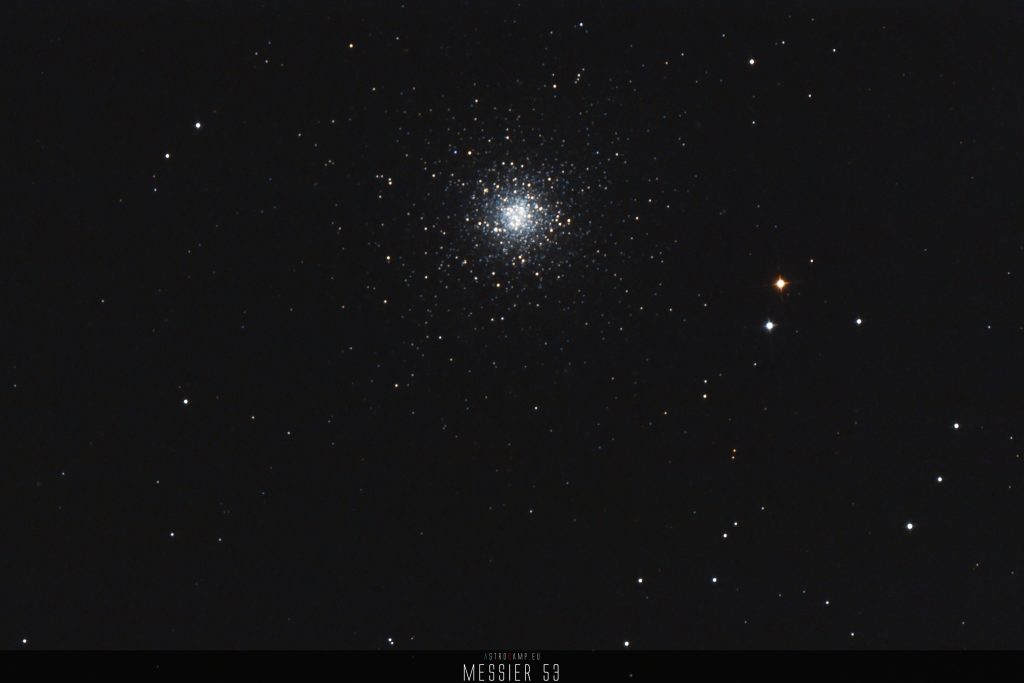
Messier 53, also cataloged as NGC 5024, is a globular cluster in Coma Berenices that shines at an apparent visual magnitude of 7.79, placing it comfortably within reach of small telescopes and modest imaging setups. Its compact angular size of 13′ means that a moderate to long focal length is ideal for resolving the dense swarm of stars into pinpoint detail across the frame. With a fairly even surface brightness of about 21.9 mag/arcsec², the cluster rewards careful exposure control that captures its bright core without clipping while still teasing out the fainter outer halo of stars. For astrophotographers, Messier 53 is a satisfying target where good seeing and accurate focus translate directly into a crisp, well-resolved starball against a dark sky.
Names and Catalog numbers
- M 53 (Messier 53)
- NGC 5024
- Mel 117 (Melotte 117)
Position and the cosmic neighborhood
Messier 53 sits in the constellation Coma Berenices at a right ascension of 13h 12m 55.25s and a declination of +18° 10′ 05.4″, a region of sky far removed from the crowded plane of the Milky Way. This placement means the cluster is framed against a relatively clean, star-poor background, which helps its condensed core and scattered outer members stand out cleanly in an image. The surrounding area of Coma Berenices is best known for its wealth of distant galaxies, so wide-field framing can occasionally catch faint background systems alongside the cluster. Its northern-hemisphere-friendly declination keeps it well positioned for imagers at mid-northern latitudes during spring nights.
Nice to Know
- Messier 53 (NGC 5024) is also listed in the Melotte catalog as Mel 117, a reminder of how frequently studied bright globular clusters accumulate multiple designations.
- At magnitude 7.79 it is bright enough to be spotted in binoculars, making it a rewarding entry-level target that still shows fine detail through longer focal lengths.
- The cluster shows a radial velocity of -63.1 km/s, indicating it is moving toward us, with a corresponding redshift of z = -0.000210457.
- Its compact 13′ angular extent lets it fit comfortably within most imaging fields, so it pairs well with tighter framing that emphasizes the resolved stellar core.
Brightness, distance and size
The object has an apparent magnitude of 7.8 mag. On the sky it appears about 13′ in size.