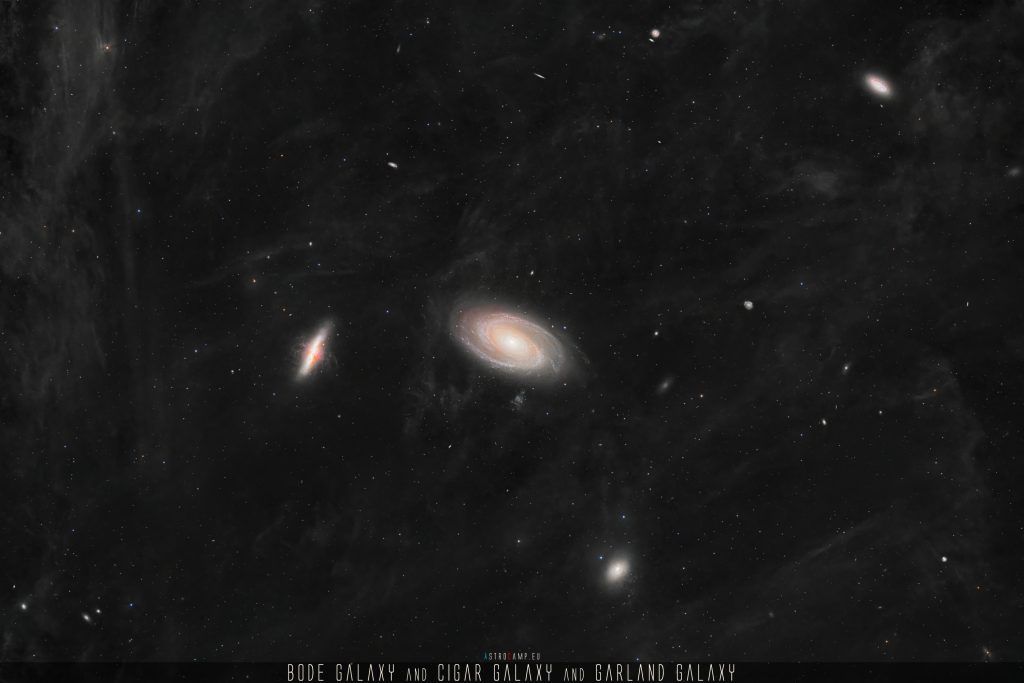
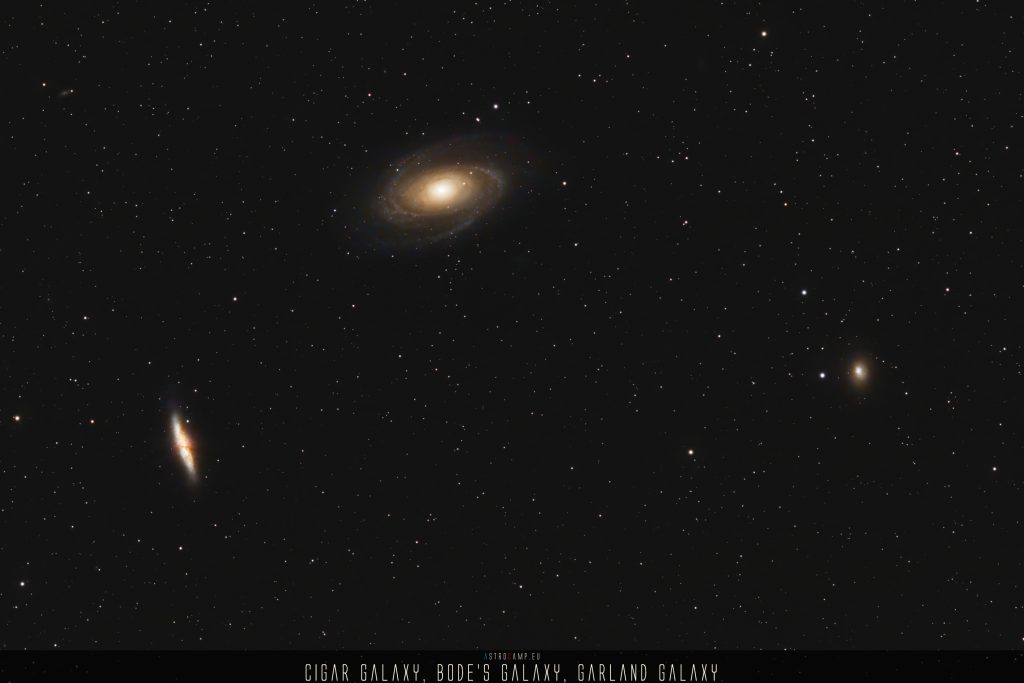
The Garland Galaxy, cataloged as NGC 3077, is a spiral galaxy in Ursa Major that presents a compact, glowing target for deep-sky imagers. At an apparent magnitude of 10.14 and with an angular size of 6.0′ × 4.5′, it fits comfortably within a moderate telephoto or small telescope field and rewards longer exposures that tease out its diffuse outer halo. Its surface brightness of around 22.3 mag/arcsec² means patient integration and dark skies help reveal the faint, disturbed structure surrounding its bright core. Spanning roughly 21,600 light-years across at a distance of about 12.4 million light-years, it makes an excellent companion subject for wide-field mosaics of its galactic surroundings.
Names and Catalog numbers
- Garland Galaxy
- NGC 3077
- UGC 5398
- PGC 29146
Position and the cosmic neighborhood
The Garland Galaxy sits high in the northern sky within Ursa Major, at right ascension 10h 03m 19s and declination +68° 44′, a placement that keeps it well above the horizon for most northern observers throughout the imaging season. NGC 3077 is a member of the nearby M81 group, and its proximity to the far brighter Bode’s Galaxy and Cigar Galaxy makes it a natural inclusion in wide-field frames capturing this rich cluster of interacting island universes. Its northern declination and near-circumpolar visibility give astrophotographers generous windows to gather the many hours of signal this modest galaxy demands.
Nice to Know
- The Garland Galaxy carries multiple catalog identities, including NGC 3077, PGC 29146, and UGC 5398.
- Its compact 6.0′ × 4.5′ angular size makes it an ideal companion object to frame alongside the larger galaxies of the M81 group.
- At roughly 12.4 million light-years away, it spans about 21,600 light-years across, making it a genuinely nearby yet modestly sized target.
- With a surface brightness near 22.3 mag/arcsec², it favors long integration times under dark skies to bring out its subtle, disturbed outer structure.
Brightness, distance and size
The object has an apparent magnitude of 10.1 mag, it lies about 12.4 million light-years from Earth and spans roughly 21,600 light-years across. On the sky it appears about 6.0′ × 4.5′ in size.