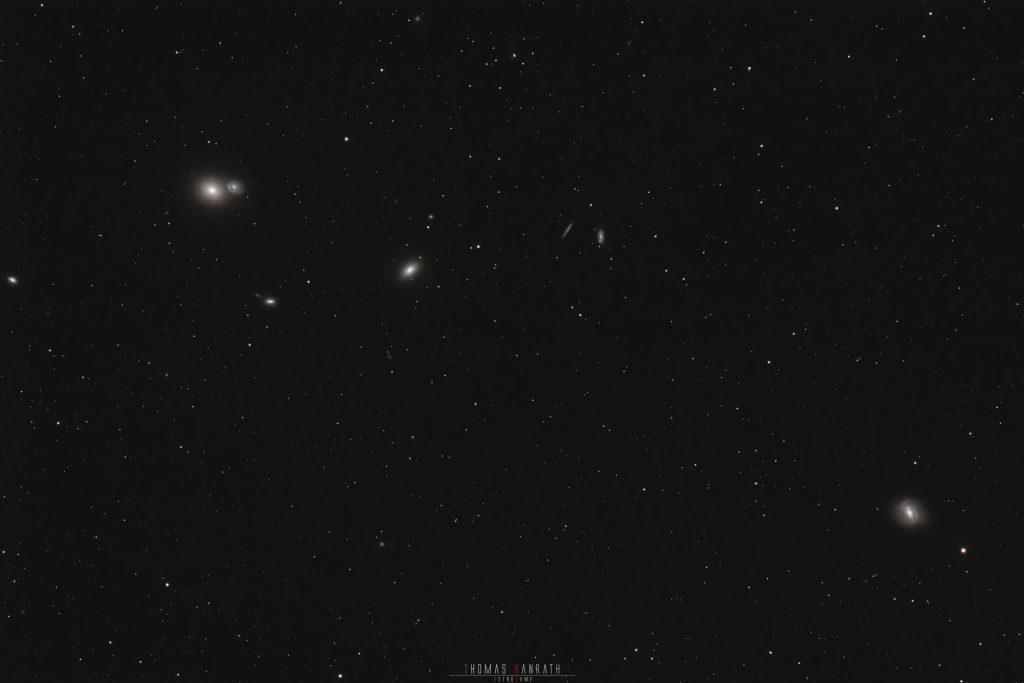
Messier 60, also cataloged as NGC 4649, is a lenticular galaxy in Virgo that presents astrophotographers with a bright, smooth elliptical glow ideal for medium to long focal lengths. Spanning an angular size of 6.4′ × 5.0′, it is compact enough to frame comfortably yet large enough to reveal a gradually brightening core against a darker halo in stacked exposures. Its warm, featureless disk contrasts beautifully with the nearby spiral neighbors that share its field, making wide-field arrangements especially rewarding. Because the galaxy carries no dust lanes or dramatic spiral structure, capturing its subtle brightness gradient and faint outer envelope becomes the primary photographic challenge.
Names and Catalog numbers
- M 60 (Messier 60)
- NGC 4649
- UGC 7898
- PGC 42831
Position and the cosmic neighborhood
Messier 60 lies in the constellation Virgo at right ascension 12h 43m 39.97s and declination +11° 33′ 09.7″, deep within the crowded Virgo Cluster region that is a favorite hunting ground for deep-sky imagers. Sitting close to the spiral galaxy NGC 4647, it forms an eye-catching pairing that lets a single frame combine a smooth lenticular ellipse with a delicate spiral companion. The surrounding sky is dense with other Messier and NGC galaxies, so careful framing and accurate plate-solving reward the photographer with several bright targets in one exposure. This part of Virgo climbs high enough from mid-northern latitudes to keep atmospheric distortion manageable during spring imaging sessions.
Nice to Know
- Messier 60 shares its telescopic field with the spiral galaxy NGC 4647, creating a photogenic contrasting pair of galaxy types.
- With a physical diameter of roughly 106,000 light-years, it is comparable in scale to many large disk galaxies despite its smooth lenticular form.
- Its multiple catalog identities — M 60, NGC 4649, PGC 42831 and UGC 7898 — reflect how thoroughly this bright Virgo member has been surveyed.
- A redshift of z = 0.00339 and a radial velocity of 1014.57 km/s place it firmly within the receding flow of the Virgo Cluster.
Brightness, distance and size
It lies about 56.4 million light-years from Earth and spans roughly 106,000 light-years across. On the sky it appears about 6.4′ × 5.0′ in size.