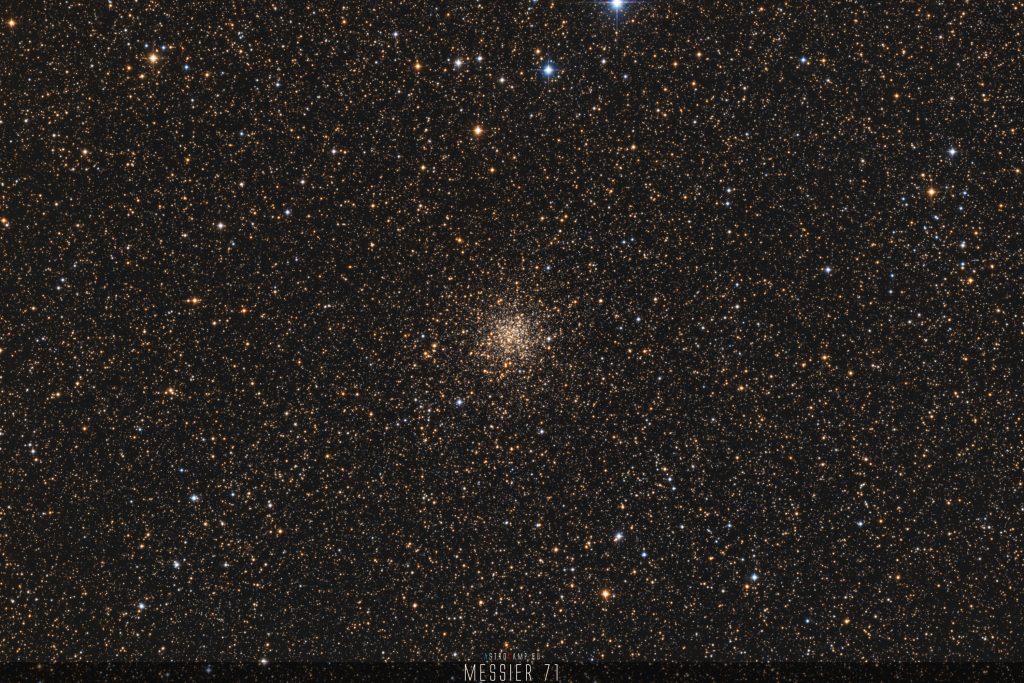
Messier 71, also catalogued as NGC 6838, is a loosely concentrated globular cluster that makes a rewarding target for both deep-sky imagers and visual observers. Spanning about 27 light-years across and presenting an apparent angular size of 7.2′, it fits comfortably within the field of most telescopes paired with a cooled astro camera. Because its stars are only moderately packed toward the center, even modest apertures and short integration times begin to resolve the cluster into a sprinkling of individual suns rather than a smooth glow. Its location within the rich Milky Way band of Sagitta means that longer exposures will capture a dense carpet of background field stars, giving the final image real depth.
Names, key data and data sources
All values come from the astronomical database SIMBAD (CDS Strasbourg). Tap a row to see where the value comes from.
Catalogue numbersM 71 (Messier 71) · NGC 6838 · Mel 226 (Melotte 226)Primary designation: M 71SIMBAD
TypeGlobular ClusterSIMBAD
ConstellationSagitta (Sge)computed
Position (J2000)RA 19h 53m 46s · Dec +18° 46′ 45″SIMBAD
Galactic coordinatesl = 56.7° · b = −4.6°Position relative to the Milky Way plane: 5° south of itcomputed
Apparent size7.2′SIMBAD
Orientation90°Position angle of the major axis, measured from north through eastSIMBAD
Distance≈ 13,000 light-years4.0 kpcSIMBAD
Diameter≈ 27 light-yearscomputed
Blueshiftz = −0.000075−23 km/s: approaching usSIMBAD
Sources and methods (10)
- Catalogue numbers: All identifiers under which SIMBAD lists the object; order according to the Astrocamp catalogue rule.
- Type: Entry in SIMBAD, object type “GlC”. Value since Jul 4, 2026 · last confirmed with SIMBAD Oct 20, 2026
- Constellation: Computed from the position (IAU constellation boundaries). Value since Jul 4, 2026 · last confirmed with SIMBAD Oct 20, 2026
- Position (J2000): Entry in SIMBAD, quality D (SIMBAD scale A–E). Publication: 2010AJ....140.1830G (NASA ADS). Value since Jul 4, 2026 · last confirmed with SIMBAD Oct 20, 2026
- Galactic coordinates: Converted from the position (IAU 1958 galactic system). Publication: 2010AJ....140.1830G (NASA ADS). Value since Jul 4, 2026 · last confirmed with SIMBAD Oct 20, 2026
- Apparent size: One catalogue value, measured in visible light, quality D (SIMBAD scale A–E). Publication: 1989Sci...246.1066D (NASA ADS). Value since Jul 4, 2026 · last confirmed with SIMBAD Oct 20, 2026
- Orientation: One catalogue value, measured in visible light, quality D (SIMBAD scale A–E). Publication: 1989Sci...246.1066D (NASA ADS). Value since Oct 20, 2026 · last confirmed with SIMBAD Oct 20, 2026
- Distance: One published measurement, rounded according to the scatter. Publication: 2008MNRAS.389.1924F (NASA ADS). Value since Jul 4, 2026 · last confirmed with SIMBAD Oct 20, 2026
- Diameter: Computed from the major axis and the distance; takes the weaker rating of the two values.
- Blueshift: One catalogue value, error ± 0.2 km/s, quality A (SIMBAD scale A–E). Publication: 2018MNRAS.478.1520B (NASA ADS). Value since Jul 4, 2026 · last confirmed with SIMBAD Oct 20, 2026
Checked against SIMBAD on Oct 20, 2026 · Open M 71 in SIMBAD
Position and the cosmic neighborhood
Messier 71 sits at a right ascension of 19h 53m 46.5s and a declination of +18° 46′ 45″, tucked into the small but distinctive constellation Sagitta, the Arrow. This region lies squarely in a bright stretch of the summer Milky Way, so the cluster is framed by an abundance of foreground and background stars that imagers can use to add texture and context to their compositions. The compact shape of Sagitta makes star-hopping to the target straightforward, and nearby star fields offer convenient opportunities for focusing and framing. The surrounding stellar density rewards wide and medium focal lengths alike, letting photographers decide whether to isolate the cluster or embed it in its glittering galactic surroundings.
Click marks an object (its path tonight) · click again for its constellation, once more to zoom to its field · click a frame to see it, again to zoom · its name shows details · click outside zooms out · drag to pan
Nice to Know
- Messier 71 is one of the more loosely structured globular clusters, so it resolves into individual stars more readily than tightly packed examples—a boon for imagers chasing pinpoint detail.
- At a distance of about 13,000 light-years, its light has traveled a long way, yet it remains bright enough to be a satisfying target for amateur setups.
- With a true diameter of about 27 light-years and an apparent size of 7.2′, the cluster frames neatly in a wide range of focal lengths.
- It carries several designations, including Messier 71, NGC 6838, and Mel 226, reflecting its long history of catalog entries.