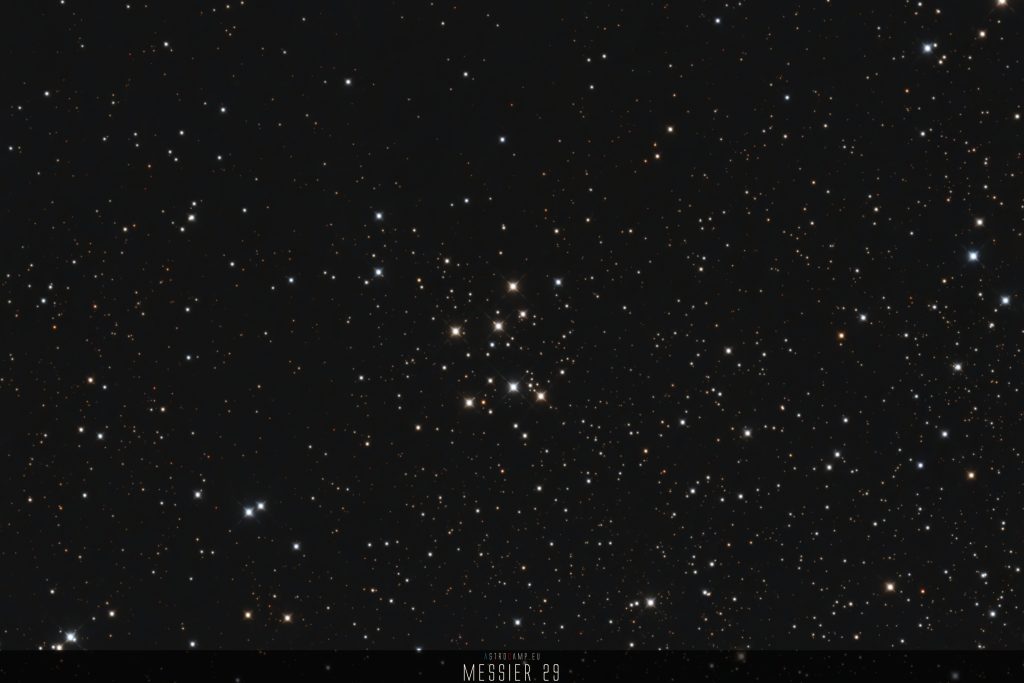
Messier 29, also cataloged as NGC 6913, is a compact open star cluster embedded in the rich star fields of Cygnus and shines at a modest apparent magnitude of 6.6, making it a rewarding target for wide-field and medium focal length astrophotography. Because the cluster is small at just 13′ across, it benefits from longer focal lengths that resolve its brightest members while still capturing the surrounding Milky Way. Imagers should be aware that this region of Cygnus is heavily crowded with faint background stars and interstellar dust, which can both enrich and complicate the composition. Careful color calibration helps the cluster’s hot, blue-white stars stand out against the dense, warm-toned stellar backdrop of the summer Milky Way.
Names and Catalog numbers
- M 29 (Messier 29)
- NGC 6913
Position and the cosmic neighborhood
Messier 29 lies in the northern constellation Cygnus at a right ascension of 20h 23m 46s and a declination of +38° 29′ 12″, placing it deep within the star-saturated band of the summer Milky Way. This part of the sky is one of the most photogenic regions for wide-field astrophotography, dense with nebulosity, dark dust lanes, and countless background stars that frame the cluster beautifully. With a physical diameter of roughly 14 light-years, Messier 29 appears as a tight knot of stars that can be easily combined with nearby emission nebulae in mosaic projects. Its high northern declination makes it an excellent target for observers and imagers in the northern hemisphere, where it climbs high overhead during summer nights.
Nice to Know
- At apparent magnitude 6.6, Messier 29 sits just below naked-eye visibility, making it a fine binocular and small-telescope target under dark skies.
- The cluster spans only 13′ on the sky, so longer focal lengths are ideal for resolving its brighter members into a distinct grouping.
- Located about 3,740 light-years from Earth, its light left the cluster roughly at the dawn of recorded human history.
- Its position within the dense Cygnus Milky Way makes it a natural centerpiece for astrophotography mosaics rich in nebulosity and dust.
Brightness, distance and size
The object has an apparent magnitude of 6.6 mag, it lies about 3,740 light-years from Earth and spans roughly 14 light-years across. On the sky it appears about 13′ in size.