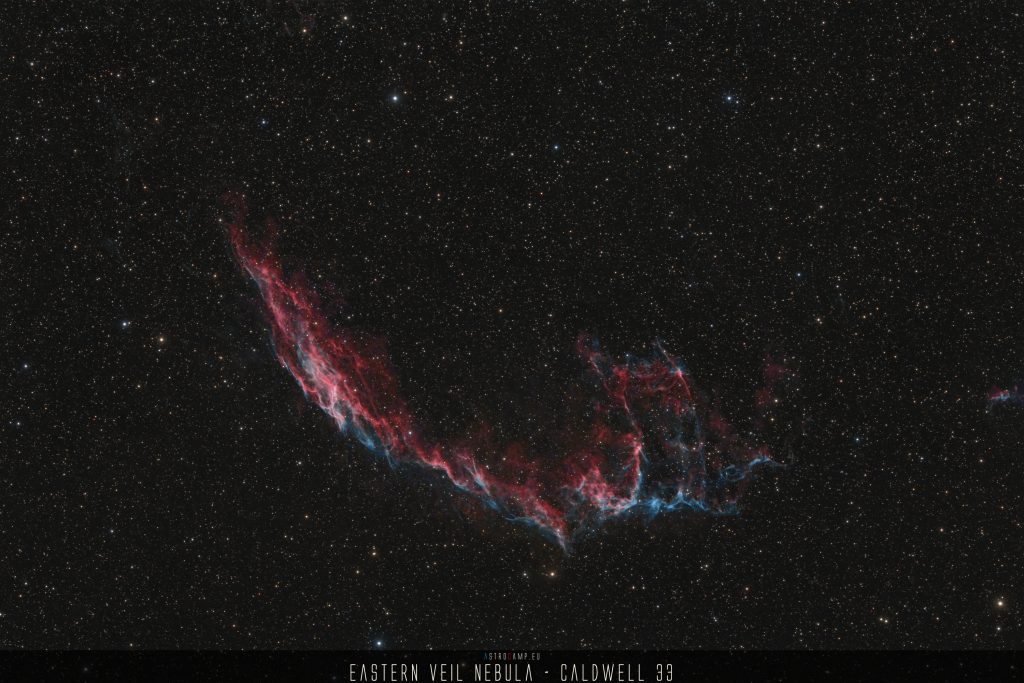
The Cygnus Loop is an expansive supernova remnant spanning an enormous 3.8° × 2.7° (230′ × 160′) of sky, making it one of the most rewarding wide-field targets for astrophotographers. Its intricate web of glowing filaments is best captured with narrowband filters, where oxygen-III renders the delicate blue-green tendrils and hydrogen-alpha brings out the warmer red structures. The Loop is not a single catalog entry but a composite of individually designated members, including the Eastern Veil Nebula (Caldwell 33, NGC 6992), the Western Veil Nebula (Caldwell 34, NGC 6960), the Bat Nebula (NGC 6995) and NGC 6979, each listed as a separate object in the catalogs. Because of its sheer angular extent, the full complex demands either a very short focal length or a multi-panel mosaic to frame in its entirety.
Names and Catalog numbers
- Cygnus Loop
- Sh2-103 (Sharpless 103)
- SNR G74.0-08.6
- Eastern Veil Nebula (member object: C 33)
- C 33 (Caldwell 33) (member object: C 33)
- NGC 6992 (member object: C 33)
- Western Veil Nebula (member object: C 34)
- C 34 (Caldwell 34) (member object: C 34)
- NGC 6960 (member object: C 34)
- LBN 191 (member object: C 34)
- LBN 074.53-08.42 (member object: C 34)
- Bat Nebula (member object: NGC 6995)
- NGC 6995 (member object: NGC 6995)
- NGC 6979 (member object: NGC 6979)
Position and the cosmic neighborhood
The Cygnus Loop lies within the rich star fields of Cygnus at a right ascension of 20h 51m and a declination of +30° 40′, embedded in one of the densest stretches of the summer Milky Way. Its brightest constituents are catalogued individually: the Western Veil Nebula (Caldwell 34, NGC 6960) drapes across the sky at 20h 45m 38s, +30° 42′ 30″, while the Eastern Veil Nebula (Caldwell 33, NGC 6992) sits opposite at 20h 56m 19s, +31° 44′ 36″. Nestled among these arcs is the Bat Nebula (NGC 6995) at 20h 57m, +31° 13′, and the fainter member NGC 6979 completes the ensemble. This surrounding region is packed with foreground stars, offering a dazzling backdrop that both complicates and enriches deep-sky imaging of the filaments.
Nice to Know
- The Cygnus Loop is catalogued under the designations Sharpless 2-103 and SNR G074.0-08.6, marking it as a large, well-studied supernova remnant.
- Its huge angular size of 3.8° × 2.7° (230′ × 160′) means it covers many times the apparent diameter of the full Moon, ideal for wide-field and mosaic astrophotography.
- The Loop is composed of several separately catalogued pieces, including the Eastern Veil Nebula (Caldwell 33, NGC 6992), the Western Veil Nebula (Caldwell 34, NGC 6960) and the Bat Nebula (NGC 6995).
- The delicate filamentary structure responds beautifully to narrowband imaging, with oxygen-III and hydrogen-alpha data revealing the intertwined blue and red shock fronts.
Brightness, distance and size
On the sky it appears about 3.8° × 2.7° (230′ × 160′) in size.