

Sh2-152, also cataloged as LBN 519, is a compact emission nebula in Cassiopeia that shines a rich hydrogen-alpha red, making it a rewarding narrowband target for astrophotographers. With an angular size of only 1.0′ × 0.9′, it is a small object on the sky and benefits from long focal lengths to reveal its faint internal structure. Lying roughly 9,460 light-years from Earth and spanning about 3 light-years across, it forms a tight knot of glowing gas set against the star-dense fields of the Milky Way. Its modest size and location in a busy region reward careful framing and patient integration to bring out both the nebula and its surrounding starfield.
Names and Catalog numbers
- Sh2-152 (Sharpless 152)
- LBN 519
- Sh2-153 (Sharpless 153) (associated object: Sh2-153)
- LBN 518 (associated object: Sh2-153)
Position and the cosmic neighborhood
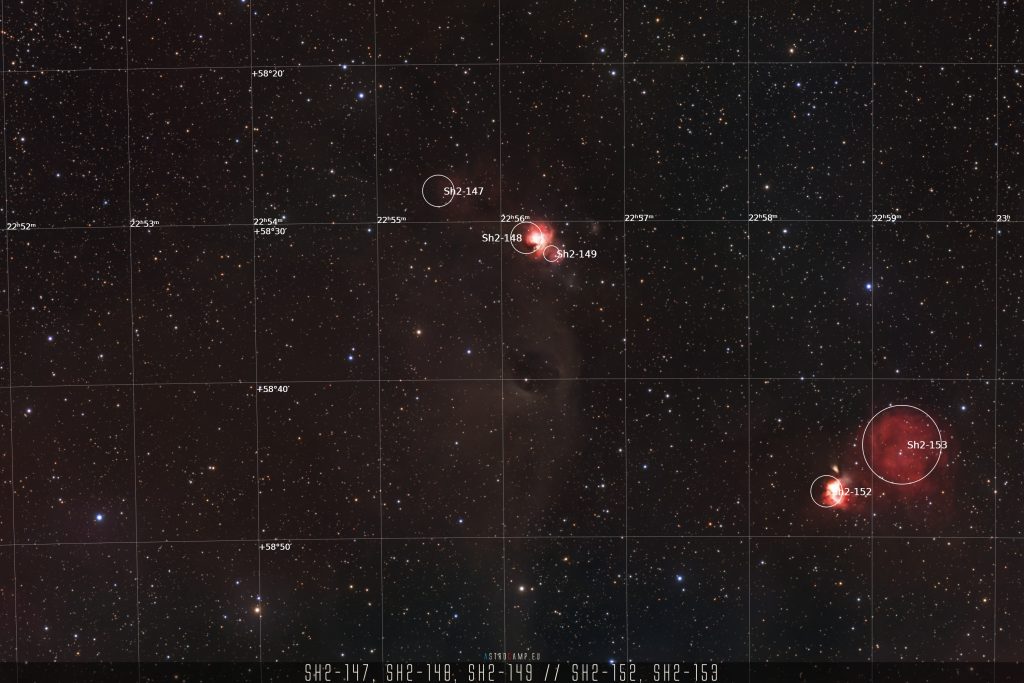
Sh2-152 sits at right ascension 22h 58m 40.8s and declination +58° 47′ in Cassiopeia, embedded in the crowded northern reaches of the Milky Way. It shares this small patch of sky with its neighbor Sh2-153 (also known as LBN 518), which lies at a greater distance of about 15,000 light-years — a reminder that the two nebulae appear side by side in a photograph purely by line of sight and are not physically paired. Although the pair reads as a single glowing target in the eyepiece or a wide image, the catalogs list them as separate, independent emission nebulae, each carrying its own designation and data. The dense stellar backdrop of Cassiopeia makes this a visually rich field, ideal for photographers who enjoy combining nebulosity with a lavish scattering of stars.
Nice to Know
- Sh2-152 carries two catalog designations, Sh2-152 and LBN 519, reflecting its inclusion in both the Sharpless and Lynds Bright Nebula catalogs.
- Despite its brightness in hydrogen-alpha light, the nebula is tiny at just 1.0′ × 0.9′, so it is often best captured at long focal lengths.
- Its close companion on the sky, Sh2-153 (LBN 518), lies far more distant at around 15,000 light-years, so the two only appear together by chance alignment.
- At roughly 9,460 light-years away and about 3 light-years across, Sh2-152 is a genuinely compact pocket of glowing gas within the Cassiopeia Milky Way.
Brightness, distance and size
It lies about 9,460 light-years from Earth and spans roughly 3 light-years across. On the sky it appears about 1.0′ × 0.9′ in size.
//
© 2025 · Thomas Hanrath · CC BY-NC-ND 4.0 · no edits · no commercial use
