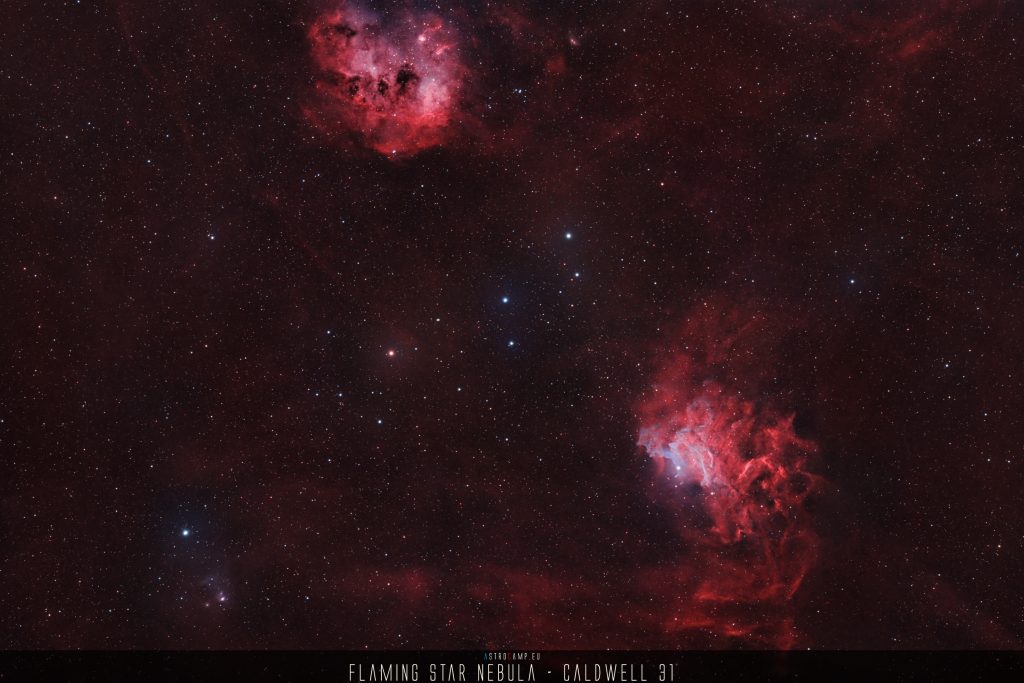
vdB 34 is a reflection nebula in Auriga that shines by scattering the light of a nearby hot star, producing the cool bluish tones prized by astrophotographers. It sits in the same crowded field as the Flaming Star Nebula (IC 405), a reddish emission nebula, so that a single wide-field frame can capture both the blue reflection glow and the warmer hydrogen emission together. At an integrated brightness of about 5.96 mag the region is a rewarding target for modest apertures and fast optics, though the faint nebulosity rewards long total exposure and dark skies. To bring out the contrast between the reflection and emission components, a combination of broadband RGB and hydrogen-alpha data works especially well.
Names and Catalog numbers
- vdB 34 (van den Bergh 34)
- Flaming Star Nebula (associated object: C 31)
- C 31 (Caldwell 31) (associated object: C 31)
- LBN 795 (associated object: C 31)
- IC 405 (associated object: C 31)
Position and the cosmic neighborhood
vdB 34 lies in Auriga at a right ascension of 05h 16m 18s and a declination of +34° 18′ 44″, placing it high in the northern winter sky where it is well positioned for imagers across the northern hemisphere. Only a short distance away on the sky sits the Flaming Star Nebula, catalogued as Caldwell 31 and IC 405 (also LBN 795), an emission nebula centered near 05h 17m 24s, +34° 23′. Although both fit comfortably within the same telescopic and photographic field and appear to form one continuous target, the catalogs list them as separate, independent objects — a reflection nebula and an emission nebula, each carrying its own designation and data. Framing the pair together produces one of Auriga’s classic mixed-nebula compositions.
Nice to Know
- vdB 34 is a reflection nebula, glowing by scattered starlight rather than by its own emission, giving it characteristically cool blue hues in images.
- It shares its field with the Flaming Star Nebula (Caldwell 31 / IC 405), an emission nebula that adds contrasting reddish tones to a wide-field frame.
- Despite appearing as a single target through the eyepiece or camera, the two nebulae are catalogued as distinct, independent objects with their own designations.
- Situated about 1,790 light-years away in Auriga, the region is a high-riding winter subject that pairs beautifully with broadband and hydrogen-alpha imaging.
Brightness, distance and size
The object has an apparent magnitude of 6.0 mag, it lies about 1,790 light-years from Earth.