
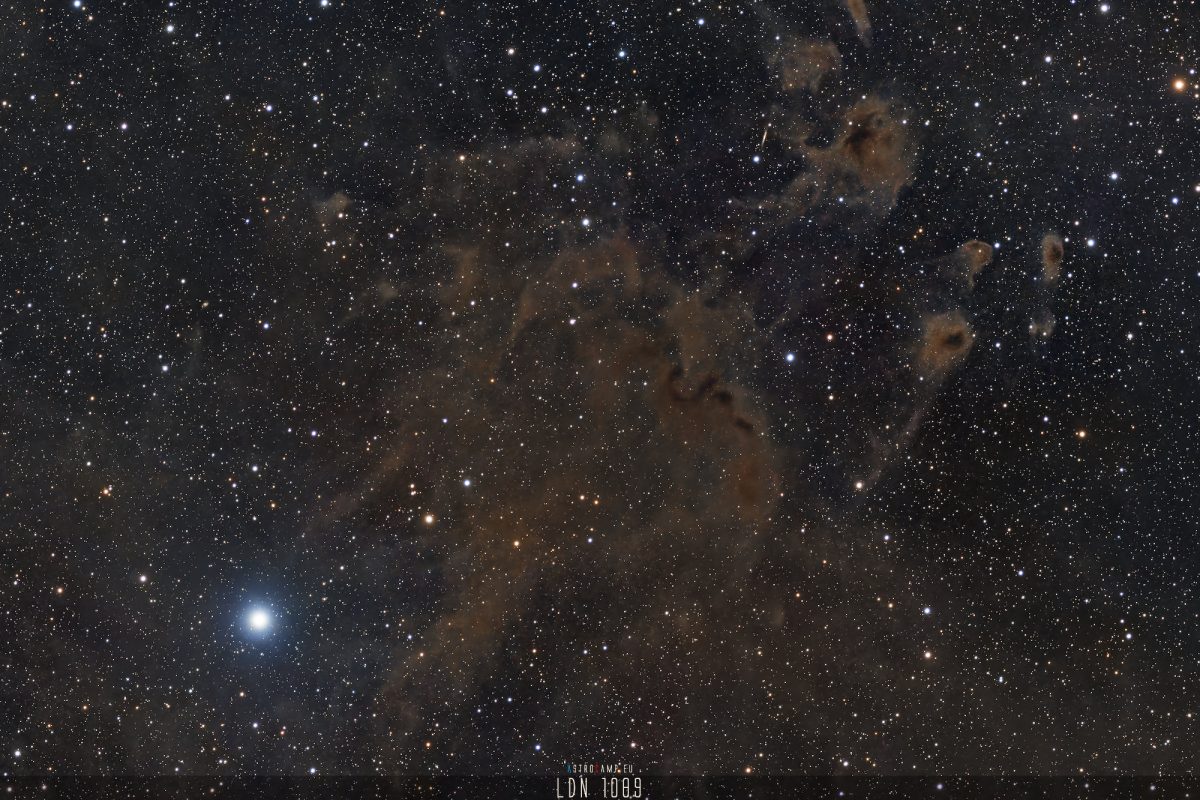
LDN 1089 is a dark nebula listed in Beverly Lynds’ Catalogue of Dark Nebulae, appearing as an opaque patch that blots out the fainter background star fields of Cepheus. For astrophotographers, this is a target of absence rather than emission, requiring long integration times to reveal the subtle contrast between the dusty obscuration and the surrounding Milky Way glow. Wide-field refractors or fast astrographs paired with a sensitive mono or color camera work well to render its ragged, ink-dark form against the star-rich backdrop. Because dark nebulae emit no light of their own, careful attention to sky darkness, flat-field calibration, and gradient control is essential to bring out the delicate structure of Lynds Dark Nebula 1089.
Names and Catalog numbers
- LDN 1089
Position and the cosmic neighborhood
Located at right ascension 20h 32m 48s and declination +63° 30′, LDN 1089 sits high in the northern constellation Cepheus, a region embedded in the dusty lanes of the summer Milky Way. From mid-northern latitudes this part of the sky is circumpolar or near-circumpolar, allowing extended imaging sessions across much of the night. The surrounding star fields are dense and offer plenty of contrast for framing the nebula’s dark silhouette, while the broader neighborhood of Cepheus hosts numerous molecular clouds and star-forming complexes that make wide-field mosaics particularly rewarding.
Nice to Know
- LDN 1089 carries its designation from Beverly Lynds’ Catalogue of Dark Nebulae, a survey that systematically cataloged obscuring dust clouds across the sky.
- With an angular size of 0.5° (30′), it spans about the apparent diameter of the full Moon, making it an accessible wide-field target.
- As a dark nebula it produces no light of its own, revealing itself only by silhouette against the brighter Milky Way star fields behind it.
- Its high northern declination in Cepheus keeps it well placed for long, uninterrupted imaging runs from northern observing sites.
Brightness, distance and size
On the sky it appears about 0.5° (30′) in size.
