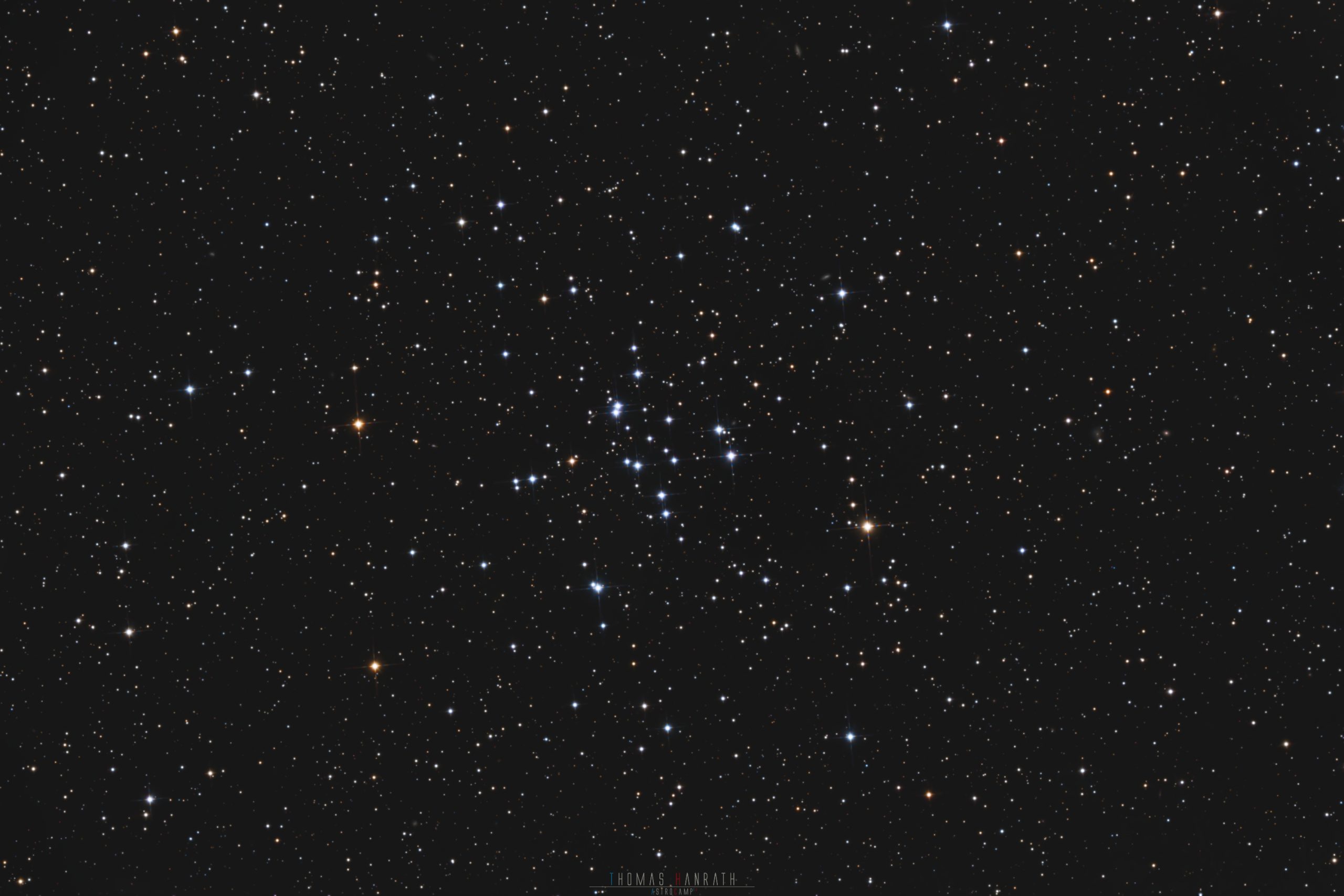
Messier 34 is a loose but visually striking cluster composed of roughly 100 stars, including several bright blue-white members that stand out beautifully in wide-field images. It spans about half a degree across the sky, making it an attractive subject for medium focal length telescopes and telephoto lenses. The cluster lies along the Milky Way’s band, surrounded by a rich stellar field that provides a detailed and colorful astrophotographic background. Photographers capturing M34 often emphasize its contrast against the darker interstellar medium, resulting in deep, textured images that highlight the cluster’s youthful energy.
Names and Catalog numbers
- Messier 34
- NGC 1039
- Melotte 17
Position and the cosmic neighborhood
Messier 34 is positioned within the northern part of the constellation Perseus, near its border with Andromeda. From an astrophotographic perspective, the cluster lies in a busy stellar environment, where numerous background stars and faint nebula-like features can enhance long-exposure images. It is located roughly halfway between the bright stars Algol (Beta Persei) and Almach (Gamma Andromedae), which makes it relatively easy to find with either binoculars or a wide-field imaging setup. The surrounding region includes other photogenic objects such as the California Nebula (NGC 1499) and the Double Cluster in Perseus, offering multiple composition opportunities for wide-field astrophotography.
Nice to Know
- Messier 34 is visible to the naked eye under dark skies and easily resolved with binoculars or small telescopes.
- The cluster is estimated to be about 200 million years old, showcasing both young and maturing stars.
- Its stellar members exhibit moderate proper motion, making long-exposure portrait imaging a stable option.
- As one of the nearest open clusters to Earth, M34 serves as an excellent calibration target for color balance and star shape testing in astrophotography.
Brightness, distance and size
Messier 34 shines with an apparent magnitude of about 5.2, making it easily visible under suburban skies. It lies approximately 1,500 light-years away and has a physical diameter of about 15 light-years. On the sky, the cluster spans roughly 35 arcminutes, or slightly larger than the apparent size of the full Moon, making it well-suited for imaging through wide-field telescopes or telephoto lenses that provide crisp star definition and contrast.