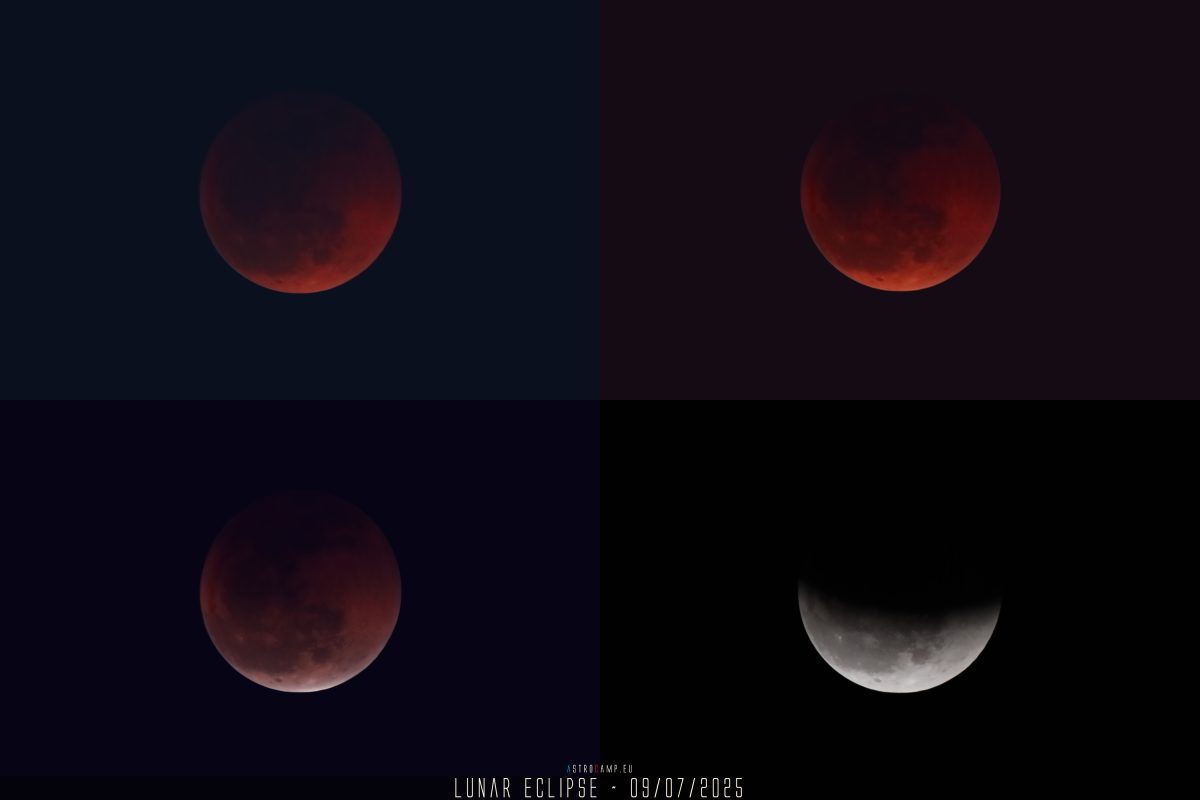
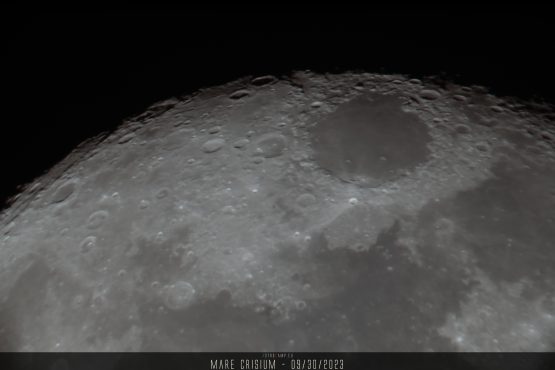
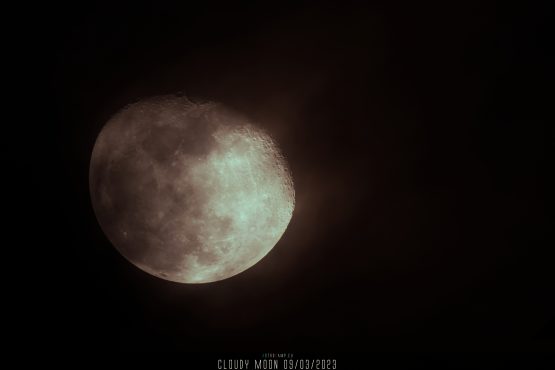
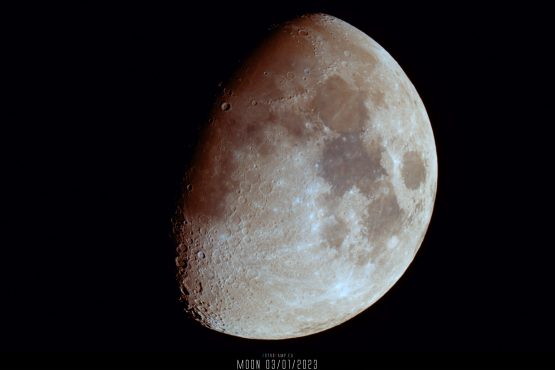
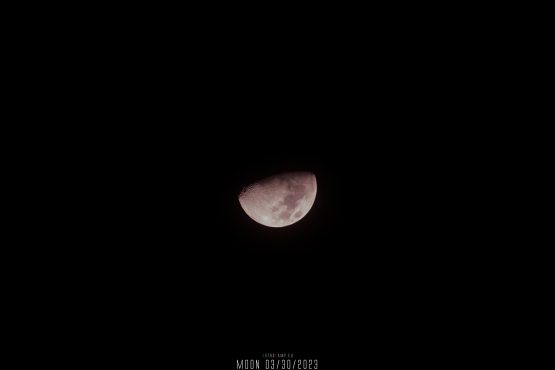
4 Phases of the Lunar Eclipse on September 7, 2025
The total lunar eclipse on September 7, 2025, was a truly special event for me. Even before it began, it was clear the Moon would rise fully shadowed by earth low above the horizon, making it difficult to see. The atmosphere was filled with anticipation-not just for me, but also for the many visitors who had gathered on the fields above “Friedland” in Lahnstein.
At around 8:39 PM, the Moon finally appeared. At first faint and reddish, barely visible in the bright evening sky, it gradually became clearer as darkness deepened. Over the next hour, the eclipse unfolded in all its beauty.
The event was organized by the astronomy club of the Johannes-Gymnasium, who brought along an impressive variety of telescopes and binoculars. Around 50–60 people attended, including students, teachers, and curious visitors, all sharing the experience.
Observing and Capturing
For me, it was the first total lunar eclipse I documented using a purely photographic setup—without a telescope. I used a Vixen Great Polaris mount (this time without a counterweight), my Canon EOS R, and the RF 100–400 mm zoom lens.
My plan was to capture both still photos and short video sequences, each 30–60 seconds in 4K. At first, I worried the Moon might not fit entirely on the cropped 4K sensor area, but that turned out not to be an issue.
The photos, however, were disappointing: slightly blurry, lacking sharpness, and limited by the lens’s f/8 aperture at 400 mm. The videos, on the other hand, turned out to be far more useful and provided great raw material for processing.
A Shared Night Under the Moon
What made the night especially memorable was the atmosphere at the site. While I worked with my camera and mount, the astronomy club students and teachers generously shared their telescopes with curious visitors. From simple binoculars to modern smart telescopes, everything was available.
This meant that not only astrophotographers and students, but also casual passersby, could get a direct look at the eclipsed Moon. That spirit of sharing turned the evening into something far more than just a technical exercise.
Lunar Eclipse – 09/07/2025 at 20:44
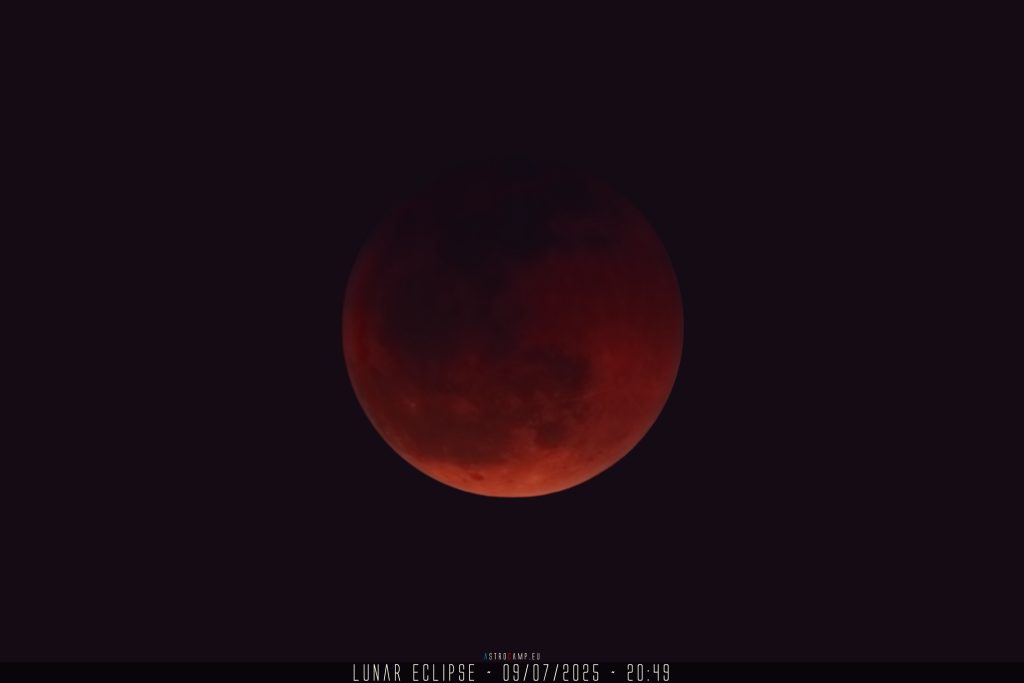
Lunar Eclipse – 09/07/2025 at 20:49
Lunar Eclipse – 09/07/2025 at 20:52
Lunar Eclipse – 09/07/2025 at 20:58
Lunar Eclipse – 09/07/2025 at 21:22
Image Processing Workflow
The video files were first converted in PIPP to uncompressed AVI format so they could be processed in AutoStakkert.
Analysis: global analysis with maximum noise reduction, Drizzle set to 1.5
Alignment points: automatic plus custom points on the uncovered Moon areas
Stacking: 75% of frames per video used, typically 1500–2500 frames each
In the end, I processed five different video sequences, representing various stages of the eclipse.
The lunar eclipse in Lahnstein showed me how different the results can be between still photography and video. While the photos with the zoom lens were underwhelming, the 4K videos provided valuable material that processed beautifully.
By the time the next total eclipse comes around in late 2028, I’ll likely be using an apochromatic refractor – and I’m already looking forward to it.