



In November Perseus and Cassiopeia ride high at midnight, with Taurus already rising in the east. The Heart and Soul Nebulae IC 1805 and IC 1848, the Double Cluster h and χ Persei, the California Nebula NGC 1499, the Pleiades M 45 and the edge-on galaxy NGC 891 are rewarding targets. Long nights leave room for several targets in one session.
November 2026 · · 41° N
At midnight, Perseus and Taurus are on the meridian. The new moon on November 9 opens the window for broadband, around the full moon on November 24 it is time for narrowband.
This month’s sky
Perseus and Taurus
The month’s sky view starts on the 15th in the evening, halfway between nightfall and astronomical midnight, and shows the framings that stand no higher at midnight in any other month and reach at least two hours per night above 30° (nautical darkness, sun below −12°). Change the date to see the framings of that month.
Click marks an object (its path tonight) · click again for its constellation, once more to zoom · its name shows details · click outside zooms out · drag to pan
Framings in November
Galaxies in November

C 5 · Hidden Galaxy
Long focal length (900–2,000 mm) · Field of view 1.1° × 46′
medium
Monthly average: 10.9 h per night above 30°
Due south at midnight: Nov 20
Coordinates:

C 24
Long focal length (900–2,000 mm) · Field of view 1.1° × 46′
Surface brightness 22.8 mag/″²medium
Monthly average: 10.5 h per night above 30°
Due south at midnight: Nov 14
Coordinates:
Image: Matthew Terrell, AstroBin · CC BY-SA · cropped

C 23
Long focal length (900–2,000 mm) · Field of view 1.1° × 46′
Surface brightness 22.3 mag/″²medium
Monthly average: 9.9 h per night above 30°
Due south at midnight: Oct 30
Coordinates:
Image: Mike Hamende, AstroBin · CC BY-SA · cropped

NGC 1055
Long focal length (900–2,000 mm) · Field of view 1.1° × 46′
Surface brightness 22.7 mag/″²medium
Monthly average: 6.5 h per night above 30°
Due south at midnight: Nov 4
Coordinates:
Image: Helder Farias, AstroBin · CC BY-SA · cropped

M 77
Long focal length (900–2,000 mm) · Field of view 1.1° × 46′
Surface brightness 21.1 mag/″²medium
Monthly average: 6.5 h per night above 30°
Due south at midnight: Nov 4
Coordinates:
Image: Helder Farias, AstroBin · CC BY-SA · cropped
Emission nebulae in November
LBN 628
Medium focal length (350–900 mm) · Field of view 3.6° × 2.4°
challenging
Monthly average: 10.9 h per night above 30°
Due south at midnight: Nov 29
Coordinates:
Planetary nebulae in November

PK 136+05.1 · Duo PK136+05.1 & PK136+04.1suits narrowband
Long focal length (900–2,000 mm) · Field of view 1.1° × 46′
challenging
Monthly average: 10.9 h per night above 30°
Due south at midnight: Nov 10
Coordinates:
Image: Jerry Macon, AstroBin · CC BY · cropped

NGC 1535suits narrowband
Long focal length (900–2,000 mm) · Field of view 1.1° × 46′
Surface brightness 20.4 mag/″²challenging
Monthly average: 3.9 h per night above 30°
Due south at midnight: Nov 27
Coordinates:
Image: Jerry Macon, AstroBin · CC BY · cropped
Reflection and dark nebulae in November

LBN 777
Medium focal length (350–900 mm) · Field of view 3.6° × 2.4°
medium
Monthly average: 9.3 h per night above 30°
Due south at midnight: Nov 24
Coordinates:
Image: Satish Ponnala, AstroBin · CC BY-SA · cropped
Open clusters in November
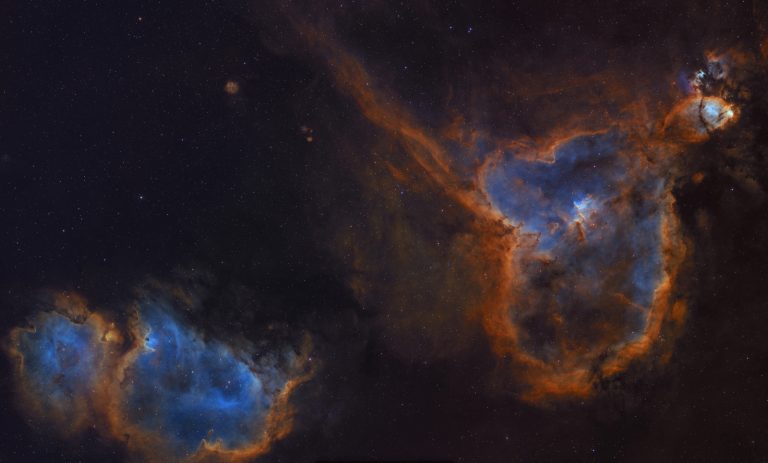
Heart, Soul and Fishhead Nebulaesuits narrowband
IC 1795IC 1805IC 1848
Wide angle (up to 135 mm focal length) · Field of view 9.5° × 6.3°
Surface brightness 22 mag/″²easy
Monthly average: 10.8 h per night above 30°
Due south at midnight: Nov 4
Frame centre:
Image: Phil Misiowiec, AstroBin · CC BY-SA · cropped

Cr 39 · mel 20
Wide angle (up to 135 mm focal length) · Field of view 15.2° × 10.2°
easy
Monthly average: 10.8 h per night above 30°
Due south at midnight: Nov 15
Coordinates:
Image: Jim Morse, AstroBin · CC BY · cropped

Persei Double Cluster
C 14 · Persei Double ClusterNGC 869 · h Persei ClusterNGC 884 · chi Persei Cluster
Long focal length (900–2,000 mm) · Field of view 1.1° × 46′
easy
Monthly average: 10.5 h per night above 30°
Due south at midnight: Oct 30
Frame centre:

M 34
Long focal length (900–2,000 mm) · Field of view 1.1° × 46′
easy
Monthly average: 10.2 h per night above 30°
Due south at midnight: Nov 4
Coordinates:

NGC 1333
Long focal length (900–2,000 mm) · Field of view 1.1° × 46′
medium
Monthly average: 9.9 h per night above 30°
Due south at midnight: Nov 16
Coordinates:
Image: Mike Hamende, AstroBin · CC BY-SA · cropped

Plejaden
M 45 · PleiadesvdB 20 · Electra NebulavdB 21 · Maia NebulavdB 22 · Merope Nebula
Medium focal length (350–900 mm) · Field of view 3.6° × 2.4°
easy
Monthly average: 9.2 h per night above 30°
Due south at midnight: Nov 20
Frame centre:

C 41 · Hyades
Wide angle (up to 135 mm focal length) · Field of view 15.2° × 10.2°
easy
Monthly average: 8.4 h per night above 30°
Due south at midnight: Nov 30
Coordinates:
Constellations in November
These constellations stand highest at midnight in November – calculated for New York, 41° N.
Perseus
Highest at midnight on November 14, almost overhead
Brightest stars: Mirfak, Algol, Atik
Framings: M 34, C 24, Cr 39 · mel 20, NGC 1333, Persei Double Cluster
Taurus
Highest at midnight on November 27, 63° up in the south
Brightest stars: Aldebaran, Elnath, Tianguan
Framings: Plejaden, LBN 777, C 41 · Hyades
Planets in November
Visibility for New York, 41° N: sun at least 6° below the horizon, planet at least 10° up (Mercury and Venus 5°).
Mercury morning sky
Virgo · −0.1 mag · 7.7″ · 40 % lit
On November 15: 05:40–06:20, highest 11° at 06:10
Venus morning sky
Virgo · −4.8 mag · 50″ · 15 % lit
On November 15: 04:40–06:20, highest 21° at 06:10
Visibility improves during the month
Mars morning sky
Leo · 0.7 mag · 7.2″
On November 15: 00:20–06:20, highest 64° at 06:10
Visibility improves during the month
Jupiter morning sky
Leo · −2.1 mag · 37″
On November 15: 00:20–06:20, highest 63° at 06:10
Visibility improves during the month
Saturn first half of the night
Cetus · 0.6 mag · 19″ · ring tilt 6°
On November 15: 17:10–02:00, highest 50° at 20:50
Visibility shrinks during the month
Uranus most of the night
Taurus · 5.7 mag · 3.8″
On November 15: 18:10–06:20, highest 70° at 00:20
Visibility improves during the month
Neptune first half of the night
Pisces · 7.7 mag · 2.3″
On November 15: 17:10–01:30, highest 49° at 20:20
Visibility shrinks during the month
Events
- Moon 0.9° from Mars
- Moon 0.5° from Jupiter
- Moon 1.1° from Venus
- Mars and Jupiter 1.2° apart
- Mercury at greatest western elongation (20° from the sun) – best time in the morning sky
- Uranus at opposition – up all night, at its largest and brightest (5.7 mag)
- Moon 0.8° from Jupiter
- Moon 3° from Mars
Lunar occultations in November
The moon covers stars to mag 5, the Pleiades and planets – calculated for New York, 41° N, local time accurate to about a minute, moon at least 5° up.
night of November 16/17: Moon occults ι Cap
moon 33° up, 44 % lit
Clear tonight, so keeping my fingers crossed.🫶