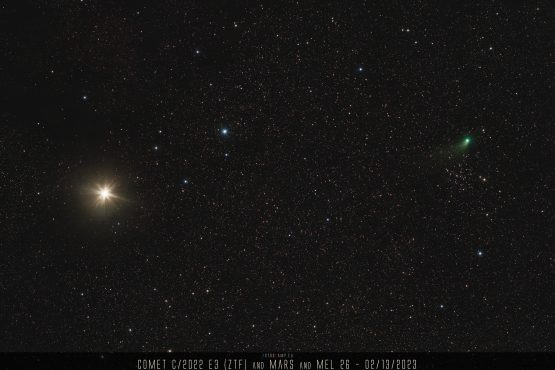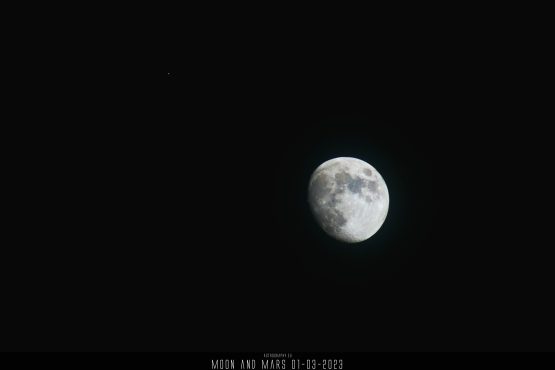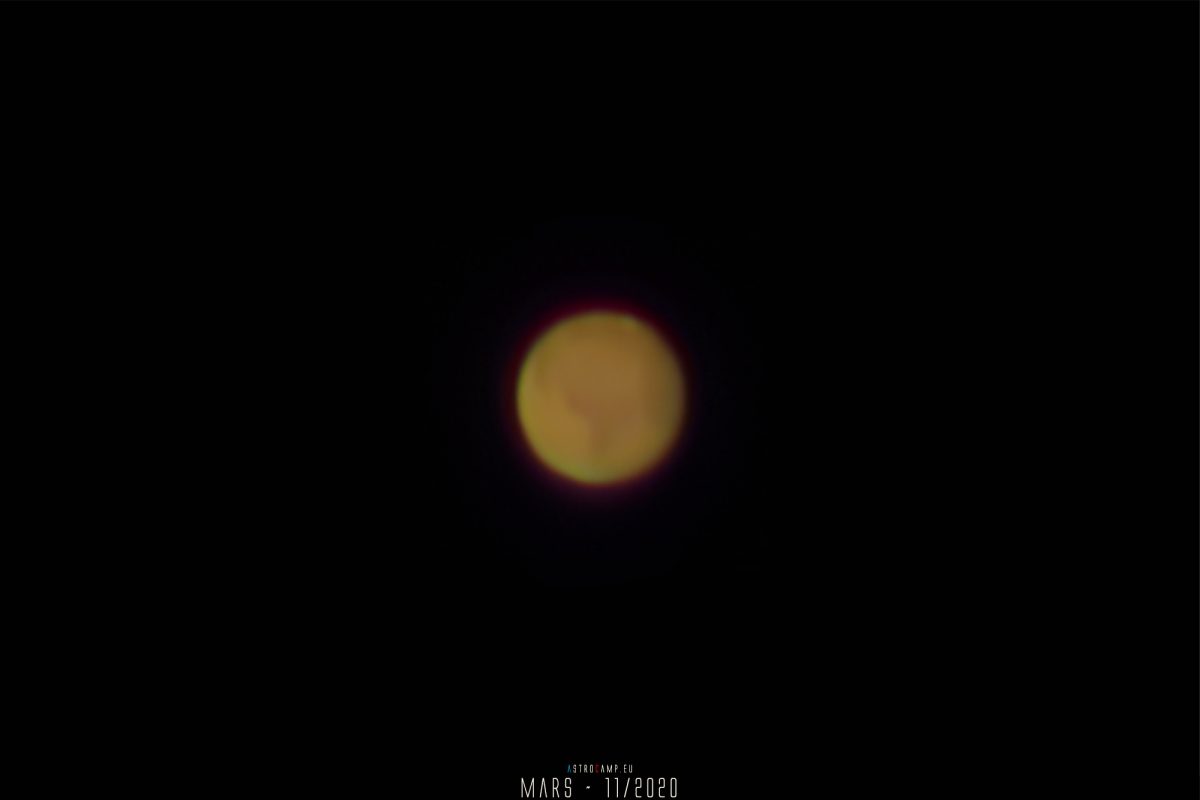
Mars was my first astronomical object in October and November 2020 that actually looked like one. I photographed it for the first time using a telescope. At that time everything was still fully manual, without automatic tracking or anything similar. Looking back, I have to admit it was quite a respectable result.
Experience with Mars
The months in the autumn of 2020 were something like the beginning of a great passion. Almost perfect! Mars was in opposition at that time, which was a fortunate coincidence.
Up to that point, my son’s refractor had only been used irregularly for visual stargazing. During the autumn months, I began taking my first astrophotos using eyepiece projection with my mirrorless EOS.
Proper polar alignment was still a foreign concept to me back then. It almost seems like a miracle that, despite all the fiddling with both axes of the mount, I managed to get anything onto the sensor at all.
Mars size and apparent size
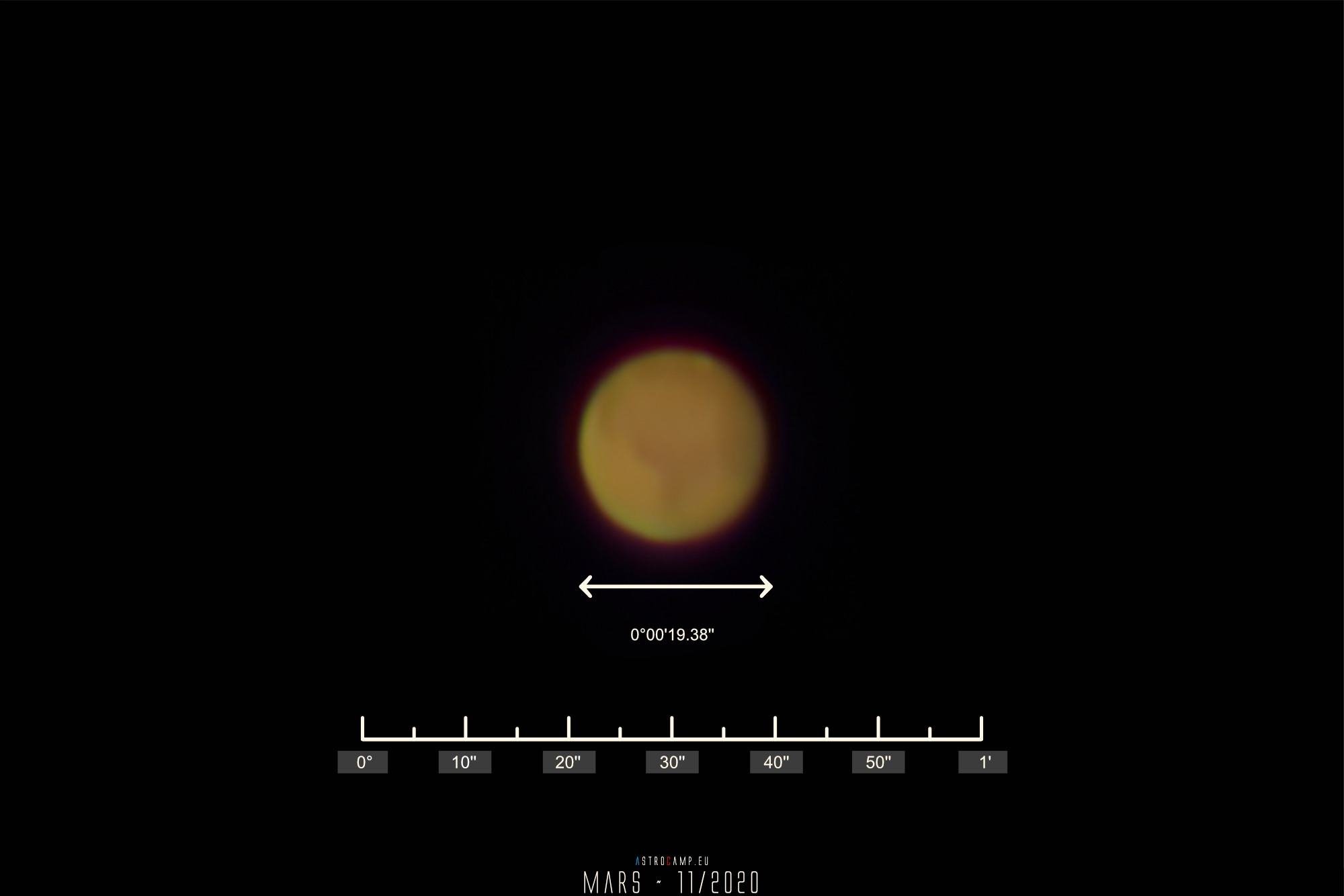
The distance between Earth and Mars on November 4, 2020 was about 72,274,000 km. Due to its close proximity to Earth, our neighboring planet had an apparent angular diameter of nearly 20 arcseconds on that day. At its greatest distance from Earth in September 2021, the visible angular diameter will be only about 3.5 arcseconds.
By comparison, the full Moon has an apparent diameter of about 30 arcminutes, which corresponds to roughly 1,800 arcseconds.
Technical overview
| Telescope | Skywatcher Evostar 90 |
| Focal Length | 900mm |
| Mount | Skywatcher EQ-2 |
| Camera | CANON EOS M100 |
| Method | Okularprojektion |
| Photography Date | 11/04/2020 |
| Lights | AVI 10.000 Frames |
| Sensitivity | auto |
| Processing Date | 11/05/2020 |
| Stacking, Integration | PIPP |
| Software | PIPP, AutoStakkert, Affinity Photo |
| Capture Place | Koblenz, Germany |