

On August 12, 2026, my son Gero and I stood in a freshly mown field somewhere between Sahagún and the Palencia provincial border, waiting for the moon. Getting there had been a long road, in every sense. This post tells the story of that journey: from setting off in Koblenz, through a location search that made me rethink my plan more than once, to the ninety seconds we had traveled a week for.
Setting Off: From Koblenz via Bordeaux to Burgos
We left on a Sunday morning. Gero, my 17-year-old son, was with me the entire week — and while I had planned this trip first and foremost as an astrophotographer, it was just as much a father-son trip, and in hindsight that mattered at least as much as the gear in the trunk.
The first day was pure driving: from Koblenz almost straight through to Bordeaux, arriving in the evening, where we stayed at a hotel on the edge of the city center. We deliberately kept the next morning free — Gero and I explored Bordeaux on our two Brompton folding bikes before continuing on. It wasn’t necessary, but it was a small reminder that this trip was meant to be more than just transport to an astronomical appointment.

From Bordeaux it was another five hours or so to Burgos, where we spent the second night. The next day we continued on to León — the actual starting point for everything that followed.
The Search for a Spot: From the Mirador to the Meseta
This trip was never meant to just happen to me. I wanted to experience this one moment as prepared as possible — which meant research, asking around, and abandoning my own plan whenever it needed abandoning, until it actually held up. Weeks earlier I had already started digging into the question of exactly where to watch this eclipse. The first sobering realization came quickly: totality over León lasts only about two minutes, and the sun sits astonishingly low during it — under ten degrees above the horizon, just before sunset. That means the height of a viewpoint doesn’t matter nearly as much as a genuinely clear line of sight to the west and northwest. A single hill or a row of trees on the horizon would have been enough to miss totality entirely.
My first recommendation was the Mirador de La Cepeda, an elevated spot west of León toward Astorga, easily reachable by car — important, since besides camera and lenses I was also hauling an AGM lead-acid battery for power, not something you carry a kilometer on foot. But the more I looked into the topography, the clearer it became: an elevated spot near the mountains might make for a beautiful view, but it also carries a higher risk of exactly the clouds that could ruin my sightline. The better logic pointed elsewhere — away from the Montes de León and out into the flat expanse of the Meseta, the Tierra de Campos between Sahagún and the province of Palencia. Not a spectacular landscape, but essentially free of relief, and reasonably safe from the kind of afternoon clouds that like to build up along mountain ranges.
That was the first real change of plan on this trip, and in hindsight the most important one: away from the most scenic viewpoint, toward the safest sky.
León: Arrival, Scouting, and an Evening Among Strangers
On Tuesday we checked into our hotel in León and spent the afternoon driving out to a few of the candidate spots various contacts had given me in the meantime — among them the Castillo de Coyanza near Valencia de Don Juan. That evening I sat in the city over a beer with a mixed group of eclipse travelers, Gero next to me with a soda — people from Wales, from England, from various corners of the US, all of whom I’d met through the same Facebook group that had also brought me my first local contact. All of them chasing the same thing we were. It was one of those spontaneous evenings you can’t plan for, and that’s exactly why it stays with you.
Three Contacts, One Decision
Alongside the location search, I’d also been trying to find local help — not leaving it to chance, but pursuing it deliberately across several channels at once: a Facebook post about the eclipse, the website of the local astronomy club, Astrobin.
The first contact came without me doing anything at all: Alejandro Martínez Fernández reached out unprompted on my Facebook post. He knew the area around León well and explained that convective clouds regularly build up in the afternoon over the Montes de León to the west. Places like Sahagún or Valencia de Don Juan, further away from those mountains, were considerably safer. He himself planned to drive with his family to a hill near Valencia de Don Juan. That tip confirmed early on that my own Meseta reasoning was pointing in the right photographic direction.
I also wrote to the Asociación Leonesa de Astronomía through their website — the reply kindly but vaguely pointed me toward official viewing spots in the city and the public ESA event at the Palacio de Congresos. A solid tip for an ordinary tourist, no doubt, but not what I was after with a telescope, a mount, and the intention of photographing the event with real focus. Nothing more came of that contact.
I found what I needed through that same club website in a roundabout way instead: I came across the name of an astrophotographer there, Javier Fuertes, and messaged him directly through Astrobin. His reply turned out to be the turning point of the whole location question. He himself was headed to the area near Sahagún, close to the Palencia border — exactly the Meseta logic I’d arrived at independently, and that Alejandro had already confirmed shortly before. He’d even prepared three possible spots in case one of them fell through, and sent me the coordinates of his first choice. It was a small, deeply satisfying moment of confirmation: the exact coordinate I had already thought about weeks earlier turned out to be precisely the point a local photographer, entirely independently, proposed to me now.
Javier also put me in touch with a second contact, Alberto Pisabarro, who was organizing his own small event near Santa Catalina de Somoza close to Astorga — interestingly, almost exactly in the area I’d originally favored with the Mirador de La Cepeda and then abandoned. I asked Alberto specifically about the risk of clouds and wildfires in the area, and whether there’d be space and time to set up my own telescope; he sent me a photo from the evening before — a beautiful spot, but with visible clouds on the horizon, along with the hope that the next day would be better.
By the morning of eclipse day, I had three independent voices all pointing in the same direction: away from Astorga, toward Javier’s spot near Sahagún. I stuck to my reasoning, sent Alberto a short message that I’d be joining Javier at his spot, wished him all the best and a great event — and set off with Gero.
The Morning of the Eclipse: Heat, a Field, and a Tense Half Hour
It was brutally hot that Wednesday, somewhere around 40 degrees Celsius, as we drove the short hour from León to the agreed meeting point. We arrived almost an hour early and waited in the car at a shaded spot.
Then came the one genuinely nerve-wracking moment of the entire trip. When I drove up to the intended spot again, I saw farmers working the field — of all places, on the exact patch we’d planned to set up on. With no signal on site, I drove back just to be able to take a photo and show it to Javier. He was already on his way to the location himself by then. We agreed to meet right there, had a quick phone call — and a few minutes later the situation resolved itself: the farmers had moved on, the field was clear.
Setting Up and Waiting: Neighbors, Nerves, and a Field Full of People

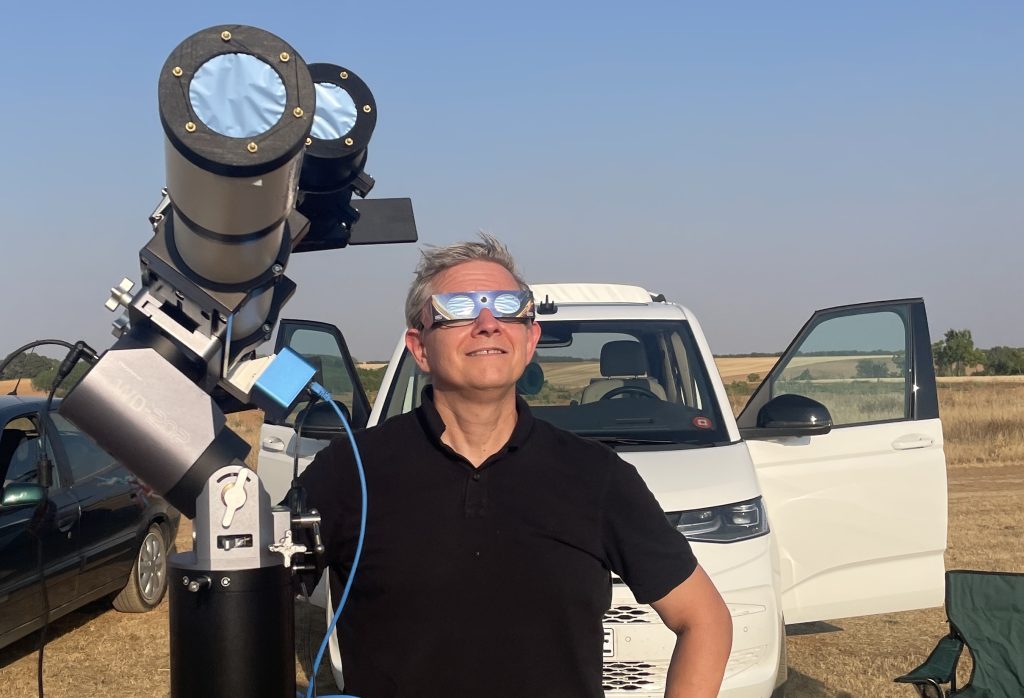
The setup itself took twenty, maybe thirty minutes, and went completely smoothly. At first it was just the three of us — Gero, Javier, and me. Javier set up his telescope, I set up my mount along with the rest of the gear. I’d roughly polar-aligned the Berlebach tripod using my phone’s compass, checking the angle the same way; my mount, a Warpastron WD-20P, has its own GPS module, so after a minute or two it knew its exact position and time and found the sun almost by itself.
Gradually the place filled up. Javier’s parents arrived once the partial phase had already begun, and over the course of the afternoon more and more villagers joined — by the end there were probably twenty to twenty-five people on that unassuming, freshly mown field, all armed with eclipse glasses.
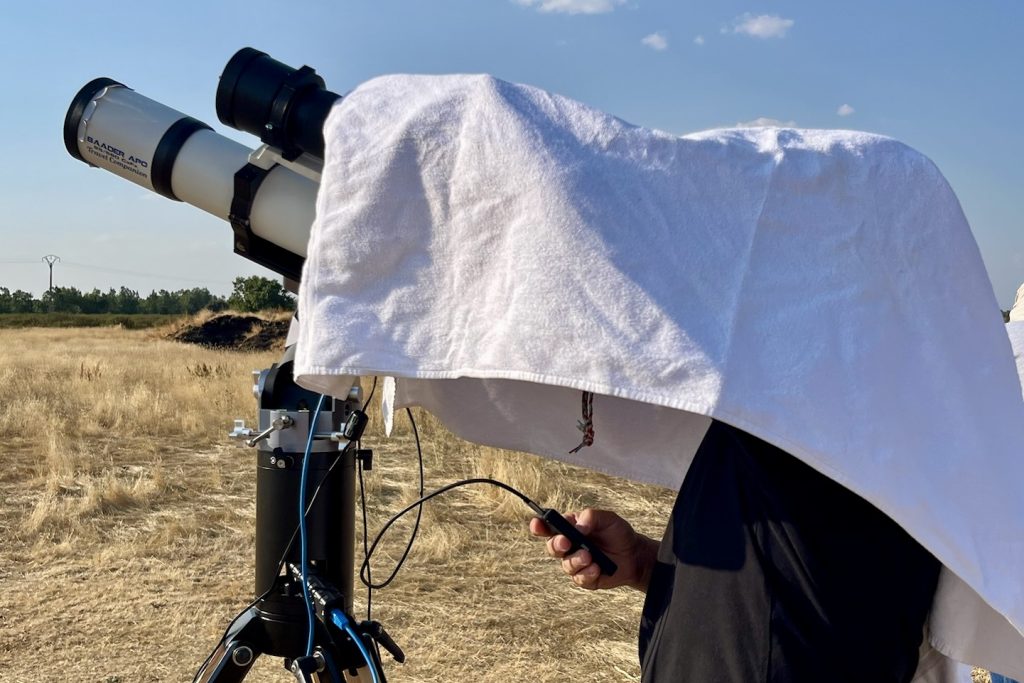
As totality approached I grew increasingly nervous myself and kept running through my setup: I’d checked focus on the telescope and the Samyang lens right after setup and again in the middle of the partial phase — after that I deliberately left it alone, unwilling to risk anything. In between, I let the exposure sequences run as tests, just to be sure everything was working cleanly. Five to ten minutes before totality, I went through every step one more time, focused: ISO correct, exposure time set properly, battery full, tracking working.
The Highlight: Ninety Seconds of Totality
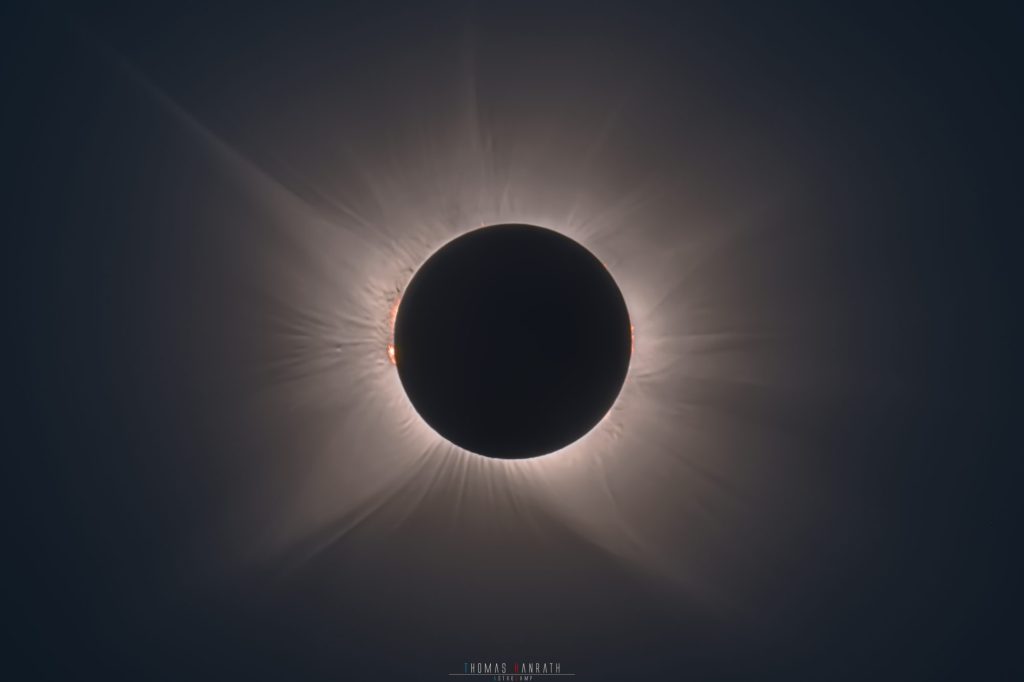
And then it was time. As soon as totality began, I simply let the equipment run — the exposure sequences went through automatically, and I deliberately let go of the camera so I wouldn’t miss the moment itself. I put my arm around Gero, and the two of us simply experienced those ninety seconds together.
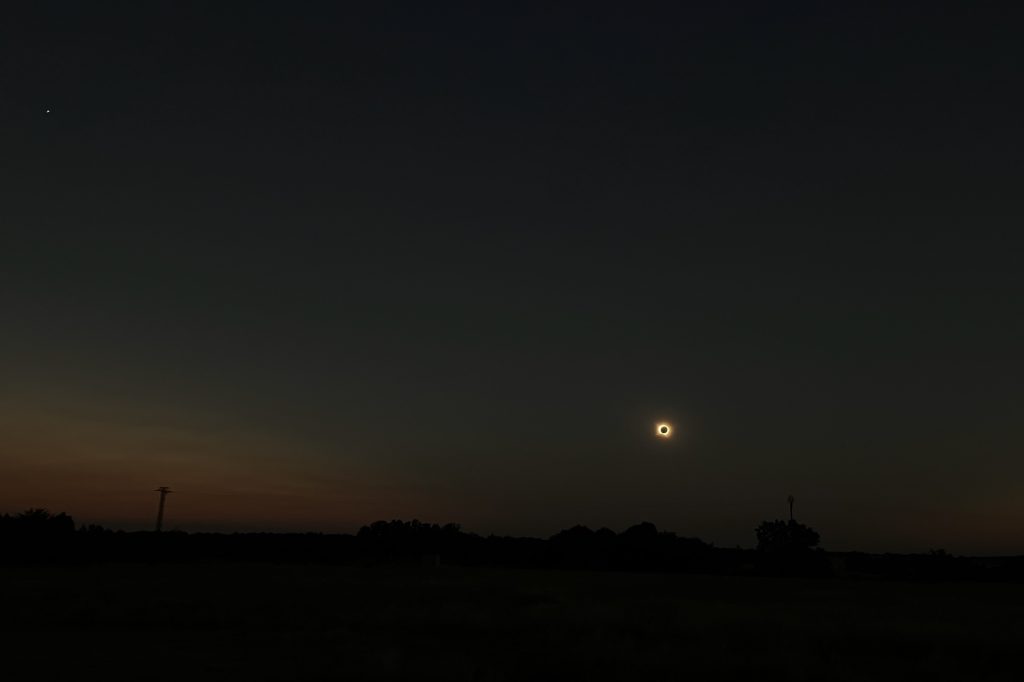
Around us there was a mix of tension and quiet excitement — the villagers, Javier’s parents, everyone with their glasses, everyone still for a moment. It’s hard to describe how short ninety seconds feels when you’ve spent months working toward exactly this moment. The instant the sun reappeared, the filters had to go straight back on the optics — and I followed up with a series of further single exposures for a planned composite of the entire eclipse, from first to last contact.
Packing Up: A Quiet End
Javier and his parents said their goodbyes before the partial phase had fully ended. Gero and I stayed longer, deliberately leaving the gear set up to keep shooting individual frames through the fading eclipse, enjoying the sunset over the Meseta as we did. By the time we finally packed everything up in peace, we were, above all, exhausted — from the heat and from the long, exciting day. The drive back to our hotel in León was correspondingly quiet.

That same evening, Javier sent me a message that gave the whole location search its meaning in hindsight: a fellow astrophotographer friend of his in the Astorga area — exactly where Alberto’s event had taken place — had had a cloud pass in front of the sun at the precise moment of totality. A few days later I saw the photo on Instagram: the eclipsed sun almost entirely swallowed by dramatic clouds. Alejandro’s cloud tip, Javier’s independent choice of location, and my own Meseta reasoning had all pointed in the same, correct direction — and the three independent sources I’d chosen to trust, instead of simply following the most scenic viewpoint, had paid off.
Technically, almost nothing went wrong that afternoon — but exactly how I ended up shooting it, with which gear and which settings, and why I ended up with two systems instead of the three I’d originally planned, is a story for the next two posts in this series.
Related Posts
 Total solar eclipse – composition, August 12, 2026
 Exposing a Total Solar Eclipse: The Technical Configuration
 Total solar eclipse – end of totality, August 12, 2026
 The Journey to the Eclipse: The Equipment
 Total solar eclipse – prominences, August 12, 2026
 Total solar eclipse – Corona, August 12, 2026
 Solar Eclipse – 10/25/2022