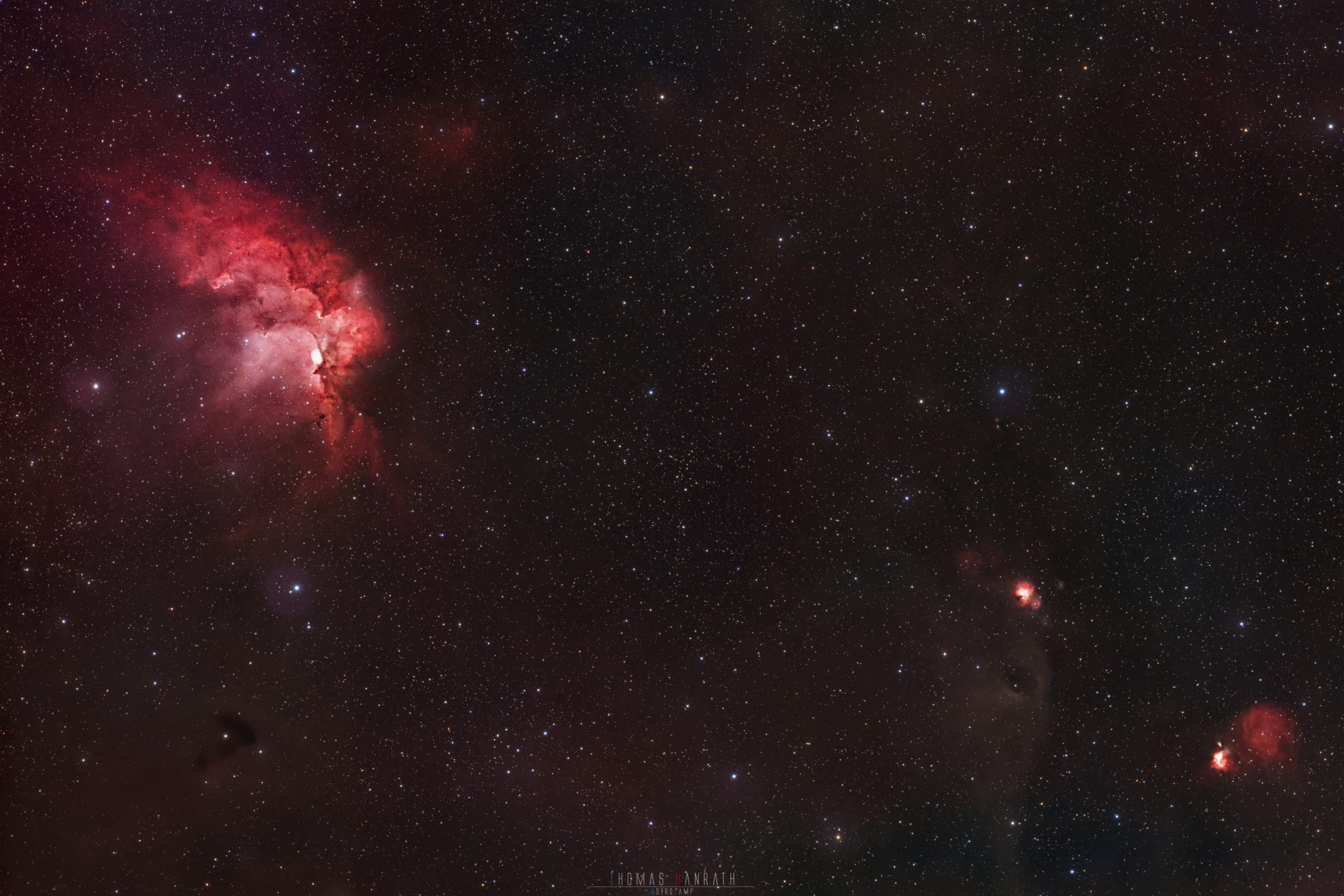
Sharpless 147, 148 & 149
These faint emission knots are embedded in a larger, diffuse H-alpha field that rewards long integrations and careful star control. For wide-field astrophotography they fit nicely in a ~3–4° frame together with the Wizard Nebula (NGC 7380) off to the west, while medium focal lengths (300–600 mm) let you separate the trio from the wider background glow. Narrowband Hα is the workhorse here; O III and S II are weak and benefit from higher gain and longer sub-exposures. Expect very low surface brightness: dither frequently, build a strong master flat, and plan for heavy noise reduction at the multi-scale stage.
Position and the cosmic neighborhood — Sharpless 147, 148 & 149
On the southeastern side of Cassiopeia, close to the Cepheus border, Sh 2-147/148/149 lie a short hop east of the Wizard Nebula (NGC 7380) and within a larger star-forming complex that also hosts Sh 2-152/153 to the east; the whole field spans roughly 3.4° on DSS imagery, with open clusters M52 and NGC 7510 and the Bubble region (NGC 7635) within ~10° for rich wide-field compositions.
Nice to Know — Sharpless 147, 148 & 149
• The three nebulae often show as subtle Hα wisps; star reduction or SHO/HOO mapping helps them stand apart from Cassiopeia’s dense star field.
• Sh 2-148 is a dusty, very compact H II patch; expect it to be the most cooperative of the trio in Hα while remaining quiet in O III.
• The field is circumpolar from Central Europe, making it a forgiving multi-night project across late summer and autumn.
• A dual-band filter on OSC cameras works, but mono + 5 nm (or narrower) Hα significantly boosts contrast against skyglow.
Brightnes, distance and size — Sharpless 147, 148 & 149
All three are intrinsically faint emission regions at an estimated distance of ~4,500 light-years; on the sky they are small—individual bright cores run on the order of ~1–3 arcminutes across—yet sit inside broad, very diffuse Hα that can fill degrees of sky, so their perceived “size” grows with depth. For imaging, think “surface-brightness limited”: long total integration (8–20 h in Hα) matters more than aperture. The trio does not have well-established integrated magnitudes; treat them as difficult targets under suburban skies and plan for aggressive gradient control. Their compactness also means seeing is less critical than transparency when shooting them at 200–600 mm focal length.

Sharpless 152 & 153
Visually and on camera, Sh 2-152 pops as a small, bright Hα core with embedded young stars, while Sh 2-153 is a fainter surrounding patch that benefits from deep integrations. Framing both with ~400–800 mm focal length is straightforward; for wider stories include the Sh 2-147/148/149 trio 1–2° west in a single shot or short mosaic. Hα dominates; O III is minimal, though it can add subtle bluish rims with aggressive stretches. Because the pair sits in a dense Milky Way field, deconvolution and star-size management (e.g., morphological transform or star-netting) markedly improve contrast.
Position and the cosmic neighborhood — Sharpless 152 & 153
Sh 2-152/153 lie just east of Sh 2-147/148/149 within the same Cassiopeia/Cepheus star-forming complex; the Wizard (NGC 7380) sits ~2° to the west, with other photogenic companions (NGC 7538, the Bubble region, and M52) within a ~10° radius, making the area ideal for panorama projects and multi-panel mosaics.
Nice to Know — Sharpless 152 & 153
• Distance estimates for the ionizing source of Sh 2-152 cluster around ~2.4 kpc; many imagers adopt ~4,500 ly (~1.4 kpc) for the whole group—don’t be surprised by conflicting numbers in captions.
• Sh 2-152’s bright core is tiny (~1′), so oversampling isn’t necessary; prioritize depth and clean calibration over resolution.
• A strong Hα master lets you use shorter O III/S II runs purely for color mapping in HOO/SHO palettes.
• Excellent candidates for “starless” renditions that reveal filamentary Hα, especially when combined with gentle HDR on the core.
Brightnes, distance and size — Sharpless 152 & 153
Both nebulae are low-surface-brightness objects dominated by Hα emission; representative distances around ~4,500 light-years are commonly quoted in observer lists, while some research places the ionizing source nearer ~2.4 kpc (~7,800 ly). Sh 2-152’s bright core is roughly 1′×0.9′ across with very faint outskirts, and Sh 2-153 is a dim adjacent patch on the order of a few arcminutes; together they still occupy only a small part of a multi-degree Hα cloud. For imaging, think deep stacks (6–15 h Hα) under transparent skies, careful background modeling, and restrained color saturation to keep stars natural amidst the red plane of the Milky Way.