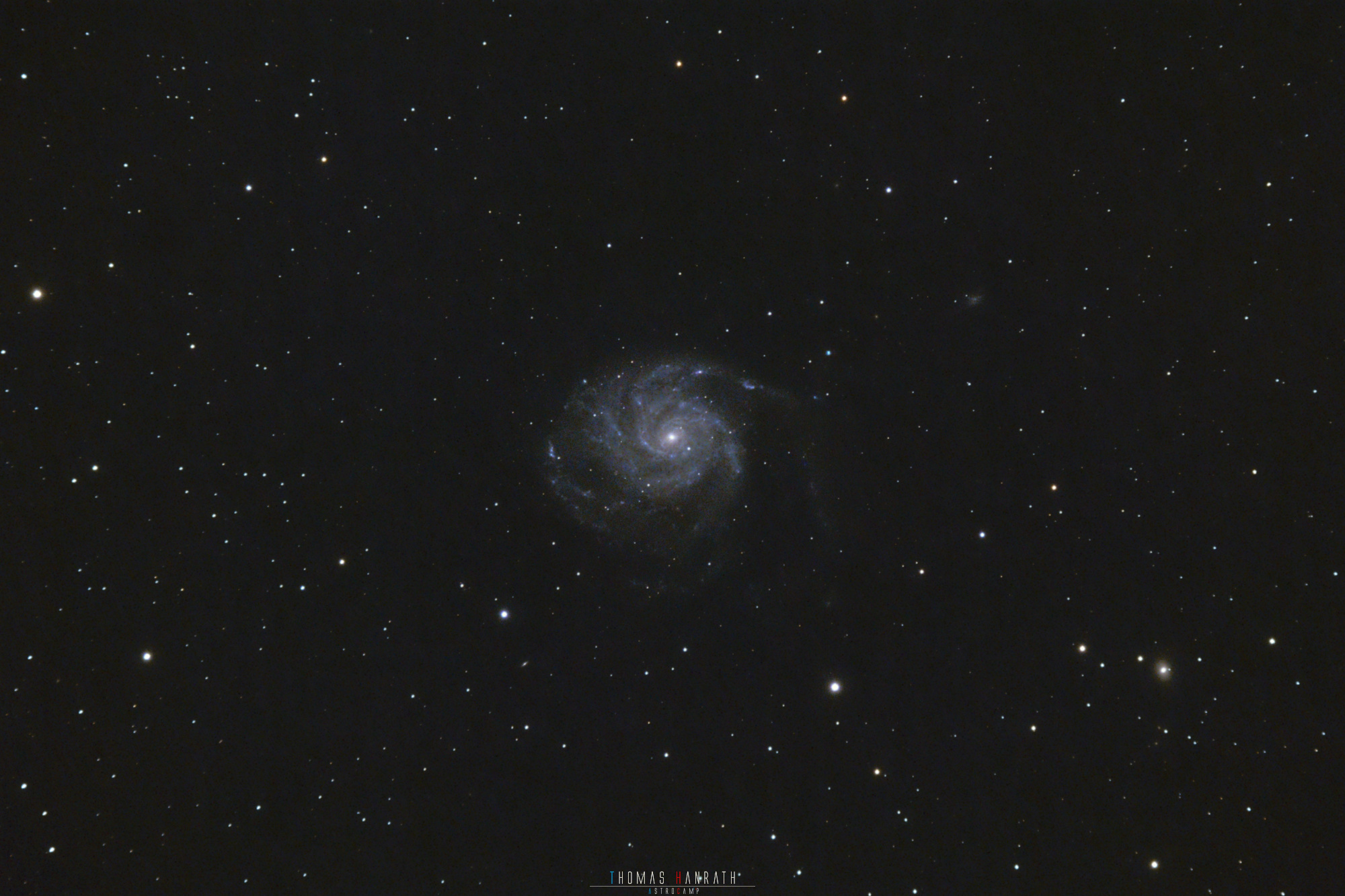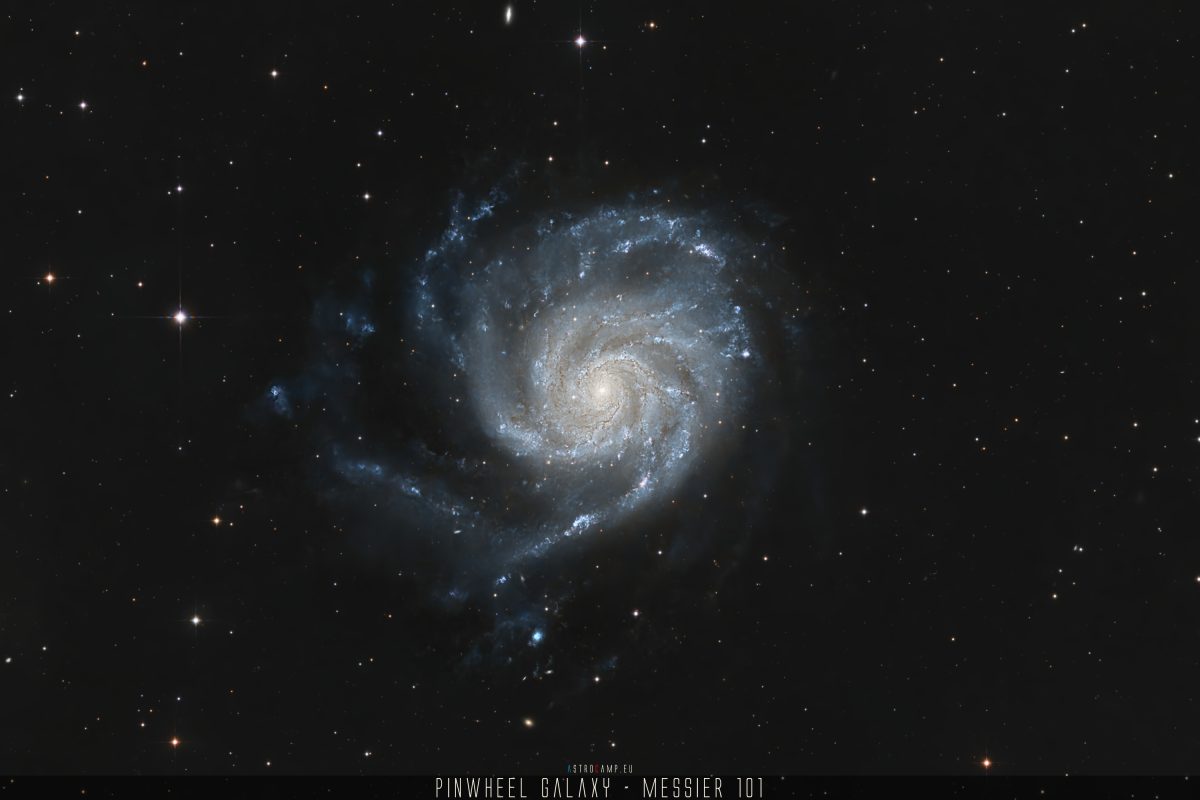
Messier 101 is renowned for its grand-design spiral structure, with sprawling, well-defined arms filled with star-forming regions and pinkish emission nebulae. Discovered by Pierre Méchain in 1781 and later added to Charles Messier’s catalog, it presents a stunning target for astrophotographers, especially in long-exposure images that reveal its delicate, extended disk and faint outer features. The galaxy’s low surface brightness and large apparent size make it a rewarding challenge for deep-sky imaging, often requiring dark skies and careful processing to bring out its full beauty. M101 is also surrounded by several smaller companion galaxies, which can be captured in wide-field astrophotography.
Names and Catalog numbers
- Pinwheel Galaxy
- Messier 101 (M101)
- NGC 5457
- UGC 8981
- PGC 50063
- ARP 26
Position and the cosmic neighborhood
Messier 101 is located in the northeastern part of the constellation Ursa Major, not far from the star Alkaid at the end of the Big Dipper’s handle. The galaxy lies in a relatively uncrowded region of the sky, but several of its satellite galaxies—including NGC 5474, NGC 5477, NGC 5204, and NGC 5585—are within the same field of view in wide-field images. Its position makes it circumpolar for much of the Northern Hemisphere, allowing for extended imaging sessions throughout spring and early summer. The Pinwheel Galaxy’s cosmic neighborhood is rich with faint background galaxies, adding depth and interest to deep astrophotographic exposures.
Nice to Know
- M101 is one of the largest and most massive nearby spiral galaxies, with a diameter even greater than the Milky Way.
- The galaxy’s spiral arms are dotted with prominent H II regions, some of which are among the largest known in any galaxy.
- Messier 101’s low surface brightness means that its delicate outer arms are best revealed with long total exposure times and careful image processing.
- Astrophotographers appreciate M101 for its colorful star-forming regions and the opportunity to capture multiple galaxies in a single frame.
Brightnes, distance and size
Messier 101 has an apparent magnitude of about 7.9, making it visible in small telescopes under dark skies, though its full structure is best seen in photographs. The galaxy is located approximately 21 million light-years from Earth and spans about 170,000 light-years in diameter, making it one of the largest spiral galaxies in the local universe. Its apparent size is roughly 28 by 27 arcminutes, nearly the size of the full Moon, offering a spectacular and expansive target for astrophotography, especially with wide-field setups.