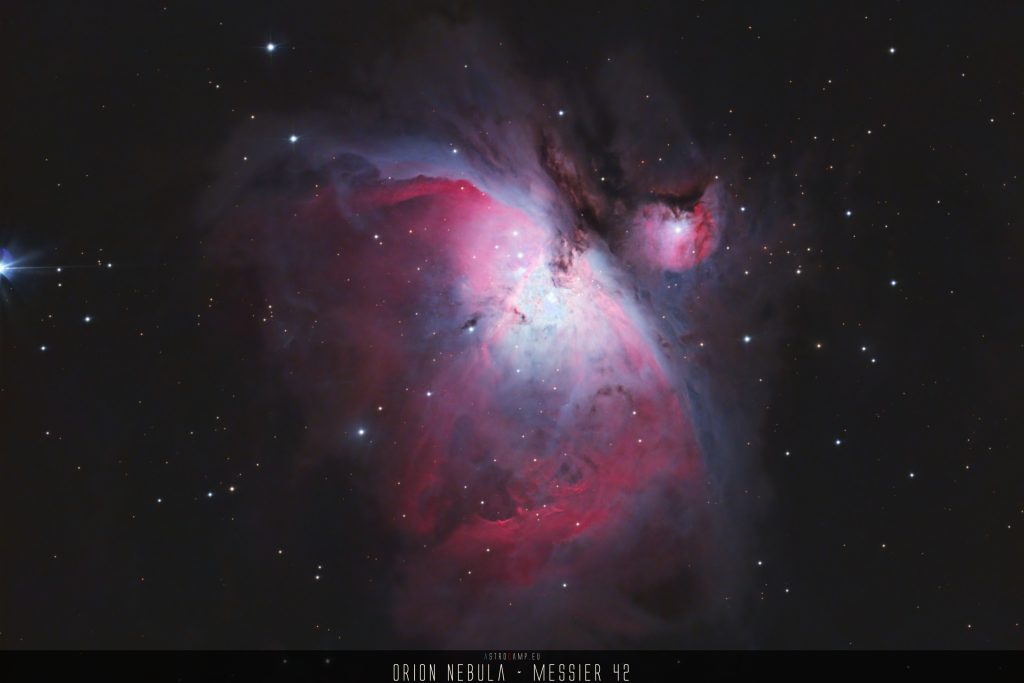
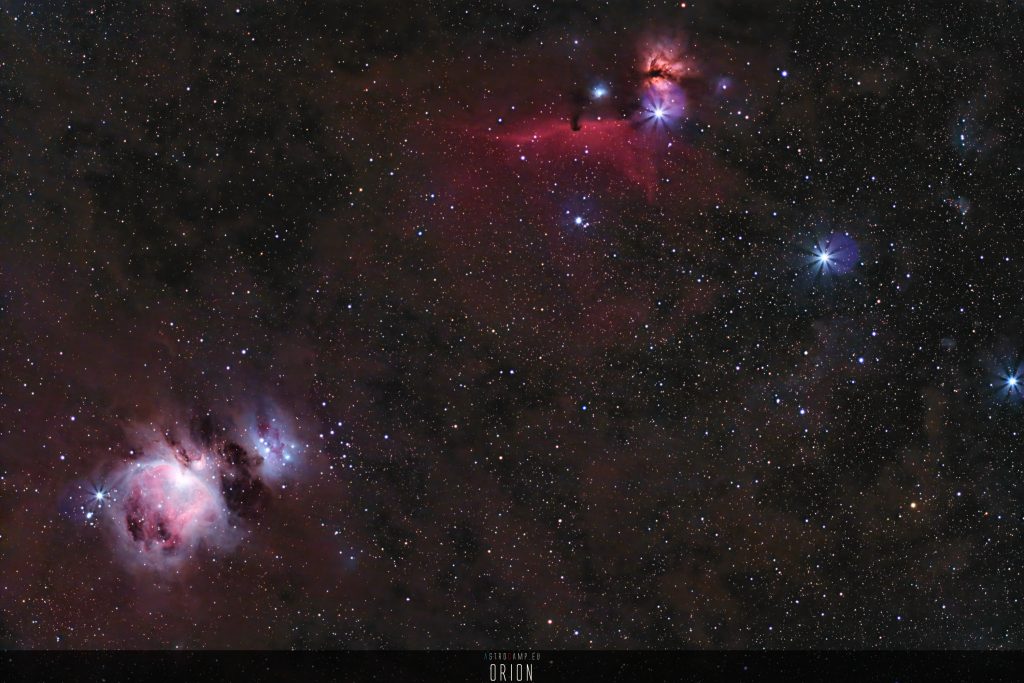
It was actually the very first evening with my small new APO, a Vixen ED80sf, on a proper mount, the Skywatcher HEQ5 Pro. That night, so many things were a first attempt.
A small miracle that I got to see my first deep-sky objects at all.
The first time polar aligned. The first time a mount connected to a PC. The first time a DSLR controlled via a PC. That evening I used my old Canon EOS 1000D, since I had no way to control my Canon EOS M100.
After a lot of fiddling and blind poking around in the dark (plate solving was still far beyond me at the time), an image appeared on the screen that wasn’t just a star field. It was the Orion Nebula. From that moment on, I was completely hooked.
Later, a processed image emerged that didn’t differ much from the individual frames on the camera.
It was probably four single exposures, each 60 seconds at ISO 1600. No bias frames, no darks, no flats.
There was later a second object as well. Of course, the following months were all about experimenting and learning.
Lessons Learned
It was first light – for the telescope and for me as well. Everything was new, and every single step was a new experience.
The most important lesson of the evening: it works!
Clumsy and awkward, yes – but it worked. That night I took only a few images. Stacking afterward was new too. Post-processing and stretching were unfamiliar terms, and Google was my best friend.
The result shown here was my very first deep-sky object. Back then, it was stacked with DeepSkyStacker and stretched just a little using GIMP.
I hadn’t even thought about guiding yet. How star alignment worked – or even something like plate solving – was completely unknown to me. I simply aimed a bit to the left and right of the target on the star chart, hoping to hit it.
But in the end, I was happy – and completely hooked on astrophotography.
Session details
| Telescope | VIXEN ED80sf |
|---|---|
| Effective focal length | 600 mm |
| Camera | Canon EOS 1000D |
| Mount | Skywatcher HEQ5 Pro |
| Date of capture | 13 February 2021 |
| Exposure (lights) | 20 × 15 s 4 × 60 s |
| Total integration | 9 min |
| Calibration frames | – |
| Capture setup | Windows, Cartes du Ciel, APT |
| Processing date | 14 February 2021 |
| Software stack | Deep Sky Stacker, Gimp |
| Location | Koblenz |
| Focal ratio | f/7,5 |
| Image scale | 1,96 ″/px |
| Field of view | 127,0 × 84,7 ′ |