
In June Hercules and Ophiuchus stand due south at midnight, with Scorpius and Antares low in the south. Nights are short, but around 41° N they still get astronomically dark. Globular clusters such as M 13, M 92, M 10 and M 12, the Cat’s Eye Nebula NGC 6543 and the rich fields around Rho Ophiuchi are good targets.
June 2027 · · 41° N
At midnight, Hercules, Ophiuchus and Draco are on the meridian. The new moon on June 4 opens the window for broadband, around the full moon on June 18 it is time for narrowband.
This month’s sky
Hercules, Ophiuchus and Draco
The month’s sky view starts on the 15th in the evening, halfway between nightfall and astronomical midnight, and shows the framings that stand no higher at midnight in any other month and reach at least two hours per night above 30° (nautical darkness, sun below −12°). Change the date to see the framings of that month.
Click marks an object (its path tonight) · click again for its constellation, once more to zoom · its name shows details · click outside zooms out · drag to pan
Framings in June
Galaxies in June
UGC 10822 · Draco Dwarf Galaxy
Medium focal length (350–900 mm) · Field of view 3.6° × 2.4°
Surface brightness 25.2 mag/″²challenging
Monthly average: 4.8 h per night above 30°
Due south at midnight: Jun 11
Coordinates:
Emission nebulae in June
Sh2-64suits narrowband
Long focal length (900–2,000 mm) · Field of view 1.1° × 46′
Monthly average: 4.4 h per night above 30°
Due south at midnight: Jun 28
Coordinates:
Sh2-54suits narrowband
Long focal length (900–2,000 mm) · Field of view 1.1° × 46′
Monthly average: 3.7 h per night above 30°
Due south at midnight: Jun 24
Coordinates:
Sh2-27suits narrowband
Medium focal length (350–900 mm) · Field of view 3.6° × 2.4°
Monthly average: 3.2 h per night above 30°
Due south at midnight: May 31
Coordinates:
Planetary nebulae in June
C 6 · Sunflower Nebulasuits narrowband
Long focal length (900–2,000 mm) · Field of view 1.1° × 46′
Surface brightness 18.7 mag/″²easy
Monthly average: 4.8 h per night above 30°
Due south at midnight: Jun 20
Coordinates:
A66 39suits narrowband
Long focal length (900–2,000 mm) · Field of view 1.1° × 46′
Surface brightness 26.5 mag/″²challenging
Monthly average: 4.8 h per night above 30°
Due south at midnight: May 29
Coordinates:
M 57 · Ring Nebulasuits narrowband
Long focal length (900–2,000 mm) · Field of view 1.1° × 46′
Surface brightness 24.7 mag/″²challenging
Monthly average: 4.8 h per night above 30°
Due south at midnight: Jul 3
Coordinates:
Reflection and dark nebulae in June
LDN 43
Medium focal length (350–900 mm) · Field of view 3.6° × 2.4°
Monthly average: 2.6 h per night above 30°
Due south at midnight: May 30
Coordinates:
Open clusters in June

NGC 6633
Medium focal length (350–900 mm) · Field of view 3.6° × 2.4°
easy
Monthly average: 4.7 h per night above 30°
Due south at midnight: Jun 27
Coordinates:
M 11 · Amas de l'Ecu de Sobieski
Long focal length (900–2,000 mm) · Field of view 1.1° × 46′
Surface brightness 19.2 mag/″²easy
Monthly average: 3.9 h per night above 30°
Due south at midnight: Jul 2
Coordinates:
M 26
Long focal length (900–2,000 mm) · Field of view 1.1° × 46′
Surface brightness 21.8 mag/″²easy
Monthly average: 3.7 h per night above 30°
Due south at midnight: Jul 1
Coordinates:

M 16 · Eagle Nebula
Medium focal length (350–900 mm) · Field of view 3.6° × 2.4°
easy
Monthly average: 3.3 h per night above 30°
Due south at midnight: Jun 25
Coordinates:
Globular clusters in June

M 13 · Hercules Globular Cluster
M 13 · Hercules Globular Cluster
Long focal length (900–2,000 mm) · Field of view 1.1° × 46′
Surface brightness 22 mag/″²easy
Monthly average: 4.8 h per night above 30°
Due south at midnight: Jun 1
Coordinates:
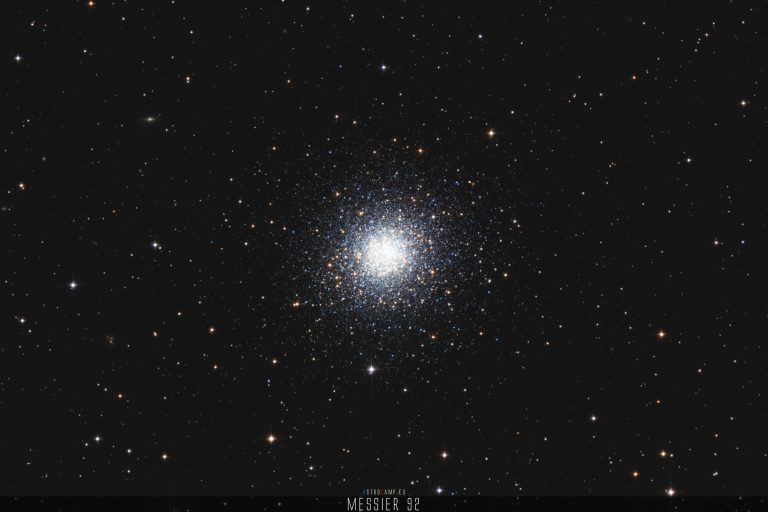
M 92
Long focal length (900–2,000 mm) · Field of view 1.1° × 46′
Surface brightness 20.4 mag/″²easy
Monthly average: 4.8 h per night above 30°
Due south at midnight: Jun 10
Coordinates:
M 14
Long focal length (900–2,000 mm) · Field of view 1.1° × 46′
Surface brightness 20 mag/″²easy
Monthly average: 4.7 h per night above 30°
Due south at midnight: Jun 15
Coordinates:
M 12
Long focal length (900–2,000 mm) · Field of view 1.1° × 46′
Surface brightness 20.5 mag/″²easy
Monthly average: 4.5 h per night above 30°
Due south at midnight: Jun 3
Coordinates:
M 10
Long focal length (900–2,000 mm) · Field of view 1.1° × 46′
Surface brightness 19.5 mag/″²easy
Monthly average: 4.5 h per night above 30°
Due south at midnight: Jun 5
Coordinates:
M 107
Long focal length (900–2,000 mm) · Field of view 1.1° × 46′
easy
Monthly average: 3.1 h per night above 30°
Due south at midnight: May 30
Coordinates:
Other objects in June
vdB 123
Long focal length (900–2,000 mm) · Field of view 1.1° × 46′
Monthly average: 4.6 h per night above 30°
Due south at midnight: Jun 27
Coordinates:
Constellations in June
These constellations stand highest at midnight in June – calculated for New York, 41° N.
Serpens Cauda
Highest at midnight on June 1, 53° up in the south
Brightest stars: Sabik, Unukalhai, Yed Prior
Framings: M 16 · Eagle Nebula, Sh2-54, Sh2-64, vdB 123
Hercules
Highest at midnight on June 5, 82° up in the south
Brightest stars: Kornephoros, Rutilicus, Rasalgethi
Framings: M 13 · Hercules Globular Cluster, M 92, A66 39
Ophiuchus
Highest at midnight on June 6, 41° up in the south
Brightest stars: Rasalhague, Sabik, Saik
Framings: M 12, M 10, M 14, NGC 6633, M 107, Sh2-27, LDN 43
Draco
Highest at midnight on June 7, 67° up in the north
Brightest stars: Eltanin, Athebyne, Rastaban
Framings: UGC 10822 · Draco Dwarf Galaxy, C 6 · Sunflower Nebula
Scutum
Highest at midnight on June 29, 40° up in the south
Brightest stars: α Sct
Framings: M 26, M 11 · Amas de l'Ecu de Sobieski
Planets in June
Visibility for New York, 41° N: sun at least 6° below the horizon, planet at least 10° up (Mercury and Venus 5°).
Mars evening sky
Leo · 0.9 mag · 6.4″
On June 15: 21:10–00:00, highest 40° at 21:10
Visibility shrinks during the month
Jupiter evening sky
Leo · −1.9 mag · 34″
On June 15: 21:10–23:00, highest 30° at 21:10
Visibility shrinks during the month
Saturn morning sky
Pisces · 0.6 mag · 17″ · ring tilt 14°
On June 15: 03:30–05:00, highest 27° at 04:50
Visibility improves during the month
Neptune morning sky
Pisces · 7.8 mag · 2.3″
On June 15: 02:40–05:00, highest 34° at 04:50
Visibility improves during the month
Not visible: Mercury (close to the sun), Venus (close to the sun), Uranus (close to the sun)
Events
- Moon 1.4° from Jupiter
- Moon 3° from Mars
Lunar occultations in June
The moon covers stars to mag 5, the Pleiades and planets – calculated for New York, 41° N, local time accurate to about a minute, moon at least 5° up.
night of June 19/20: Moon occults Nunki
moon 20° up, 98 % lit
night of June 30/July 1: Moon passes through the Pleiades
moon 10° up, 11 % lit
 Mastodon-Feed