
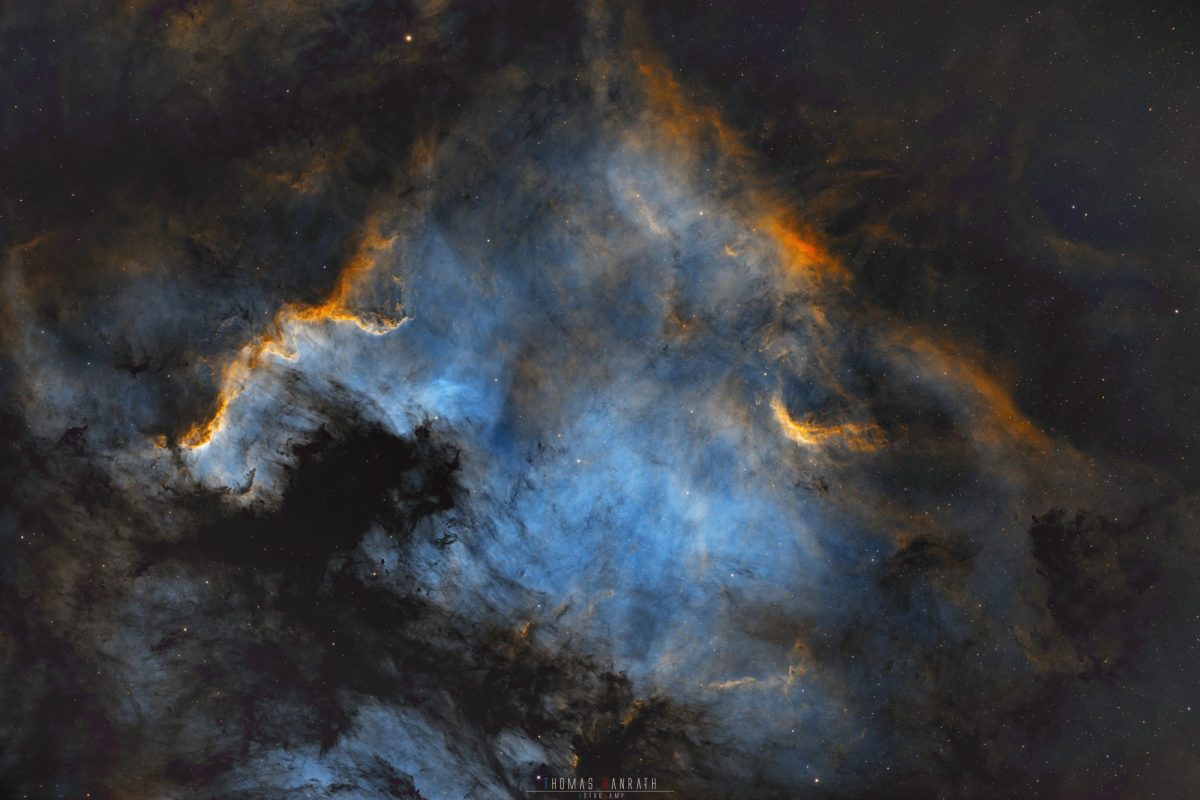
During the two weeks leading up to my trip to Spain to observe the solar eclipse, we enjoyed a fantastic spell of clear and sunny weather.
While I was simultaneously imaging several objects with my second telescope during that week, I used my Baader APO to capture my first complete dataset with my ultra-narrowband filters over the course of three nights.
Unfortunately, the equipment caused a few issues during those three nights; otherwise, I would have been able to collect a little more integration time.
As a result of these problems, I have now purchased a second Stellavita.
High resolution on Astrobin:

The annotated image:

Session details
| Telescope | Baader Apo 95 CaF2 – Travel Companion |
|---|---|
| Corrector | Baader M68 Field Flattener |
| Effective focal length | 590 mm |
| Camera | SkyEye62AM |
| Filters | Baader O CMOS Optimized 50.4mm Baader H CMOS Optimized 50.4mm Baader S CMOS Optimized 50.4mm |
| Mount | WarpAstron WD-20P Berlebach UNI18 ASTRO |
| Guiding equipment | William Optics Uniguide 50 |
| Guiding camera | ToupTek GPM462M |
| Date of capture | 2026-07-27 2026-07-28 2026-07-29 |
| Nights | 3 |
| Exposure (lights) | OIII: 25 × 300 s Ha: 25 × 300 s SII: 25 × 300 s |
| Total integration | 6 h 15 min |
| Calibration frames | FLATS, DARKS |
| Sensitivity | GAIN 100, Offset 125 |
| Capture setup | Stellarmate OS, Raspberry Pi 5, PowerBox Adv. |
| Processing date | 2026-07-31 |
| Software stack | PixInsight, Affinity |
| Location | Koblenz, Rheinland |
| Focal ratio | f/6,2 |
| Image scale | 1,31 ″/px |
| Field of view | 208,9 × 139,3 ′ |

