

The Moon is one of the most impressive subjects in astrophotography and offers an incredible variety of visible structures. Unlike the gas giants, its surface and numerous geological features can be photographed directly. Craters, mountains, rilles and large plains can be captured in considerable detail even with relatively small telescopes.
The boundary between the lunar day and night, known as the terminator, is particularly interesting. In this region, sunlight reaches the surface at a very low angle. As a result, crater walls and mountains cast long shadows, emphasizing even subtle changes in elevation. The appearance of the lunar surface therefore changes continuously throughout the lunar phases.
For high-resolution lunar images, short exposure times and video recordings containing many individual frames are commonly used. By stacking the sharpest frames, atmospheric blur can be reduced and numerous fine details can be revealed. The Moon is an especially versatile subject, ranging from wide-field images of the entire lunar disk to highly detailed close-ups of individual craters and regions.
Related Posts
 Moon – mosaic with the Baader Apo – September 25, 2026
 Total solar eclipse – composition, August 12, 2026
 Total solar eclipse – end of totality, August 12, 2026
 Total solar eclipse – prominences, August 12, 2026
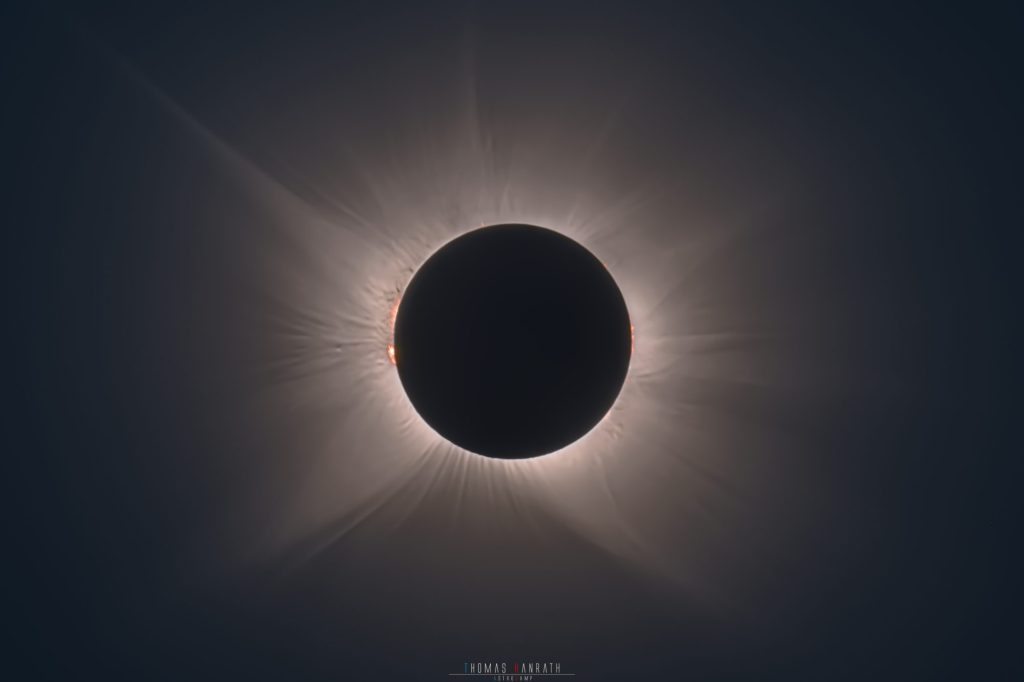 Total solar eclipse – Corona, August 12, 2026
 Moon with the VC200L – December 1, 2025
 Moon – super moon – November 5, 2025
 Lunar Eclipse, Sep’25
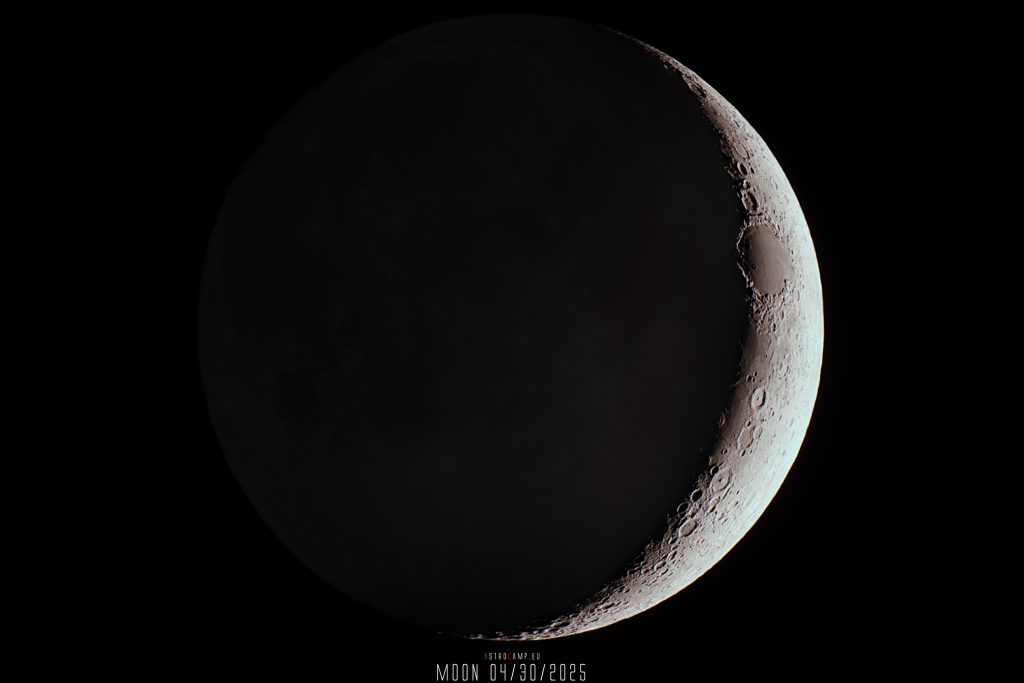 Moon, Mar 4 ’25
 The Moon, Mar 05 ’25
 The Moon, Jan 13 ’25
 Map of the Moon, Sep’24