

My Baader APO 95/580 CaF₂ “Travel Companion” is, as the name suggests, my mobile setup. I store it fully assembled in a transport case that is deliberately tight and handy. I want good flats on the road too, and a classic flat box is usually too large for that. So I was looking for a light source that is flat, weighs little, and fits into the case together with the telescope.
The choice: Aurora Flatfield by Gerd Neumann
I ordered the Aurora Flatfield Panel in the smallest size offered (100 mm) directly from the manufacturer. It was shipped a day later and arrived after two days.
The shop descriptions state that what matters is the free optical aperture and not the slightly larger dew cap. With a 95 mm aperture, my Apo is therefore a good match for the 100 mm.
Why an panel at all? In my view, the differences between flats from an electroluminescent panel and flats from an improvised source such as the iPad display are large.
Build quality and scope of delivery
Based on the photos on the internet, I had expected something foil-like, light and flimsy. In fact, the panel is remarkably high-quality:
- Plexiglas at the front and back
- solid plastic frame
- battery operation with 2× AA, small inverter with on/off switch included
It is not heavy, but feels high-quality and sturdy.
Only a square lights up

When switched on, the whole disc does not light up, only a square with an exact edge length of 100 mm. This corresponds exactly to the size I ordered, and Gerd Neumann points this out on his website. For this reason, the telescope has to be aligned very precisely with the illuminated area.
The solution: A 3D-printed holder
I measured the illuminated area and the outer diameter of my dew cap with a caliper and designed a suitable holder in my 3D program. It is 5 mm thick and clamps into the plastic frame of the panel.
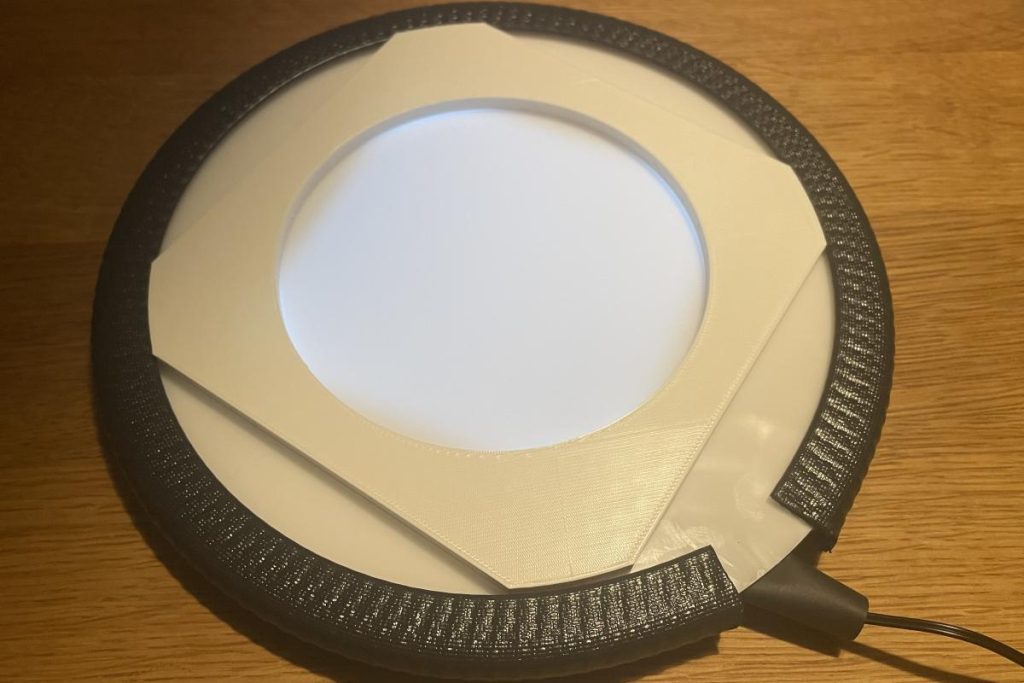
It sits firmly and does not wobble.
The panel is aligned exactly to the center of the telescope.
It even holds on the telescope when it is horizontal. Originally it was intended for a telescope pointing upwards.

The result: Clean flats
The flats show no darkening in the corners. The illumination is even, and the flats look the way they should. The panel illuminates the 95 mm aperture completely.

Stored to save space
The panel sits in the transport case together with the telescope and takes up hardly any space. That was exactly what mattered for the mobile setup.

Conclusion
The Aurora Flatfield electroluminescent panel is well built, compact, and the ideal addition for my Travel Companion. With a suitable holder, alignment is no problem (but it also works without one). On my Vixen VC200L I continue to use my Lacerta flat box, which fits the tube to the millimeter. On the Apo, the panel takes over. I am very satisfied and can warmly recommend it.


